
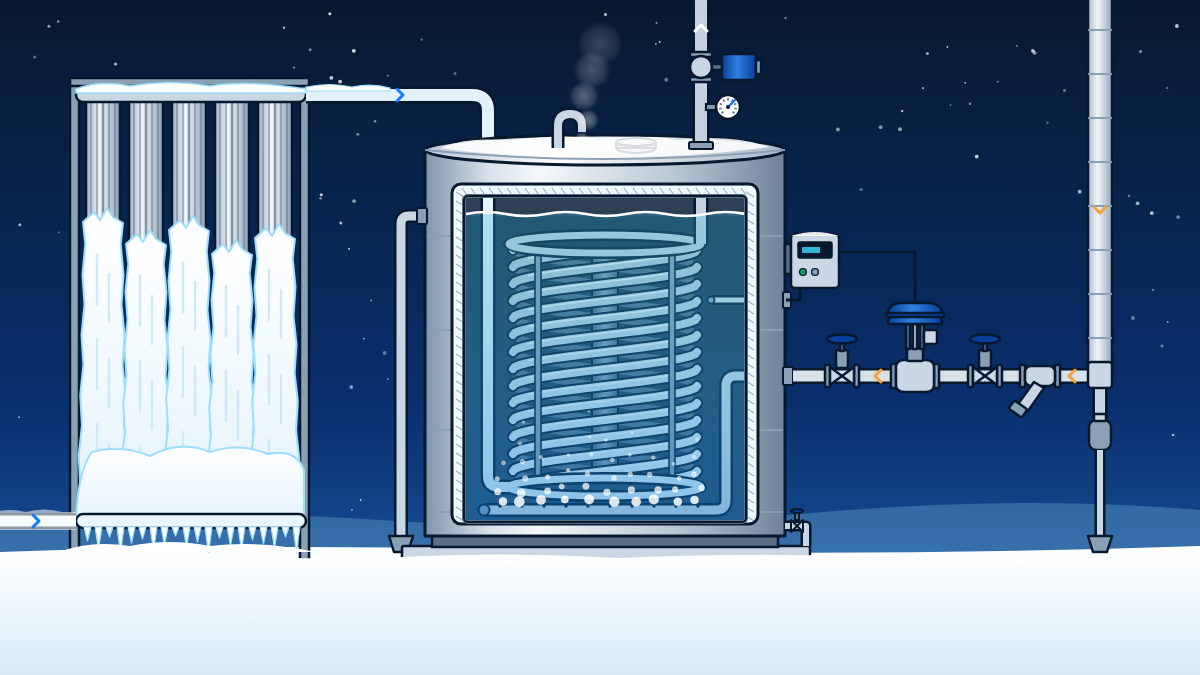
An ambient air vaporizer is the default answer for turning cryogenic liquid back into gas: no fuel, no moving parts, just finned aluminum absorbing heat from the surrounding air. But every ambient vaporizer has a working limit, and when a line crosses it — high continuous flow, cold or humid climate, CO2 service — the answer is a steam-heated cryogenic vaporizer. This guide explains where that line runs and how the two formats pair in practice.
How an ambient air vaporizer runs out of air
An ambient vaporizer draws heat from the surrounding air; moisture can freeze on its cold surfaces. As liquid nitrogen or oxygen at cryogenic temperature passes through the finned tubes, frost builds on the fin surface. Frost is insulation: as it thickens, heat transfer drops, and the outlet temperature starts to fall. On an intermittent duty the frost sublimates away between draws. On a continuous duty it never gets the chance — capacity fades shift by shift, and in cold or humid weather the fade is faster. The usual planning rule is to derate an ambient vaporizer heavily for continuous service or install switching pairs: one bank works while the other defrosts.
What a steam-heated vaporizer changes
A steam-heated (or hot-water) vaporizer replaces the atmosphere with a heat source you control. The cryogenic liquid passes through a coil or shell immersed in steam-heated water, so the available heat does not depend on the weather, the season, or the frost cycle. Capacity is constant around the clock, the outlet temperature is stable and adjustable, and the footprint per delivered Nm³/h is far smaller than a bank of ambient towers sized for the same continuous duty.
When steam heating is the right call
Four situations reliably justify a steam or water-bath unit. First, continuous high flow — filling lines, furnace atmospheres, gas plants — where ambient banks would need constant switching. Second, cold climates: low ambient temperatures reduce available heat-transfer capacity and can affect the outlet temperature. Third, CO2 service: carbon dioxide expands with a strong cooling effect and can form dry ice in the line if the heat input is marginal, so CO2 systems normally use a heated vaporizer or an electric gas heater as standard. Fourth, tight outlet-temperature specifications: processes that feed gas to sensitive equipment need the stable outlet only a heated bath gives.
The hybrid layout most plants actually use
Steam is not free — it needs a boiler or plant steam supply. So the economical layout is usually hybrid: an ambient air vaporizer bank carries the base load, and a steam-heated trim vaporizer downstream guarantees the outlet temperature and covers peaks, winter months and defrost cycles. The ambient section does the cheap work; the steam section does the guaranteed work. Sizing the split is a duty calculation — peak flow, profile over the day, coldest design ambient — the same inputs as our vaporizer sizing guide.
Selection fields for a steam-heated unit
To quote a steam-heated vaporizer a supplier needs: the gas and flow rate (Nm³/h), inlet liquid (LN2, LOX, LAr or CO2), required outlet temperature and pressure, steam pressure available (or hot-water supply temperature), duty cycle, and the design code for the destination market — the pressure-bearing parts follow the same code logic as any cryogenic vessel selection. Materials are stainless steel on the cryogenic side; the bath and jacket are carbon steel or stainless depending on service.
What Cryofortune supplies
Cryofortune sources ambient air vaporizers, steam-heated and electric vaporizers, and complete storage-plus-vaporization skids from vetted Chinese manufacturers, matched to the destination market’s design standard and documentation requirements. For each inquiry we confirm the manufacturer, the code (ASME, PED/TPED or GB), and the certificate pack before production — the vaporizer arrives paired to the tank behind it.
Steam-heated vaporizers: common questions
What is a steam-heated cryogenic vaporizer?
A vaporizer that regasifies cryogenic liquid in a water bath heated by steam, instead of taking heat from ambient air. Capacity stays constant regardless of weather or frost, and the outlet temperature is stable and adjustable.
When is an ambient air vaporizer not enough?
On continuous high flows where frost never clears, in cold climates that reduce available heat-transfer capacity, in CO2 service where marginal heat input risks dry-ice formation, and wherever a tight outlet-temperature specification must be guaranteed.
Can ambient and steam vaporizers work together?
Yes — the common layout is an ambient bank for base load with a steam-heated trim unit downstream that guarantees outlet temperature and covers peaks, winter operation and defrost cycles.
Do CO2 systems always need a heated vaporizer?
Practically always. CO2 can form dry ice when it expands without enough heat input, so CO2 supply systems use steam-heated, water-bath or electric heaters as the standard solution rather than plain ambient towers.