
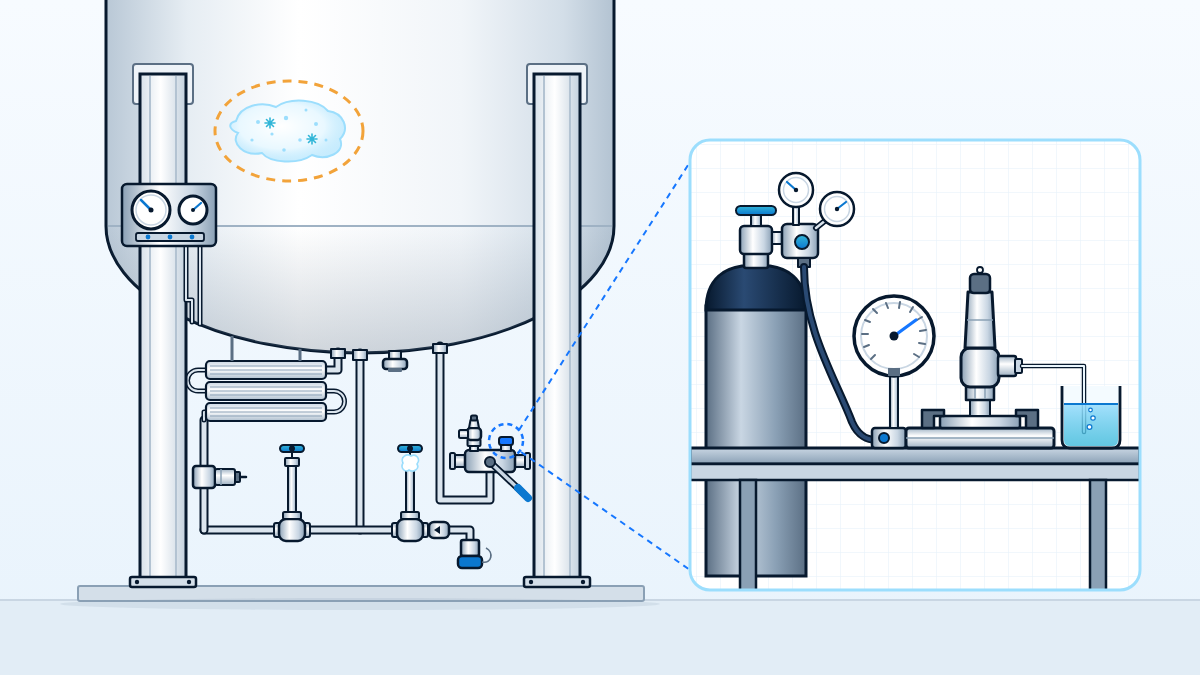
A double-walled cryogenic tank is one of the few pieces of industrial equipment that can honestly be called low-maintenance. The vessel has no moving parts — no motor, no compressor, just an inner tank, an outer jacket and a vacuum between them doing silent work. Owners of cryogenic storage tanks sometimes read that as “needs no attention at all”, and that is the mistake. Low-maintenance is not no-maintenance. The list of things that matter is short, but each item protects your product or your people — and cryogenic tank maintenance is mostly the discipline of watching that short list.
The daily habit that beats any instrument
The cheapest diagnostic tool for a cryogenic tank is a logbook. Have the operator record liquid level and pressure once a day, at roughly the same time. One reading tells you little; a trend line tells you almost everything. Pressure that creeps up faster than it used to, a level that falls quicker at unchanged draw, a pressure-building circuit cycling more often — all of it shows up in the log weeks before anything is visible on the tank.
Pair the log with a short walk-round:
- Frost on the outer shell. The outer jacket should sit at ambient temperature and stay dry. A cold or frosty patch on the jacket itself means the insulation is compromised at that spot. Frost on cold pipework during heavy draw is normal; frost on the shell never is.
- Ice on valves and fittings. Light frosting on cold lines is expected, but a fitting buried in a growing ice ball usually hides a small leak feeding it.
- Sounds. A steady hiss where there was silence means gas escaping somewhere — find it.
- Relief valve weeping. A safety valve that dribbles or hisses below its set pressure is not “doing its job” — the seat is damaged or the setting has drifted.
Boil-off is a health report
Every cryogenic tank loses some product to evaporation. The datasheet states this as the normal evaporation rate, or NER — the share of the contents that boils off per day (definitions in our cryogenic glossary). That figure is your baseline. If consumption rises while actual draw has not changed, the tank is telling you heat is getting in faster than before — and in a vacuum-insulated vessel that almost always means the vacuum in the annular space is degrading. Our article on vacuum insulation explains why this happens slowly over years. The owner’s rule is simple: track boil-off against the datasheet NER and treat a sustained rise as an early warning, not a cost to absorb by ordering more liquid.
Relief devices: the safety chain
The relief system is the part of the tank you never economise on. On a properly specified vessel, primary relief valves are installed in redundant pairs on a changeover valve, so one valve can be removed for testing while its twin protects the tank. Three rules follow:
- Relief valves are tested and recertified periodically. The intervals and procedures are set by the regulations of the country where the tank operates — not by the supplier — so confirm them with your local inspection authority.
- Never plug, cap or isolate a relief path, however annoying the venting. A cryogenic tank with blocked relief is a pressure vessel with no way out.
- If a bursting disc ruptures, replace it with a disc of the correct rating — and establish why it burst before returning the tank to service.
Valves, glands and seals
Valve packing relaxes with thermal cycling; a gentle, even tightening of the gland nut usually cures a stem leak. A leaking seat on a closed valve betrays itself as a frost trail on the downstream line — pipe that stays cold when it should have warmed to ambient. On liquid oxygen service one rule stands above all: any lubricant, sealant or thread compound near the oxygen circuit must be oxygen-compatible. Ordinary hydrocarbon grease in a LOX valve is fuel waiting for ignition — the discipline our installation guide demands of the site applies to the smallest fitting.
The vacuum: monitor it, never touch it
The vacuum jacket is the component owners can watch but must never service. Monitoring is indirect — the boil-off trend above is your vacuum gauge. What you must not do is open, loosen or “check” the vacuum port. It was sealed after evacuation at the factory; opening it even briefly admits air, destroys the insulation and turns a question into a major repair. If the vacuum has genuinely deteriorated, re-evacuation is a specialist job done with proper equipment through the proper port, arranged with manufacturer support — more on the physics in the vacuum article.
On liquid cylinders and other vessels with a compatible capacitive level probe, that log can keep itself. A CryoFor TM2 module takes the place of the stock electronic level gauge and reports to CryoFor Telemetry, which keeps the level history with fill markers, and the pressure history once a separate pressure sensor is fitted, so a level that falls faster than it used to shows up as a trend. It records readings; it does not diagnose the vacuum or detect leaks.
Statutory inspection and the data book
Beyond the owner’s routine, cryogenic storage tank inspection is a regulated activity. Most jurisdictions require periodic in-service inspection of static pressure vessels, but the intervals, scope and who may perform it differ widely by country — and the statutory duties rest with the owner, not the supplier. Start from our standards overview and the destination pages in cryogenic equipment by country, then confirm specifics with your local authority.
What good sourcing gives you is paperwork that survives the first visit. Keep the manufacturer’s data book — drawings, material certificates, weld and test records — accessible on site. It is the first thing an inspector asks for, and reconstructing it years later from a factory on another continent is far harder than filing it at handover.
Cryogenic storage vessel repair: what it actually involves
When a cryogenic vessel stops holding temperature, the cause is almost always one of three things: the vacuum in the annular space has degraded, a valve is leaking or seized, or a relief device has failed. Repair starts with telling them apart. Lost vacuum shows as heavy frost or sweating on the outer jacket and boil-off climbing well above the nameplate rate — the fix is re-evacuation of the vacuum space (re-pulling the vacuum and, usually, renewing the adsorbent), not a new tank. Valve, gland and relief work is a rebuild-or-replace call made against the data book. As long as the inner vessel itself is sound, a cryogenic storage vessel is almost always worth repairing rather than scrapping.
Re-evacuation is a specialist job: a soft vacuum can be re-pumped on site by a qualified service crew with the proper pump set, while anything that opens the jacket goes to a workshop — which is exactly why the owner’s rule stays “monitor the vacuum, never touch it.” The gauge tells you a repair is due; the repair itself belongs to a qualified service crew or workshop with the pump set and the recertification paperwork.
Cryogenic storage vessel repair scope at a glance
Most repair conversations start with a symptom the owner can see, not with a diagnosis. The table maps the common ones to their likely cause, the repair that follows, and whether the work is normally done where the tank stands or back at the manufacturer. Downtime ranges are indicative and assume parts are available; a vessel that also needs recertification will be out of service longer.
| What the owner sees | Likely cause | Repair action | Where | Typical downtime |
|---|---|---|---|---|
| Boil-off climbing, frost or sweating on the outer shell | Vacuum degraded or lost, insulation saturated | Vacuum re-evacuation and leak trace; perlite replacement and re-pumping if the jacket was opened | On site if the vacuum is only soft, factory if the jacket is breached | Days to several weeks |
| Relief valve weeping or lifting below set pressure | Seat damage, contamination, spring fatigue, wrong set pressure after a previous swap | Replace or overhaul the relief device and reset the safety chain; verify both sides of the changeover | On site | Hours to a few days |
| Frost ball or audible leak at a valve stem | Worn gland packing, damaged seat, cold-cycled bonnet bolting | Repack or replace the cryogenic valve, retorque cold | On site | Hours to a day |
| Tank will not build pressure, or pressure runs away | Pressure-build circuit fault: regulator, coil frosted solid, isolation valve left shut | Regulator replacement, coil defrost and inspection, circuit retest | On site | Hours to days |
| Corrosion, dents or damaged cladding on the outer jacket | Weather, impact, standing water at the base ring | Assessment for vacuum integrity, local repair and recoating; jacket weld repair needs vacuum work after | On site if cosmetic, factory if the vacuum boundary is affected | Days, or weeks with vacuum work |
| Persistent vacuum loss after re-evacuation, product in the annulus | Inner vessel, nozzle or piping leak inside the jacket | Jacket opening, leak location, weld repair and full re-test; often an inner vessel replacement quotation instead | Factory | Weeks to months |
| Level or pressure gauge reading wrong or stuck | Blocked or frozen impulse lines, failed transmitter, differential gauge out of calibration | Purge and recalibrate, or replace the instrument | On site | Hours |
The on-site versus factory decision usually comes down to one question: does the repair break the vacuum boundary? Valves, relief devices, instruments and the pressure-build circuit all sit outside it and are field work. Anything that means opening the jacket, cutting into the inner vessel or replacing insulation belongs at a workshop with vacuum pumping, leak detection and the ability to re-test and re-stamp the vessel. Getting that wrong is expensive, because a jacket opened in the field and closed without proper evacuation gives a tank that never recovers its hold time.
Cryofortune is a sourcing and engineering supplier, not a repair contractor: we do not send crews to site. What we do supply is the hardware and the paperwork behind a repair. That means replacement relief devices, cryogenic valves, regulators, gauges and level instruments matched to the original specification; manufacturer service support and re-evacuation arranged through the factory that built comparable vessels; inner vessel or complete replacement quotations when a repair stops making economic sense; and the material, weld and test documentation an inspector needs before the vessel goes back into service.
Refurbishment: bringing an older cryogenic tank back into service
Refurbishment goes further than a single repair — it is the full return-to-service of a used or long-idle tank: re-evacuation, new valves, relief devices and burst discs, fresh gauges and instrumentation, an external blast-and-recoat, and a pressure test with recertification to the governing code (ASME, PED/TPED, or GB). A refurbished vertical cryogenic storage tank may be an option when the lead time on a new vessel is long, provided inspection confirms its suitability for the intended service. Cryofortune sources refurbished units and the full parts list — valves, relief devices, instrumentation — and can arrange refurbishment through vetted manufacturers.
When to call for support
Four findings justify a call rather than a line in the log:
- a sudden jump in boil-off that does not track usage;
- a cold or frosty spot on the outer shell that keeps returning;
- a relief valve that lifts and will not reseat;
- any damage to the vacuum port or its protective cover.
Each points into the tank’s engineered systems — insulation, relief, vacuum — where improvisation costs more than the phone call.
Cryofortune is an international sourcing and engineering supplier, not a factory. We supply cryogenic tanks from a network of vetted Chinese manufacturers, and the relationship does not end at delivery: through the same network we coordinate spare parts — relief valves, bursting discs, gauges, seals — and manufacturer support for work such as re-evacuation assessment. If your tank shows any of the signs above, or you want a spares kit on the shelf before you need one, contact us with the model and serial number.
Availability and applicability of any standard, certificate, marking or registration procedure are confirmed for the specific manufacturer, model and order before production.
Cryogenic tank repair and refurbishment: common questions
Can a cryogenic storage vessel be repaired, or does it have to be replaced?
Repair suitability must be assessed by qualified personnel. The work may include restoring the insulation-space vacuum and repairing or replacing valves or relief devices, where permitted by the manufacturer and applicable requirements. Return to service must follow any required inspection or recertification.
What does cryogenic storage tank refurbishment include?
Typically re-evacuation of the vacuum space, new valves, relief devices and burst discs, new gauges and instrumentation, an external recoat, and a pressure test with recertification to ASME, PED/TPED or GB.
How can I tell a cryogenic tank has lost its vacuum?
Heavy frost or condensation on the outer jacket and boil-off well above the nameplate rate. Both point to a degraded annular vacuum, which means the tank needs re-evacuation.
Who repairs cryogenic tanks?
Re-evacuation and pressure-test recertification are specialist jobs: a soft vacuum can be re-pumped on site by a qualified service crew, while work that opens the jacket goes to a workshop. Cryofortune sources replacement and refurbished tanks, valves and relief devices, and arranges refurbishment through vetted manufacturers.
Can a cryogenic tank be repaired on site?
Yes, for anything outside the vacuum boundary. Relief valves, cryogenic valves, the pressure-build circuit, gauges and instruments are routine field work, and a soft vacuum can sometimes be re-pumped in place. Work that opens the jacket or touches the inner vessel needs a workshop with vacuum pumping, leak detection and re-test capability.
What does cryogenic tank vacuum repair cost?
There is no single figure, because the cost is driven by what caused the loss. Re-evacuating a tank whose vacuum has simply degraded is a service visit. If the perlite is saturated it has to be removed, dried or replaced and the jacket re-pumped. If the leak is on the inner vessel the jacket must be opened and re-welded, which is factory work and often approaches the cost of replacement. Vessel size, site access, downtime and whether recertification is due move the number as much as the repair itself, so the first step is a diagnosis, not a quotation.