
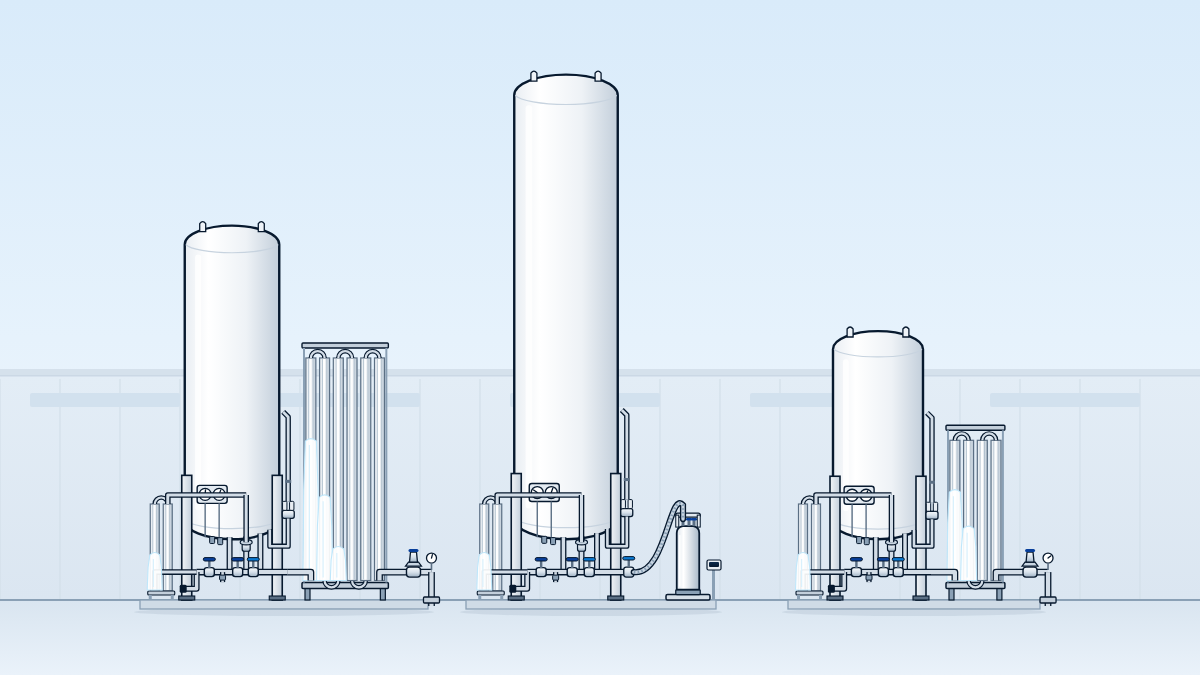
Choosing a cryogenic storage tank is a sequence of engineering decisions, not a single number. Get the order right and everything else falls into place: the gas sets the material rules, consumption sets the size, and the way you draw product sets the pressure class. This guide walks a first-time buyer through that sequence, one step at a time.
At Cryofortune we source and engineer cryogenic equipment from a network of vetted Chinese manufacturers — we are not a factory ourselves. The walkthrough below is written to help you specify the right tank, then confirm every detail against a specific manufacturer, model and order.
Step 1 — Start with the gas and the media
Every later choice depends on what you store. Standard cryogenic storage tanks are configured for liquid nitrogen (LN2), liquid oxygen (LO2) or liquid argon (LAr); some are built for liquid CO2. Each liquid has its own density, so a tank holding argon (about 1.40 kg/L) carries very different weight from one holding nitrogen (about 0.81 kg/L).
Oxygen adds a layer. Because it is a strong oxidizer, oxygen service demands strict cleanliness — degreased wetted parts, oxygen-compatible valves and gaskets — and its own handling discipline. If there is any chance you will switch a nitrogen tank to oxygen later, flag it now: adding oxygen cleanliness after the fact is rarely practical. Decide the media first, and decide it honestly.
Step 2 — Turn consumption into volume
Size the tank around real demand, not the headline capacity. Start with your daily consumption and, separately, your peak draw — the two are not the same and both matter.
Consumption is usually known in gas terms (Nm³ or kg per day), but a tank is sized in liters of liquid, so convert first. Our cryogenic conversion tables give the working figures: one kilogram of nitrogen is about 1.24 L of liquid, oxygen about 0.88 L, argon about 0.72 L. Read the other way, a liter of liquid nitrogen yields roughly 0.65 Nm³ of gas, oxygen about 0.80 Nm³, argon about 0.78 Nm³.
With daily demand in liters, add a refill-interval reserve. If a supplier delivers weekly, hold at least a week of liquid plus a safety margin and an allowance for evaporation between fills. Remember that usable volume is below gross — vertical tanks typically deliver around 95% of rated capacity. Standard vertical units run from roughly 7,990 L to 25,000 L, which covers most site installations; for smaller or intermittent use, look at microbulk tanks instead.
Step 3 — Choose the pressure class
Pressure is where buyers most often over- or under-spec. Vertical tanks come in working-pressure classes of 0.8, 1.6 and 2.2 MPa, and the right one depends on how you take product out.
If you draw liquid — feeding a pump, filling dewars, supplying a liquid line — a lower class such as 0.8 MPa is often enough. If you draw gas through a vaporizer and need pressure held at the point of use, a higher class (1.6 or 2.2 MPa) sustains delivery pressure as the tank empties. Higher is not automatically better: it changes the build and the rate at which pressure rises during idle periods. Match the class to the draw, not to a “bigger is safer” instinct.
Step 4 — Vertical or horizontal
Orientation is driven by your site, not preference. Vertical cryogenic storage tanks have a small footprint and suit plants where floor area is tight but headroom is available — vertical variants can stand from about 5 m to over 11 m tall, so confirm overhead clearance and any planning limits. Horizontal tanks spread the same volume over a lower profile, which helps where height is restricted or where wind and seismic rules favor a low center of gravity. Walk the delivery route and the final pad before you commit to either.
Step 5 — Compare evaporation rate, not just price
No cryogenic tank is perfectly sealed against heat; a little liquid always boils off. That loss is the normal evaporation rate (NER), usually quoted as a percentage of capacity per day, and it is the single most important figure for lifetime cost. Two tanks at the same price with different NER are not the same purchase — over years, higher boil-off quietly bills you in lost product every day the tank stands idle.
NER depends on size, media and the quality of the vacuum insulation (standard units use a vacuum-perlite jacket). Always ask for the NER of the exact model and media, and weigh it against price. The cheaper tank can turn out to be the expensive one.
Step 6 — Size the vaporizer and downstream together
A storage tank rarely works alone. If you are turning liquid into gas, the tank and the cryogenic vaporizer must be sized as one system: a tank that stores a week of liquid is no help behind a vaporizer that cannot meet your peak gas flow. Size for the peak, not the average. Our vaporizer sizing guide covers the flow, ambient and duty-cycle factors that set capacity. The same holds further downstream — regulators, piping and any manifold must carry the peak flow at the delivery pressure you fixed in Step 3.
Step 7 — Confirm destination and documentation
Where the tank will operate governs which rules apply. Pressure vessels are regulated, and the applicable standard follows the destination country, not the place of manufacture — our standards page and the cryogenic equipment by country guide map the common regimes. Raise this early: the documentation, markings and registration path a tank needs are defined per manufacturer, model and order, and confirming them before production is far easier than reworking a finished vessel. Ask what a given factory can certify for your destination rather than assuming one mark applies everywhere.
Cryogenic storage tank specification and standards
A complete cryogenic storage tank specification pins down eight fields: gross and usable volume; maximum allowable working pressure (MAWP) and pressure class; the stored media (LN2, LOX, LAr or CO2); daily evaporation rate (NER, % per day); insulation type (vacuum-perlite or multilayer); orientation and footprint; material grades of the inner vessel and jacket; and the design code with its certificate pack. Ask for these eight and quotations become directly comparable.
The design standard is set by the destination market, not by preference: ASME Section VIII with a U Stamp for the USA, EN 13458 under PED/TPED for Europe and the UK, and GB 150 / GB/T 18442 for Chinese domestic designs, with further national registration schemes layered on top (CRN in Canada, DOSH in Malaysia, EAC in the EAEU). The full map by country is in our standards and procedures section. Cryofortune matches the manufacturer and the certificate pack to the destination before production starts. For vessels already in service, the same logic runs in reverse — see our guide to cryogenic storage vessel repair and refurbishment.
An inquiry checklist
When you contact us, having these ready turns a quote around quickly:
- Gas and media (LN2, LO2, LAr, LCO2), and whether oxygen service is possible now or later
- Daily and peak consumption, in Nm³/day or kg/day
- Delivery or refill interval and the reserve you want
- Liquid draw or gas draw, and the required delivery pressure
- Site constraints: footprint, headroom, access route, seismic and wind
- Destination country and any documentation or registration you already know you need
Work the seven steps in order and you arrive at a specification that fits your process, your site and your paperwork — not just the budget line. Availability and applicability of any standard, certificate, marking or registration procedure are confirmed for the specific manufacturer, model and order before production.
Specification and standards: common questions
What should a cryogenic storage tank specification include?
Volume (gross and usable), MAWP and pressure class, media, daily evaporation rate, insulation type, orientation, material grades, and the design code with certification. With those eight fields fixed, offers from different factories can be compared line by line.
What standards apply to cryogenic storage tanks?
ASME Section VIII (USA and U-Stamp markets), EN 13458 with PED/TPED (Europe and UK), and GB 150 / GB/T 18442 (China), plus destination-specific registrations such as CRN, DOSH or EAC. The governing standard is decided by the country where the tank will operate.
Can one tank be certified for several markets?
Sometimes — some manufacturers hold both ASME and PED approvals — but certificates belong to a specific factory and model, so multi-market certification must be confirmed per order, not assumed from a catalog.