
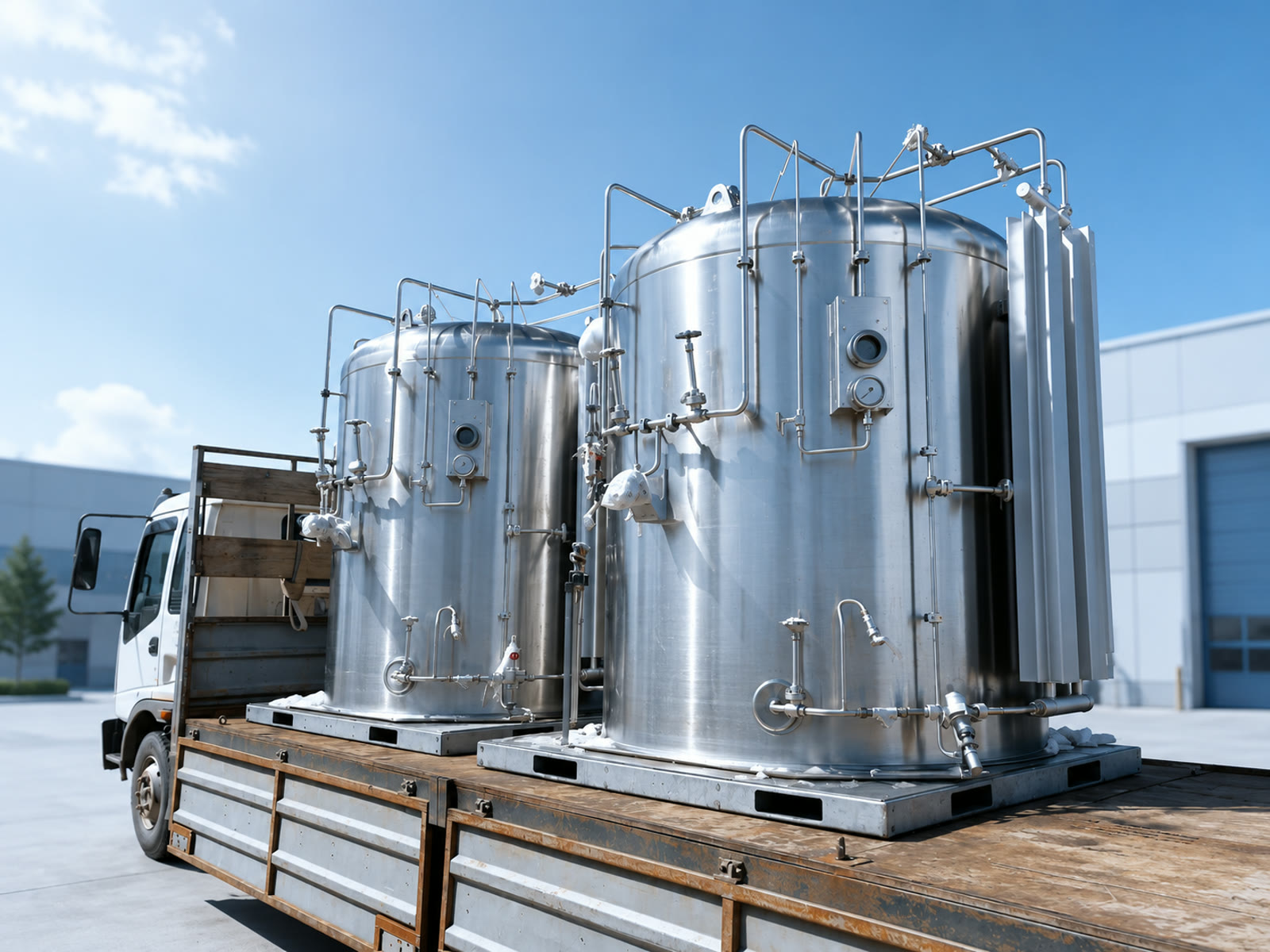
Cryogenic equipment inquiries mix mechanical engineering, gas physics and conformity language, and the same word often means something narrower on a datasheet than in conversation. This glossary defines the terms that appear across our product range, standards section and guides — the working vocabulary of a tank or vaporizer purchase.
Liquids and physics
Cryogenic liquid. A gas liquefied at very low temperature — nitrogen at −195.8 °C, oxygen at −183.0 °C, argon at −185.9 °C at atmospheric pressure. Stored cold rather than under high pressure.
Boiling point. The temperature at which the liquid turns to gas at a given pressure. Raising storage pressure raises the boiling point — the principle behind pressure building.
Expansion ratio. How many volumes of gas one volume of liquid yields on vaporization — roughly 1:680 for nitrogen, 1:840 for oxygen at 15 °C. See the conversion tables.
Sublimation. Passing directly from solid to gas, the way dry ice behaves at −78.5 °C; liquid CO2 exists only above its triple-point pressure of about 5.2 bar.
Heel. The residual liquid left in a vessel before refilling; keeping a heel keeps the vessel cold and cuts cool-down losses.
Ullage. The vapour space intentionally left above the liquid — the difference between gross and usable volume — allowing for thermal expansion.
Storage equipment
Vacuum insulation. A double wall with the interspace evacuated to stop convective heat leak; combined with perlite fill on bulk tanks or multilayer wrapping on smaller vessels.
Perlite. Expanded volcanic glass powder filling the annular space of most bulk storage tanks.
Multilayer insulation (MLI / super insulation). Dozens of reflective foil layers in high vacuum, used on liquid cylinders and dewars where perlite would be too bulky.
Evaporation rate (NER). Normal Evaporation Rate — the share of contents boiling off per day through insulation losses, quoted at a reference fill; the key quality figure of any cryogenic vessel.
Dewar. An open- or narrow-neck vacuum vessel for smaller LN2 volumes, typically non-pressurized or low-pressure.
Liquid cylinder. A self-pressurizing vacuum-insulated cylinder (commonly 175–500 L) that dispenses liquid or gas; the bridge between dewars and microbulk.
Microbulk tank. A stationary refillable vessel between cylinder packs and bulk storage, filled on site by truck without exchanging hardware.
Pressure building circuit (PBC). A coil that vaporizes a small liquid stream back into the vessel’s vapour space to hold delivery pressure as liquid is withdrawn.
Economizer. A circuit that preferentially draws vapour when tank pressure rises, cutting venting losses.
Gas side
Vaporizer. The heat exchanger converting stored liquid into process gas — ambient-air, water-bath, steam or electric; compared in types of cryogenic vaporizers.
Frosting. Ice build-up on ambient vaporizer fins that throttles capacity over a duty cycle; the reason banks are sized with switchover margin.
Manifold. The piping assembly connecting multiple cylinders or outlets to one line, with regulators and safety accessories. On a liquid-cylinder manifold, remote level monitoring shows each cylinder’s level and, with a pressure sensor, its pressure, so the reserve cylinder building pressure can be connected first rather than left to vent.
Nm³ (normal cubic metre). Gas volume at 0 °C and 1 atm — the reference unit that avoids temperature ambiguity in supply contracts.
Pressure and safety
MAWP / design pressure. The maximum allowable working pressure the vessel is designed and certified for; relief devices are set at or below it.
Safety relief valve (PRV). The self-reclosing valve that vents excess pressure; on cryogenic service installed in redundant pairs with a changeover.
Bursting disc. A one-time membrane backing up the relief valve at a higher set point.
Hydrostatic test. Pressure test with liquid (typically 1.3–1.5 × design pressure depending on code) proving vessel integrity before service.
Oxygen cleaning. Removal of oils and particulates from every oxygen-wetted surface; hydrocarbons in enriched oxygen are an ignition hazard, and electronics are kept out of enriched zones as well: on oxygen sites, liquid cylinder telemetry uses a dedicated version where only the probe and its cable stay at the vessel and the electronics and battery box are installed outside zones of possible oxygen enrichment. Both points drive the site rules on liquid oxygen equipment.
Purging. Displacing air or moisture from lines and vessels with dry nitrogen before cool-down; skipping it leads to ice plugs.
Cool-down. The controlled first chilling of a warm vessel or line, consuming extra liquid before stable service begins.
Conformity language
Design code. The calculation-and-fabrication rulebook a vessel is built to — EN 13445, ASME Section VIII, GB 150 and others; distinct from the legal regime that mandates it, a distinction unpacked in the standards section.
Conformity assessment. The defined procedure demonstrating compliance for a specific market — a notified-body module in the EU, shop certification and data reports under ASME.
Nameplate. The permanent plate carrying the manufacturer, serial number, design data and markings; its data must match the certificates and the invoice line for customs and registration.
Manufacturer’s data book. The document package behind a vessel — material certificates, weld and NDT records, test reports — that travels with an exported unit.
NDT. Non-destructive testing of welds (radiographic, ultrasonic, dye penetrant) recorded in the data book.
Remote monitoring
Telemetry. Automatic transmission of equipment readings to a remote screen. On liquid cylinders, a CryoFor TM2 module reports level on a set schedule, and pressure once a separate pressure sensor is fitted, to the CryoFor Telemetry platform, which keeps the history and raises alerts; see liquid cylinder telemetry.
Capacitive level probe. A probe inside a cryogenic vessel whose electrical capacitance changes with the liquid level. TM2 reads the vessel’s own probe and needs one within 120–500 pF across the fill range; cylinders with only float or dial gauges need a compatible probe first.
Level gauge head. The electronic part of a liquid cylinder’s level gauge that reads the probe and displays or reports the level. TM2 takes the place of the stock electronic level gauge rather than adding a second instrument; see replacing a liquid cylinder level gauge.
Two-point calibration. Setting a level gauge against two reference points, 0% and 100%. With TM2, the fill event is registered at each fill and the calibration is recalculated.
Fill event. A refill of the vessel as registered by the monitoring module. In CryoFor Telemetry every fill shows as a marker on the level chart.
Low reserve. The level at which a vessel needs a refill planned. CryoFor Telemetry raises a low-level alert while there is still time to plan the refill rather than send a rush delivery.
Offline. A monitoring module that has stopped reporting. CryoFor Telemetry flags offline modules separately and raises a lost-connection alert, so silence is never mistaken for a full vessel. Short connection drops lose no readings: up to 12 unconfirmed packets stay queued and are re-sent when the link returns.
Run-out forecast. An estimate of when a vessel will run empty. CryoFor Telemetry shows it with the level history, so refills can be scheduled before they become rush deliveries.
Monitoring vs metering. Monitoring shows how much a vessel holds and how the gas is used; metering measures quantities for invoicing. TM2 is a monitoring device: it is not a measuring instrument, is not subject to metrological verification and is not intended for commercial gas metering, so invoicing stays with metering equipment.
Direct / hub mode. The two ways a monitoring module reaches the cloud. In direct mode TM2 reports through the site’s ordinary 2.4 GHz Wi-Fi router; where internet is unreliable, an optional local hub, not part of the TM2 kit, collects and buffers data from several modules. Hub operation is recorded in each unit’s passport, and hub availability is confirmed per project.
Consumption heat map. A chart of gas use by hour and day that makes patterns such as unexplained overnight draw easy to spot; part of the consumption analytics in CryoFor Telemetry.
Terms here are described in their common engineering sense; exact definitions follow the design code and regulations applicable to a given order. Availability and applicability of any standard, certificate, marking or registration procedure are confirmed for the specific manufacturer, model and order before production.