
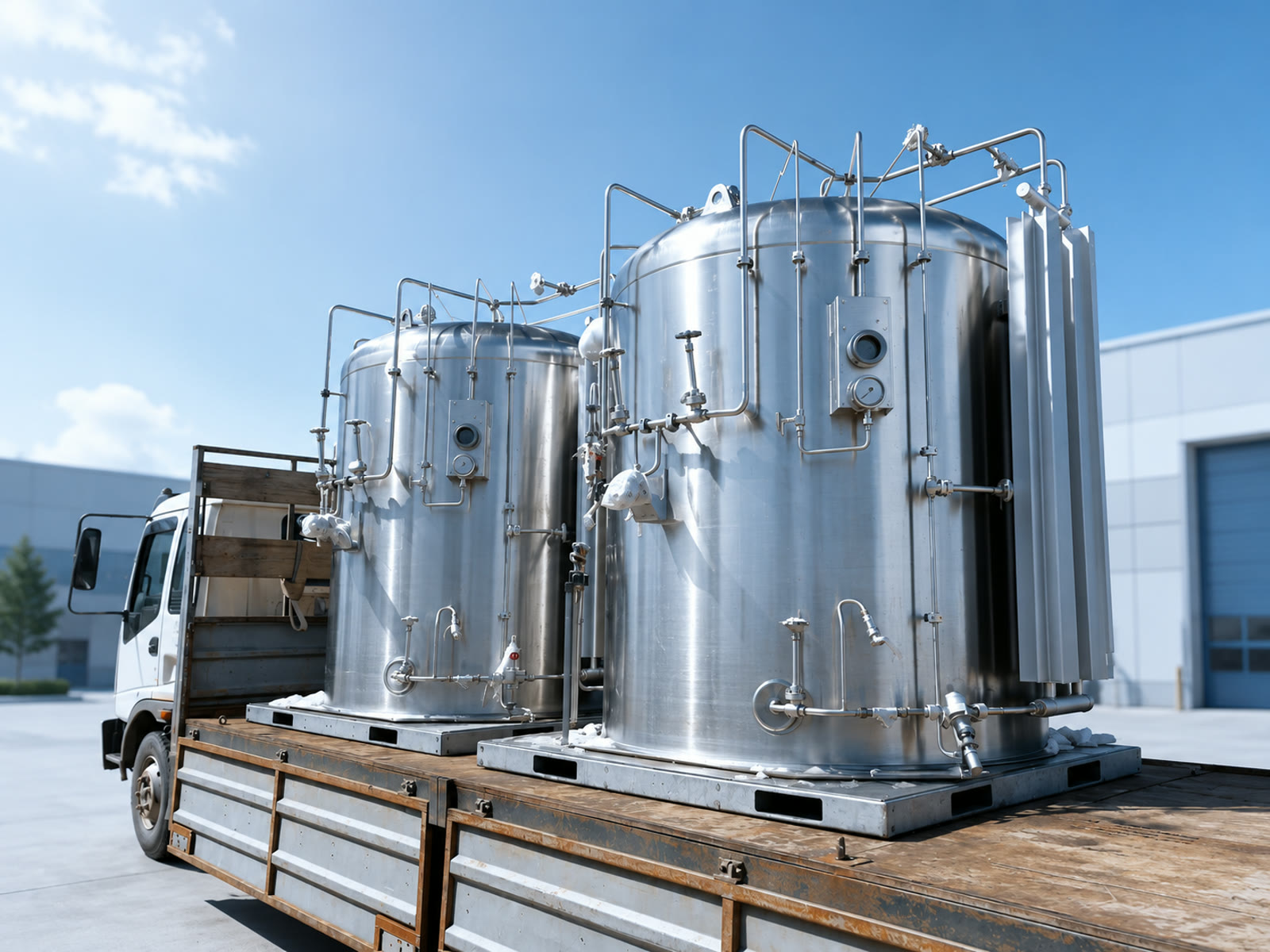
Every cryogenic supply conversation eventually needs the same arithmetic: how many kilograms sit in a litre of liquid, how many cubic metres of gas a tank really holds, how many high-pressure cylinders one liquid cylinder replaces. This page collects those conversions for liquid nitrogen, oxygen, argon and CO2 in one place, at clearly stated reference conditions, so capacity planning starts from the same numbers on both sides of the inquiry.
All figures are engineering approximations for planning. Liquid densities are taken at the normal boiling point at atmospheric pressure (CO2 at typical storage conditions of about −20 °C and 2.0 MPa, since at atmospheric pressure CO2 exists only as gas or dry ice). Gas volumes are given both as Nm³ (0 °C, 1 atm) and at 15 °C, 1 atm — mixing reference temperatures is the most common source of mismatched numbers between supplier and buyer.
One litre of cryogenic liquid
| Liquid | Boiling point, °C (1 atm) | Mass, kg | Gas, Nm³ (0 °C) | Gas, m³ (15 °C) | Expansion, approx. |
|---|---|---|---|---|---|
| Liquid nitrogen (LN2) | −195.8 | 0.81 | 0.65 | 0.68 | ≈ 1 : 680 |
| Liquid oxygen (LOX) | −183.0 | 1.14 | 0.80 | 0.84 | ≈ 1 : 840 |
| Liquid argon (LAr) | −185.9 | 1.40 | 0.78 | 0.83 | ≈ 1 : 830 |
| Liquid CO2 (−20 °C / 2.0 MPa) | −78.5 (sublimes) | 1.03 | 0.52 | 0.55 | ≈ 1 : 550 |
Reading the table: a litre of liquid argon weighs almost twice as much as a litre of liquid nitrogen, which is why the same tank shell carries very different payloads by media — the effect visible in the payload columns of the ISO tank container guide.
The same densities matter when a liquid cylinder’s level is monitored remotely: CryoFor Telemetry handles nitrogen, oxygen, argon, CO2 and other gases with the density set per gas, and level accuracy depends on the connected probe, the calibration and the density of the medium.
One kilogram of gas
| Gas | Liquid volume, L | Gas volume, Nm³ |
|---|---|---|
| Nitrogen | 1.24 | 0.80 |
| Oxygen | 0.88 | 0.70 |
| Argon | 0.72 | 0.56 |
| CO2 | 0.97 | 0.51 |
Per 1,000 litres of stored liquid
Multiply by your tank’s usable volume to estimate the gas reserve. A vertical storage tank of 8,000 L usable therefore holds roughly 5,200 Nm³ of nitrogen gas; a 25,000 L vessel about 16,000 Nm³.
| Liquid | Mass, kg | Gas, Nm³ |
|---|---|---|
| LN2 | 808 | 646 |
| LOX | 1,141 | 798 |
| LAr | 1,396 | 782 |
| LCO2 | 1,030 | 521 |
Liquid cylinders vs high-pressure cylinders
A standard high-pressure cylinder of 40 L water volume filled to 150 bar carries a nominal 6 m³ of gas — slightly less in practice once compressibility and residual pressure are counted. A 175 L liquid cylinder of nitrogen holds about 113 Nm³, so one liquid cylinder replaces roughly 18–20 high-pressure cylinders of deliverable gas. That ratio — not the price per unit — is what usually decides the switch, and the operational side of that decision is covered in microbulk vs cylinders.
Working the numbers backwards
The same tables run in reverse for sizing. A process drawing 50 Nm³/h of nitrogen for 10 hours a day consumes 500 Nm³ ≈ 775 L of liquid daily — so an 8,000 L tank refilled weekly is comfortable, while cylinder supply would mean handling dozens of bottles a day. Vaporizer capacity is sized from the peak hourly draw rather than the daily total; that method is set out in the vaporizer sizing guide, and the storage side in the cryogenic storage tank range overview.
These conversions are typical engineering values at the stated reference conditions, suitable for capacity planning; exact figures for a given order follow from the selected equipment’s datasheets. Availability and applicability of any standard, certificate, marking or registration procedure are confirmed for the specific manufacturer, model and order before production.