Where liquid nitrogen equipment is used
Liquid nitrogen (LIN) supports food freezing, laboratory and biobank storage, metal processing and inerting, and biological storage on farms. Each application draws on the same hardware chain: a storage vessel, a means of withdrawal and, where gas is needed, a vaporizer.
Cryofortune Engineer & Supply sources this hardware from a network of Chinese manufacturers. The factory is selected per destination country, design standard, documentation package and duty.
Working properties of liquid nitrogen
Nitrogen boils at about −196 °C at atmospheric pressure, which is why every vessel in LN2 service relies on vacuum insulation. The medium is inert, colorless and non-flammable, so the engineering concerns are cold, pressure and oxygen displacement rather than reactivity. One liter of liquid yields roughly 700 liters of gas at ambient conditions, a ratio that shapes both vaporizer sizing and relief practice.
Food freezing and chilling
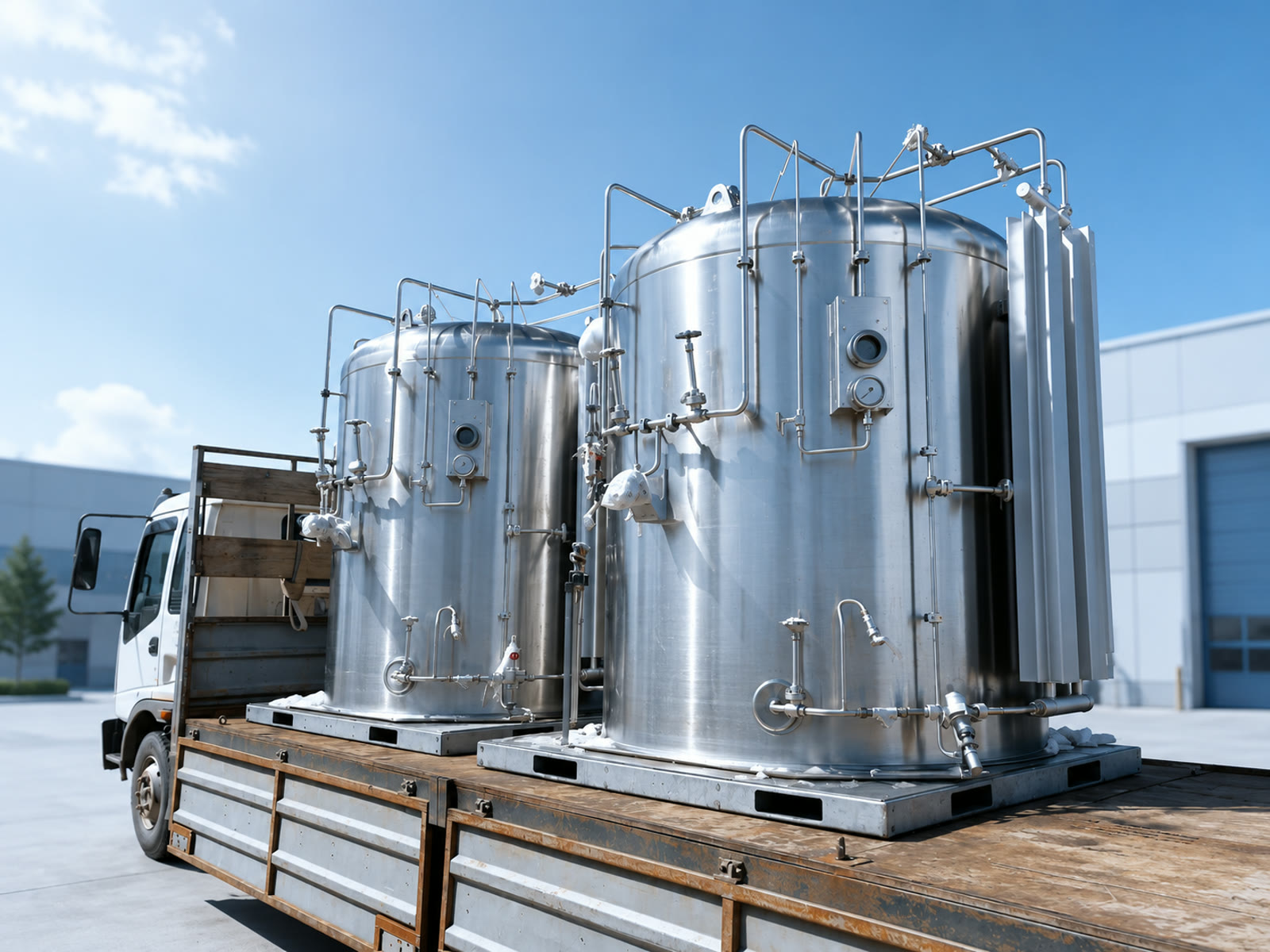
Cryogenic freezing lines consume liquid continuously, so the storage vessel is sized from daily throughput rather than from batch volume. Plants running tunnel or cabinet freezers usually hold their reserve in a vertical cryogenic storage tank; catalog configurations span 7,990–25,000 L gross volume at 0.8–2.2 MPa working pressure.
Smaller processors often start with vertical cryogenic cylinders of 50–500 L, then move to bulk storage when refill frequency becomes a cost. That trade-off is examined in microbulk vs cylinders: when to upgrade.
While a site is still on cylinders, each LN2 liquid cylinder with a compatible capacitive level probe can report its level remotely: a CryoFor TM2 module takes the place of the stock electronic level gauge and reports to CryoFor Telemetry on a set schedule, with pressure added once a separate pressure sensor is fitted. The level history then shows how often refills really come round before the move to bulk storage is decided.
Laboratories and biobanking
Sample storage and controlled decanting favor open-neck vessels rather than pressurized cylinders. Liquid nitrogen dewar vessels cover 3–100 L capacities with neck diameters from 50 to 210 mm, chosen to suit the canisters or racks they hold.
The YDZ-50 container adds low-pressure dispensing at 0.05 MPa; its static evaporation is listed at 2.2% per day, about 1.10 L. Neck diameter, holding behavior and transport handling are discussed in the dewar buyer’s guide.
Metal processing and industrial inerting
Shrink fitting and cold treatment use the liquid directly; blanketing, purging and assist-gas duties need nitrogen as a gas at stable pressure. For gas duties, a cryogenic vaporizer converts stored liquid on demand; catalog configurations reach 500 m³/h capacity and working pressures up to 200 bar.
Storage is then matched to the draw profile: cylinders with pressure build-up at 2–10 bar feed intermittent loads, and bulk tanks feed continuous ones. Where installation height is limited, the horizontal 500 L cryogenic cylinder offers 474 L usable volume and holds 383 kg of LN2.
On-farm biological storage
Breeding programs keep semen and embryos in portable dewars that move between farm, vehicle and collection point. Small dewar sizes from 3 L upward remain practical to carry, while the 50 L YDZ-50, at 46 kg empty, works as a station vessel refilled less often.
Static evaporation, not consumption, dominates sizing in this duty: the vessel must hold samples safely between scheduled refills.
Filling and distribution
Distributors filling high-pressure cylinders from a liquid reserve add a cryogenic cylinder filling pump; the skid family covers 800–1,000 L/h flow at discharge pressures of 16–25 MPa. Downstream filling hardware is mapped on the gas filling systems page.
Selecting liquid nitrogen equipment by duty
- Continuous liquid consumption — food lines, cold treatment: a bulk tank sized to throughput; see cryogenic storage tanks.
- Intermittent liquid or gas draw — 50–500 L cylinders with pressure build-up; see cryogenic liquid cylinders.
- Gas at stable pressure — a vaporizer matched to peak flow; see cryogenic vaporizers.
- Cylinder filling — a reciprocating pump skid; see cryogenic pumps.
- Sample storage and decanting — open-neck dewars and YDZ containers.
How nitrogen duty differs from oxygen, argon and CO2 service is set out in cryogenic equipment by gas.
Safety basics in LN2 service
Nitrogen displaces oxygen without odor or warning, so enclosed rooms holding LN2 vessels are normally ventilated and often fitted with oxygen monitoring. Materials in liquid contact are selected for −196 °C service; carbon steels embrittle at these temperatures, so wetted parts are typically austenitic stainless steel.
Closed vessels carry relief devices because trapped liquid expands greatly as it warms; open dewars avoid pressure build-up but lose more product to evaporation.
Standards and destination documentation
Pressure-vessel and transport rules differ by market, and specific design codes may apply depending on the destination; the applicable set is confirmed per order. The standards overview summarizes the main regimes, and destination notes are collected for Australia and New Zealand, with further markets added as their pages publish.
Configurations and documentation are confirmed for the specific manufacturer, model and order before production. Send a rough duty description — daily LN2 consumption, required gas flow and pressure, installation constraints and destination country — and we will propose a vessel and vaporizer configuration with the documentation route.