
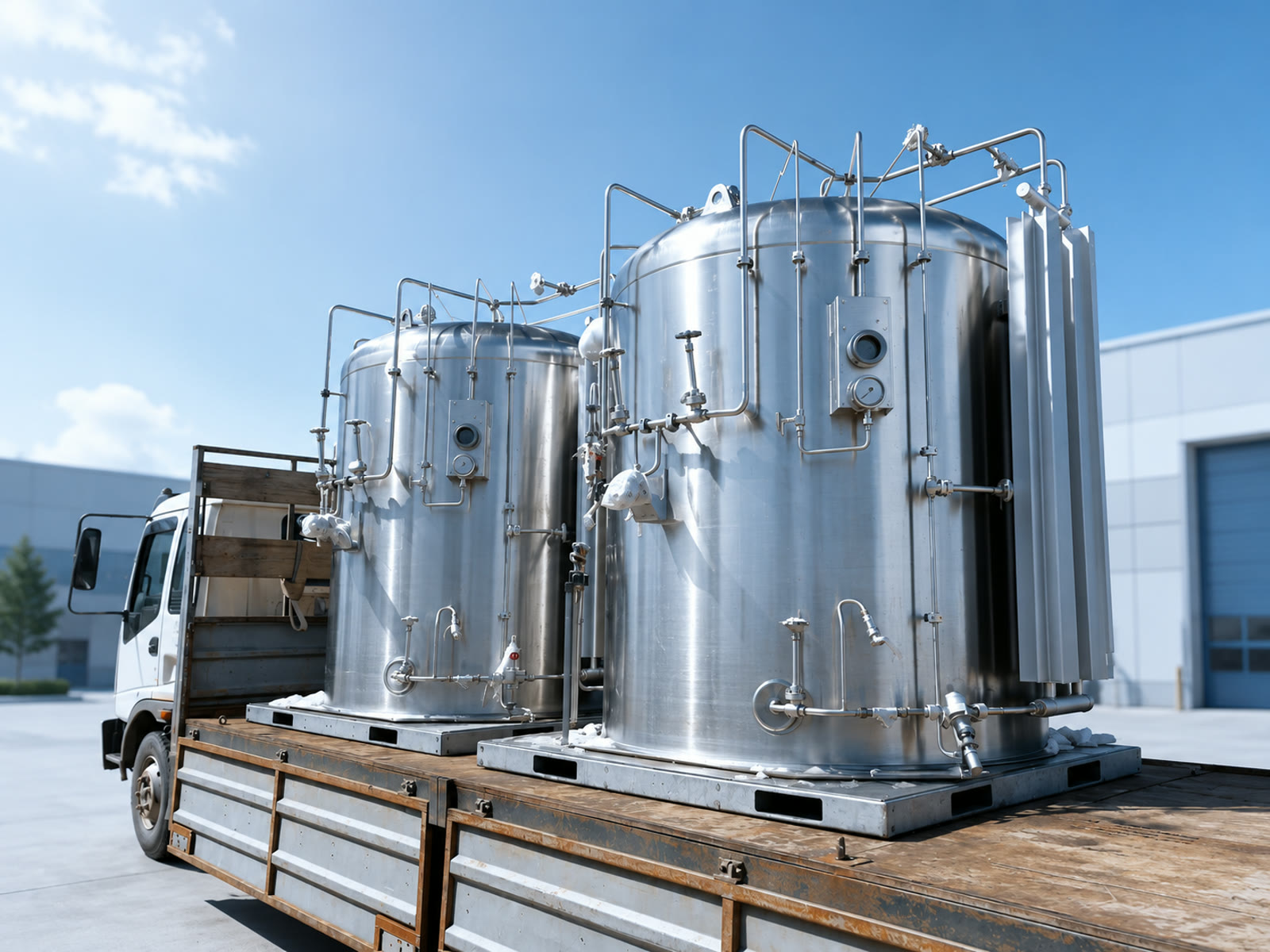
A cryogenic vaporizer converts stored liquid into process gas at the flow and pressure the duty requires. It sits between the storage vessel and the point of use, and in most installations it decides how much gas the station can actually deliver. This page explains the main vaporizer types, maps our catalog units to typical duties, and outlines how sizing and station integration are approached.
What a cryogenic vaporizer does: liquid in, gas at duty flow
Cryogenic media are stored as liquid because liquid is dense and economical to hold. Processes, with few exceptions, consume gas. The vaporizer bridges the two states, absorbing heat from ambient air or a powered source and gasifying liquid on demand. An undersized vaporizer caps the whole installation, regardless of how large the tank behind it is. Selection therefore starts from the duty: gas, peak flow, working pressure and climate. How duties differ between nitrogen, oxygen, argon and CO2 is summarized in our equipment-by-gas overview.
Ambient-air vaporizers: the default configuration
For most industrial duties, ambient-air units are the starting point. They draw heat from the surrounding air across extended heat-exchange surfaces and typically consume no power in normal operation. Our catalog Cryogenic Vaporizer spans this class and its heated variants in three configurations. Across the family, capacity reaches 500 m³/h, with a 350 m³/h option, and working pressure extends to 200 bar for high-pressure filling duties; a low-pressure option rated 3.0 MPa serves pipeline and process supply. The high-pressure models are tested to 300 bar. Units are built as atmospheric, vertically installed vaporizers for outdoor or skid-mounted vaporization areas. The medium — LN2, LOX, LAr or CO2 — is fixed by configuration at order. The Ambient Air Vaporizer line, built for micro-bulk and bulk storage tanks, extends the catalog to 50–10,000 Nm³/h, with maximum working pressures from 1.6 to 25 MPa (250 bar).
Heated types: water-bath, steam and electric
Ambient air is not always enough heat. Cold climates, continuous round-the-clock draw, or duties that need a controlled outlet temperature push the selection toward water-bath, steam-heated or electric designs. These add operating cost but remove the dependence on weather. The same catalog Cryogenic Vaporizer is supplied in water-bath, steam or electric-heated configurations, matched to duty, climate and continuous or peak demand. The trade-offs between the types are set out in our comparison of cryogenic vaporizer types. In practice many stations combine both: ambient banks carry the base load, and a heated unit covers winter or peak trimming.
CO2 service and the downstream gas heater
Carbon dioxide behaves differently from the air gases. Outlet temperatures that drift too low can risk solid CO2 forming in lines and regulators, so CO2 duties are commonly paired with a heater stage. Our Gas Heater / CO2 Heater is that companion: electric or steam-assisted packages that stabilize outlet gas temperature after vaporization. Seven variants cover working pressures of 2–25 MPa and capacities of 100–300 m³/h, with heating power of 24–96 kW at 380 V. The same packages are configured for oxygen, nitrogen and argon where a duty requires a defined outlet temperature.
Sizing: flow, media, climate, duty cycle
Four inputs drive vaporizer sizing. Peak gas flow, not average consumption, sets the required exchange surface. The medium matters, because each liquid demands a different amount of heat per cubic metre of gas produced. The design ambient temperature — the coldest realistic operating day — discounts the nameplate capacity. And the duty cycle determines whether one unit can recover between draws or whether paired banks are needed. The working method is set out step by step in the cryogenic vaporizer sizing guide.
Vaporizer icing and duty-cycle derating
An ambient vaporizer extracts heat from air, and the moisture in that air freezes onto its surfaces. Frost builds during operation and progressively reduces capacity over the run. Common practice is to derate the unit for continuous duty, or to install two banks that alternate: one gasifies while the other defrosts. Humid coastal sites and sustained high flows shorten the useful run time between switchovers. These effects belong inside the sizing calculation, not as an afterthought.
Where the vaporizer sits in the gas supply station
A typical supply scheme runs tank, vaporizer, regulation, process. Bulk liquid comes from a vertical cryogenic storage tank; smaller and intermittent draws are served by vertical cryogenic cylinders, which handle pressure build-up and gasification at cylinder scale. For cylinder-filling stations the chain extends: a cryogenic filling pump raises liquid to discharge pressure, the high-pressure vaporizer gasifies it, and a heater trims temperature before the manifold. Together, pump, vaporizer and heater form the regasification chain of a complete filling station.
Standards and destination country
Vaporizers and their heater packages fall under pressure-equipment and electrical rules that differ by market. Design codes and documentation may apply per destination and are selected accordingly — the framework is outlined on our standards hub. Because we source from a network of Chinese manufacturers, the factory is chosen per destination country, design standard and documentation set. Country-level notes are collected for Australia and New Zealand, with further markets to follow.
The availability and applicability of any standard, certificate, marking, or registration procedure are confirmed for the specific manufacturer, model, and order before production. Send a rough duty description — gas, peak flow, working pressure, climate and destination country — and we will return matched vaporizer and heater configurations from the appropriate factory.