
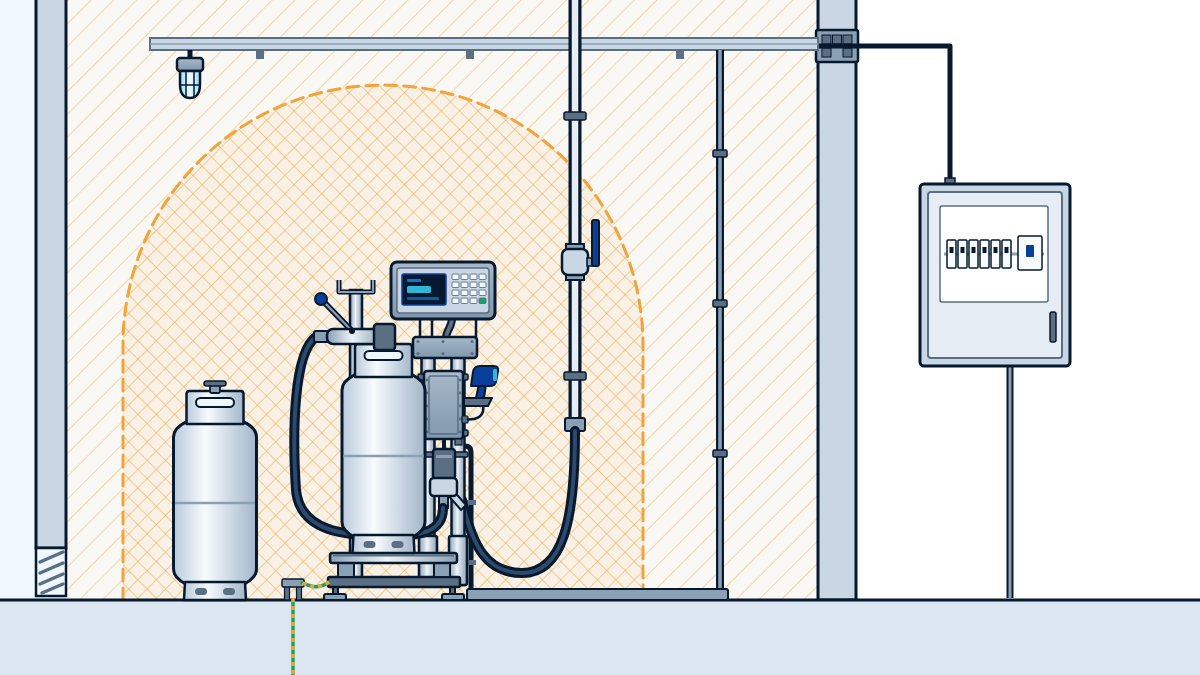
An LPG filling post puts electrical equipment where LPG vapour can collect: the scale’s weighing electronics and controller, the solenoid cut-off valve, the power supply and, where fitted, a cylinder scanner and a data module. Buyers therefore ask one question early: is it ATEX certified? The useful question is narrower. Which scheme applies in your market, which exact model and configuration does the certificate cover, and does its protection level match the zone at your filling post?
This article compares the five schemes an LPG filling scale is most often asked about: ATEX in the European Union, the international IECEx system, TR CU 012/2011 in the Eurasian Economic Union (EAEU), CCC in mainland China and safety registration in Taiwan. The equipment itself is described on LPG cylinder filling scales. For any product we source the rule is the same: the scheme is confirmed per model, market and order. Certificates belong to a manufacturer, a model and a configuration, and Cryofortune does not hold Ex certificates of its own.
Start from the zone, not from the certificate
Explosion protection is chosen against a hazardous-area classification, and that classification is the site’s responsibility. In the EU, the workplace directive 1999/92/EC requires the employer to classify places where explosive atmospheres may occur into zones. For gases and vapours:
- Zone 0: an explosive atmosphere is present continuously, for long periods or frequently.
- Zone 1: an explosive atmosphere is likely to occur occasionally in normal operation.
- Zone 2: an explosive atmosphere is not likely in normal operation and, if it does occur, persists only for a short period.
The zone then sets the minimum protection. Under the EU rules, zone 0 needs category 1 equipment, zone 1 needs category 1 or 2, and zone 2 accepts category 1, 2 or 3. In the IEC system that IECEx and many national schemes use, the same idea is expressed as an Equipment Protection Level (EPL): Ga for zone 0, Gb or Ga for zone 1, and Gc, Gb or Ga for zone 2. Gas group and temperature class must also suit your LPG mixture. All of this comes from your site’s classification and your engineer, not from a brochure.
What a certificate actually covers
An Ex certificate is issued to a named holder for a defined product type and configuration. Depending on the scheme, it may also carry a validity period and special conditions of use. For a filling post this matters because the post is an assembly. A certificate for a scale with a scanner does not automatically cover the same scale without it, or with a different power supply or data module, and the reverse is equally true. Four checks catch most problems:
- the holder named on the certificate, and its relation to the company that will actually build your equipment;
- the model code and configuration, compared line by line with what you are ordering;
- the certificate’s current status and, where the scheme sets one, its validity date, compared with your expected delivery date;
- the protection level and marking, compared with your zone, gas group and temperature class.
European Union: ATEX Directive 2014/34/EU
Directive 2014/34/EU covers equipment and protective systems intended for use in potentially explosive atmospheres. It has applied since 20 April 2016, replacing Directive 94/9/EC. Equipment for surface industries is group II, split into three categories by level of protection: very high (category 1), high (category 2) and normal (category 3).
The conformity assessment route depends on the category:
- Category 1: EU-type examination by a notified body, combined with quality assurance of production or with product verification.
- Category 2, electrical equipment: EU-type examination by a notified body, combined with internal production control plus supervised product testing, or with product quality assurance.
- Category 3: internal production control by the manufacturer, with no notified body involved.
The product carries the CE marking, followed by the notified body’s number where that body is involved in the production control phase, then the specific explosion-protection mark and the symbols of the equipment group and category. Notified bodies are listed in the European Commission’s NANDO database. Before placing a product on the EU market, the importer must make sure the manufacturer has carried out the right procedure. How the CE marking itself works is covered on our CE marking page.
IECEx: the international certification system
IECEx is the IEC System for Certification to Standards Relating to Equipment for Use in Explosive Atmospheres. Under its Certified Equipment Scheme, an IECEx certification body (ExCB) issues a Certificate of Conformity on the basis of a type test report (ExTR) and an assessment of the manufacturer’s quality system (QAR), which is then audited periodically. Every IECEx certificate is published in the IECEx online certificate system, and certified equipment carries its IECEx certificate number on the marking plate. A certificate you cannot find online should be treated as not issued.
IECEx is not in itself a legal requirement in the EU, where the law asks for ATEX. In most IECEx member countries it works as a fast track: the national body accepts IECEx test results when it issues its own national certificate or mark. One difference from ATEX is worth knowing: IECEx requires independent testing and certification for zone 2 equipment too, where ATEX category 3 can rest on the manufacturer’s own production control.
EAEU: TR CU 012/2011
In the EAEU, Ex equipment falls under Technical Regulation of the Customs Union TR CU 012/2011, “On safety of equipment for work in explosive atmospheres”, adopted by Customs Union Commission Decision No. 825 of 18 October 2011 and in force since 15 February 2013.
- Conformity is confirmed only by certification, not by a declaration, carried out by accredited certification bodies and test laboratories included in the EAEU unified register.
- Serial products are certified by testing a type sample and analysing production, followed by surveillance (scheme 1c). A limited batch or a single unit can be certified by testing samples from that batch or the unit itself (schemes 3c and 4c).
- For scheme 1c the applicant must be registered in an EAEU member state, either as the manufacturer or as a party acting for the foreign manufacturer under a contract with it.
- A certificate for serially produced equipment is valid for no more than five years.
- Certified equipment carries the EAC mark and the Ex marking, which includes the special explosion-safety mark. Special conditions of use are flagged by an “X” in the Ex marking and set out in the certificate annex.
Pressure equipment falls under a separate regulation; see EAC and TR CU 032.
Mainland China: CCC and the GB/T 3836 series
China moved explosion-proof electrical products from production licensing to China Compulsory Certification (CCC) under SAMR Announcement No. 34 of 2019. Designated certification bodies began accepting applications on 1 October 2019. Since 1 October 2020, explosion-proof electrical products within the CCC scope may not leave the factory, be sold, be imported or be used in other business activities without a CCC certificate and the CCC mark.
The implementation rule is CNCA-C23-01:2019. Since 1 May 2022 its basis standards have been the revised GB/T 3836 series, headed by GB/T 3836.1-2021 on general equipment requirements, with separate parts for each type of protection, such as flameproof enclosure “d”, increased safety “e” and intrinsic safety “i”.
Two points matter for buyers outside China. First, CCC is a domestic requirement: it does not replace ATEX, IECEx, EAC or Taiwan registration. Second, several Chinese Ex institutes are also IECEx certification bodies, so a Chinese-built product can hold an IECEx certificate issued in China. Ask which of the two documents you are being shown. Cylinder filling in China is also governed by a separate special-equipment rule, TSG 23-2021, the Gas Cylinder Safety Technical Regulation, which is not an Ex scheme.
Taiwan: safety registration and the TS mark
In Taiwan, explosion-proof electrical equipment is one of the machines, equipment and devices designated under Article 7 of the Occupational Safety and Health Act, administered by the Occupational Safety and Health Administration (OSHA) of the Ministry of Labor. The rules have applied since 1 January 2015:
- equipment that does not meet the national safety standard for machinery may not be shipped from the factory, imported, leased, supplied or installed;
- for Ex equipment used with gases, that standard refers to the CNS 3376 series or the IEC 60079 series, and where the two differ, IEC 60079 prevails;
- the manufacturer or importer declares conformity and registers the product’s safety information on OSHA’s machinery safety information website;
- the product then carries the safety mark, known as the TS mark, with a TD identification code.
The evidence behind the registration depends on the product type. Ex luminaires, Ex motors and Ex switch boxes need a type test by a testing body recognised by the Ministry of Labor, even when they already hold foreign certificates. According to ITRI, which runs Ex type testing in Taiwan, the switch-box type covers enclosures with operable switching devices driving mechanical contacts, and its examples include control boxes, plugs and sockets, limit switches and indicators. A filling scale’s controller or power box may therefore need a domestic type test even when it holds an IECEx certificate; this is confirmed per model. For other Ex equipment a valid IECEx certificate can serve as evidence. Certificates under other foreign schemes are usually not treated as full proof and are assessed case by case, and certificates from mainland Chinese bodies are accepted only where the body is an IECEx certification body and the standards applied meet Taiwan’s requirements.
Registration is made online with a Taiwanese business certificate, so a foreign manufacturer cannot register; in practice the importer does. Ex equipment follows this Article 7 registration route, not the separate Article 8 type-verification route, whose mark carries a TC code.
Trade-use weighing is a separate approval
Explosion protection says nothing about whether the filled mass may be used to sell LPG. That is legal metrology, with approvals of its own:
- EU: the Non-automatic Weighing Instruments Directive 2014/31/EU treats weighing for commercial transactions as a distinct category of use, and the Measuring Instruments Directive 2014/32/EU defines automatic gravimetric filling instruments in its annex MI-006.
- Taiwan: under the Weights and Measures Act, non-automatic weighing instruments and automatic gravimetric filling instruments are among the legal measuring instruments that must pass verification, handled by the Bureau of Standards, Metrology and Inspection (BSMI). A verified instrument must be verified again after repair, adjustment or modification, or when its verification period ends.
- EAEU and mainland China: national legal-metrology rules decide whether type approval or verification applies, confirmed per model and market.
Whether a particular filling scale counts as a non-automatic instrument or as an automatic filling instrument depends on its design and on national practice, so this is confirmed per model and market together with the Ex scheme.
The five schemes side by side
ATEX (EU)
- Legal basis: Directive 2014/34/EU, applied since 20 April 2016
- How conformity is shown: Categories 1 and 2 (electrical): EU-type examination by a notified body plus production control. Category 3: manufacturer’s internal production control.
- Mark on the product: CE marking, notified body number where applicable, explosion-protection mark, group and category
- Where it counts: EU single market
IECEx
- Legal basis: IECEx system rules; IEC 60079 standards
- How conformity is shown: Type test report (ExTR) and quality assessment (QAR) by an IECEx certification body, for every zone
- Mark on the product: IECEx certificate number on the marking plate; certificate listed online
- Where it counts: International; in most member countries a fast track to national certification, not a replacement for it
TR CU 012/2011 (EAEU)
- Legal basis: Customs Union Commission Decision No. 825 of 2011, in force since 15 February 2013
- How conformity is shown: Mandatory certification by an accredited body in the EAEU register (schemes 1c, 3c, 4c); applicant registered in a member state
- Mark on the product: EAC mark and Ex marking with the special explosion-safety mark
- Where it counts: EAEU member states
CCC (mainland China)
- Legal basis: SAMR Announcement No. 34 of 2019; rule CNCA-C23-01:2019; GB/T 3836 series
- How conformity is shown: Certification by a designated certification body
- Mark on the product: CCC mark
- Where it counts: Mainland China
Safety registration (Taiwan)
- Legal basis: Occupational Safety and Health Act, Article 7; safety standard referring to CNS 3376 or IEC 60079
- How conformity is shown: Registration by the Taiwanese manufacturer or importer, backed by a domestic type test (required for Ex luminaires, motors and switch boxes) or by an IECEx certificate
- Mark on the product: TS safety mark with a TD identification code
- Where it counts: Taiwan
What to ask before you order an LPG filling scale
- Which scheme applies in your destination market, and who will be the local applicant or registrant where the scheme needs one (the EAEU applicant, the Taiwanese importer)?
- Which model and configuration the certificate covers, including the scanner, the power supply and the data module.
- Who holds the certificate, and whether that is the company building your equipment.
- Whether the certificate is current now and, where it has a validity date, will still be valid at delivery.
- Whether the category or EPL, gas group and temperature class match your zone and LPG mixture.
- Whether there are special conditions of use, and what they require at your site.
- Whether the filled mass will be used for trade, and which legal-metrology approval that needs in your market.
How Cryofortune handles Ex documentation
Cryofortune sources LPG filling-post equipment through its network of manufacturers in China and does not hold Ex certificates itself. Before an order, we identify the manufacturer, model and configuration, request the certificate for your market’s scheme, and check its holder, model, configuration, validity and marking against what you are buying. If no certificate exists for that exact configuration, we tell you before the order, not after it. The scheme is confirmed per model, market and order. Hazardous-area classification, permits and approval of the station stay with the operator and its local engineer. More on our approach is in how Cryofortune selects a manufacturer and on the standards hub.
Common questions
Is an IECEx certificate enough to sell Ex equipment in the EU?
Not on its own. Placing Ex equipment on the EU market requires conformity with the ATEX Directive 2014/34/EU and the CE marking. An IECEx certificate is a separate international certificate, so check which of the two the equipment actually carries.
Is a Chinese CCC certificate accepted in other markets?
Not in the markets compared here. CCC is a mainland China requirement. The EU requires ATEX, the EAEU requires certification under TR CU 012/2011, and Taiwan accepts certificates from mainland Chinese bodies only where the body is an IECEx certification body and the standards applied meet its requirements. An IECEx certificate issued in China is a different document from CCC.
Can equipment for zone 2 be certified without a third party?
Under ATEX, yes: category 3 equipment, which is suitable for zone 2, is assessed by the manufacturer’s internal production control. IECEx and TR CU 012/2011 have no such route: IECEx requires independent testing for zone 2 equipment as well, and in the EAEU conformity is always confirmed by certification.
Who registers Ex equipment in Taiwan?
The Taiwanese manufacturer or importer, online with a Taiwanese business certificate. A foreign manufacturer cannot register, so the importer’s role has to be settled before shipment.
Does a certificate for the scale also cover the scanner and data module?
Only if they are part of the certified configuration or are certified themselves. Check the model code and configuration on the certificate against the exact filling post you order, including the scanner, power supply and data module.
Does Cryofortune hold ATEX or IECEx certificates?
No. Certificates belong to the manufacturer for a specific model and configuration. We confirm the scheme per model, market and order and check the certificate before you order.
Official sources
- European Commission: equipment for potentially explosive atmospheres (ATEX)
- Directive 2014/34/EU, original text
- Directive 1999/92/EC, original text
- IECEx Certified Equipment Scheme
- IECEx: frequently asked questions
- Eurasian Economic Commission: TR CU 012/2011
- SAMR Announcement No. 34 of 2019 (explosion-proof electrical products to CCC)
- CNCA Announcement No. 6 of 2022 (CCC basis standards, GB/T 3836)
- Taiwan Occupational Safety and Health Act
- Taiwan regulation on safety information registration of machinery and equipment
- Taiwan Weights and Measures Act
Check the scheme for your market
Tell us the destination country, the zone your engineer has set for the filling post and the configuration you need. We will say which scheme applies and whether a valid certificate exists for that exact configuration. Send an inquiry.