In Vietnam, the date that decides a gas project is not the day the tank clears the port — it is the day it passes kiểm định. Pressure equipment sits on the list of machinery with strict occupational-safety requirements maintained under circulars of the Ministry of Labour, Invalids and Social Affairs (MOLISA), and before it may be put into use — and periodically afterwards — it must pass technical safety inspection, kiểm định kỹ thuật an toàn, carried out by a licensed inspection organisation against the QCVN national technical regulations for pressure vessels, with declaration to the local labour authority to follow. A cryogenic tank whose manufacturer file does not satisfy the inspector does not go into service, however sound the vessel itself may be. That file is arranged before production, not after arrival — and that is what this page is about.
Cryofortune Engineer & Supply Co., Ltd. is an international sourcing and engineering supplier: the equipment described here comes from a network of vetted Chinese manufacturers, and we are not a factory. For a Vietnamese order that model works twice — we match the manufacturer to the duty and to the documentation the inspection will demand, and the goods then travel one of the shortest industrial supply routes in the world. This page expands the Vietnam section of our Southeast Asia overview into the detail a Vietnamese project actually needs.
Cryogenic equipment supplied to Vietnam
The scope for Vietnamese buyers follows the standard industrial-gas chain:
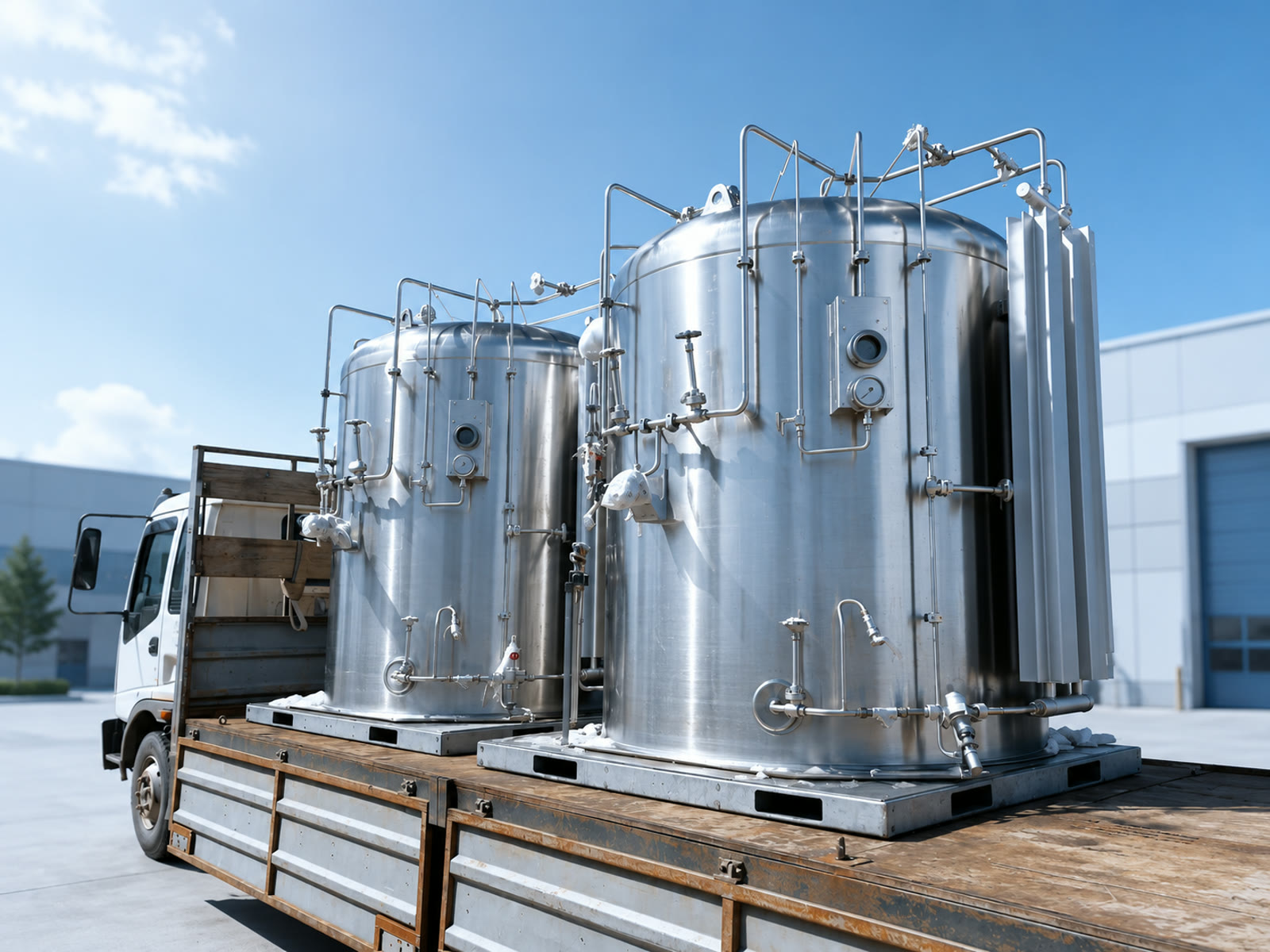
- Cryogenic storage tanks — vertical and horizontal vacuum-insulated vessels for liquid oxygen, nitrogen, argon, carbon dioxide and LNG, typically 3–200 m³, installed at gas plants, filling stations, hospitals, electronics factories and steel works.
- Cryogenic vaporizers — ambient-air and heated units that turn stored liquid back into process gas, sized against the site’s actual drawdown rather than a catalogue line.
- Cryogenic liquid cylinders — palletised dewars for gas distributors, workshops, laboratories and hospitals where a fixed tank is not yet justified.
- Pressure vessels — buffer tanks and other static pressure equipment that completes a gas system, held to the same code and documentation discipline as the cryogenic scope.
Complete stations — tank, vaporizer bank, pressure regulation and safety devices — are configured as one engineered package, so the inspection organisation reviews one coherent file rather than a folder of unrelated deliveries.
The kiểm định layer: technical safety inspection
Vietnam regulates pressure equipment primarily through its occupational-safety framework. Because cryogenic tanks and their associated vessels fall within the MOLISA list of machinery with strict safety requirements, they must pass technical safety inspection before first use, performed by an inspection organisation licensed for that equipment group and assessed against the applicable QCVN technical regulations. Inspection is then repeated periodically through the equipment’s service life, and the equipment’s use is declared and registered with the labour authority of the province where it operates.
Two practical consequences follow. First, the statutory steps — appointing the inspection organisation, presenting the equipment, declaration and registration — are performed in Vietnam by the buyer, the importer or their local representative; a foreign supplier cannot lawfully do them for you, and we do not pretend otherwise. Second, the inspection stands or falls on the manufacturer file: drawings, calculations, material certificates, test reports and nameplate data that let the inspector map the vessel onto the QCVN requirements. Arranging that file, in the form the inspection organisation expects, is our part of the work. The exact circular numbers, capacity and pressure thresholds, and the amendments in force at order time are confirmed per order with the buyer’s Vietnamese inspection partner rather than quoted here — the framework moves, and a country page is no place to freeze it.
Design codes and the language of the file
Most cryogenic vessels imported into Vietnam are built to an internationally recognised pressure-vessel code, and ASME Section VIII is the common choice for export work: it gives the inspection organisation a design basis it has seen many times before. Manufacturers in our network hold their own code qualifications, and several produce ASME-designed or ASME-stamped vessels as routine export production. Whether a given code file satisfies a given inspection organisation is confirmed before production — acceptance of a foreign design basis is applied through the Vietnamese regulations, never assumed.
Language is the quieter half of the same problem. The kiểm định file is reviewed in Vietnamese, so Vietnamese-language documentation — translated data-book extracts, certificates and operating documents — is arranged per order as part of the delivery scope, not left for the buyer to improvise at the port.
Importing from China: Vietnam is the easy case
Every market we serve involves moving equipment out of China; Vietnam is the one where geography does most of the work. The two countries share a land border, so road freight runs through crossings such as Huu Nghi in Lang Son province and Lao Cai, while short-sea sailings from southern Chinese ports reach Hai Phong and Ho Chi Minh City on transit times measured in days. For a cryogenic tank, freight becomes a modest line in the project budget rather than a schedule risk.
Proximity keeps paying after delivery. Spare parts move quickly, a manufacturer’s service engineer can realistically visit site, and Chinese-built equipment is already everywhere in Vietnamese industry — plant engineers and inspection organisations handle it routinely. The general mechanics of a cross-border purchase — contracts, shipping terms and what happens at each end — are described in our guide to importing cryogenic equipment from China; customs clearance and the statutory steps inside Vietnam remain with the buyer or their broker.
Where the demand comes from
Vietnamese demand for cryogenic capacity is broad and growing across several fronts:
- Electronics and FDI manufacturing. Samsung-scale electronics plants and the component supply chain around them consume nitrogen in serious volumes — storage tanks with vaporizer banks, backed by liquid cylinders for smaller lines.
- Steel. A fast-growing steel industry draws oxygen and argon for its furnaces and downstream processing, with site storage and high-throughput vaporization to match.
- Seafood and food export. Freezing for export markets runs on liquid nitrogen and carbon dioxide; see our page on liquid nitrogen food freezing for how the cold chain is equipped.
- Welding and gas distribution. Regional fillers and distributors serving fabrication shops rely on storage tanks, pumps and fleets of liquid cylinders.
- Healthcare. Hospital liquid-oxygen systems — tank, vaporizers and controls — carry the same kiểm định obligations as any other pressure installation, and the file is prepared accordingly.
Choosing the factory for a Vietnamese order
No single factory is best at every vessel, which is the point of working through a network. For Vietnam the shortlist weighs proven export history, code capability where ASME is specified, documentation quality — a complete, legible data book is easier to translate and review — and practical service reach into the country. The full method is described in how Cryofor selects a manufacturer.
One rule never bends: certificates belong to a specific manufacturer, a specific model and a specific order. We do not present network-level or brand-level certificates, because no honest version of one exists. What you receive is the chosen manufacturer’s own qualification and the test documents of your actual vessel.
Inside the documentation file
A typical delivery file for a Vietnamese order includes:
- the manufacturer’s data book — design drawings, strength calculations and nameplate details;
- material certificates for pressure-bearing parts;
- test and examination reports, including hydrostatic testing, non-destructive examination and vacuum performance for cryogenic vessels;
- documentation for safety valves and instrumentation supplied with the vessel;
- the manufacturer’s code certification for the vessel where a stamped design is ordered;
- operating and maintenance documentation, with Vietnamese translation arranged per order.
The final scope is aligned with the checklist of the buyer’s inspection organisation before production starts, so the file that travels with the tank is the file the inspector expects to open.
Starting a Vietnam enquiry
The fastest opening message covers five things: the medium (LOX, LIN, LAr, CO2 or LNG), the required capacity, the working pressure, the province and installation site, and whether an inspection organisation is already engaged. Send them through the contact page and the reply is a working configuration proposal, a candidate manufacturer profile and the documentation scope for the kiểm định file — enough to put in front of your inspection partner before any money moves.
For other markets, from Southeast Asia to the Middle East and beyond, see the full country directory.
Availability and applicability of any standard, certificate, marking or registration procedure are confirmed for the specific manufacturer, model and order before production.