Every cryogenic vessel that enters Nigeria crosses two regulatory thresholds, and only one sits at the port. Before shipment, imports of regulated products pass through the Standards Organisation of Nigeria’s conformity assessment scheme — SONCAP — with certificates issued while the cargo is still in the exporting country. After arrival, pressure equipment lives under Nigeria’s operator-side safety framework. A supplier who understands only the equipment, not the sequence, delivers a tank that clears neither.
The market is worth the sequence. Nigeria is West Africa’s largest economy and one of the continent’s most active gas markets: medical oxygen infrastructure building out since 2021, oil and gas services centered on Onne, steel and fabrication shops from Lagos to Kano, and breweries drawing liquid CO2 at scale — all supplied through a gas-distribution trade that, in practice, buys much of its hardware from China.
Cryofortune Engineer & Supply Co., Ltd. is an international sourcing and engineering supplier. We source cryogenic and gas equipment from a network of vetted Chinese manufacturers — we do not own a factory, and we put that in writing because it determines how certification works: every certificate belongs to a specific manufacturer, model and order, never to a brand name. This page covers what we supply to Nigeria and how the paperwork is sequenced so SONCAP, customs and operator obligations are ready before the vessel sails.
Equipment supplied to Nigeria
The Nigerian order book concentrates on four core lines, with oxygen service leading:
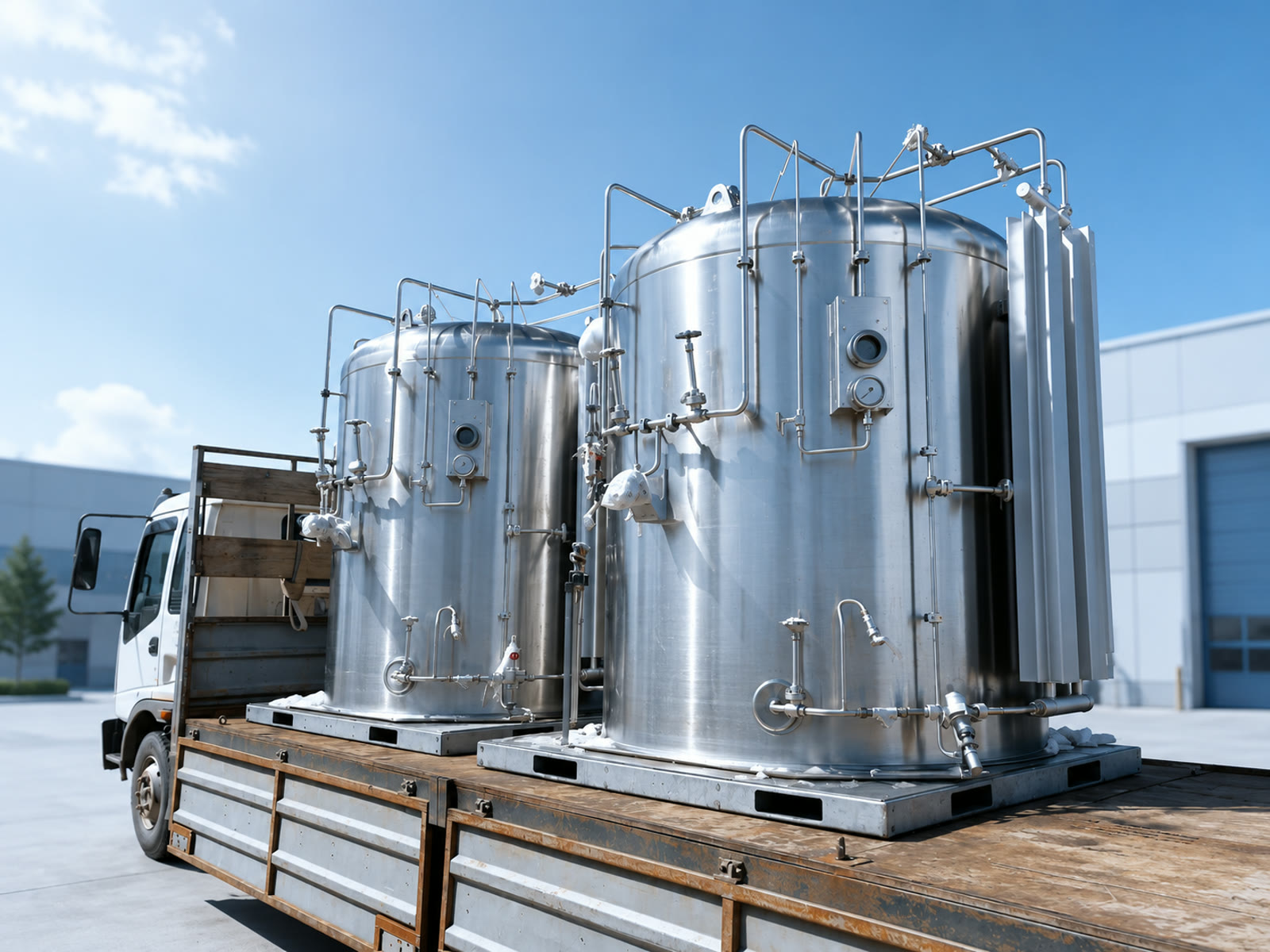
- Cryogenic storage tanks — vertical and horizontal vacuum-insulated vessels for liquid oxygen, nitrogen, argon, CO2 and LNG, sized and pressure-rated per application: hospital LOX installations, filling-plant storage, on-site industrial supply.
- Cryogenic vaporizers — ambient air vaporizers as the default for Nigeria, with water-bath and electric units where the flow profile requires them; the ambient unit’s grid independence matters here — more below.
- Cryogenic liquid cylinders — the workhorse of the distributor trade: palletized liquid deliveries to hospitals, welders and food plants not yet ready for a bulk tank.
- Pressure vessels — air receivers, buffer and process vessels built to a recognized pressure vessel code with the documentation to prove it.
SONCAP: the import layer that starts before shipment
Imports of regulated products are controlled by the Standards Organisation of Nigeria (SON) through SONCAP. Products within the regulated scope require product certification and a per-shipment Certificate of Conformity, issued through SON-accredited firms in the exporting country before the goods ship; the resulting certificate is part of what Nigerian customs expects at clearance. The assessment happens where the factory is, not where the port is; a certificate route left unresolved at sailing cannot be fixed retroactively at Apapa.
Whether a particular cryogenic tank, vaporizer or pressure vessel falls within SONCAP-regulated scope — and which certificate route applies — is not something we assert generically on a web page. Scope and procedure sit with SON and its accredited firms, and the answer depends on product classification and the shipment. We confirm it at order time, together with the buyer’s clearing agent, and build it into the production and shipping schedule.
The division of labor is clean. On the manufacturer’s side, we arrange what the assessment needs: documentation, test reports, workshop access for inspection or testing, coordination with the accredited firm in China. On the Nigerian side, the import file — Form M, customs entry, clearing at the port — is run by the buyer and their agent, as it must be. The general mechanics are described in importing cryogenic equipment from China; Nigeria adds the SONCAP layer on top, and the time to add it is before production, not after.
Inside Nigeria: the operator’s safety layer
Installed equipment answers to a second framework, on the operator’s side. Nigeria’s Factories Act provides the long-standing statutory basis for workplace safety in registered premises, including provisions for the examination of boilers and pressure vessels by approved persons. How the Act applies to a specific installation — which vessels fall under examination requirements, and at what points — is determined in-country by the operator with the relevant authorities. We do not quote examination intervals, because they are not ours to quote.
Oil and gas facilities run under a separate regime. Equipment at petroleum facilities answers to Nigeria’s petroleum regulators and to the operator’s own technical requirements, which are typically explicit about design codes, inspection and documentation. Where the end user is a petroleum operator or their contractor, the contract usually tells us exactly what the file must contain; that specification goes to the manufacturer as a contract term before fabrication.
In both cases the statutory steps inside Nigeria belong to the buyer, the importer or their local representative — not to Cryofortune and not to the manufacturer in China. Our contribution is the manufacturer’s data book: complete, code-referenced and in English, so whoever examines the vessel is reading a file rather than chasing one.
Design codes and the data book
Nigerian industry reads American codes fluently — oil and gas has worked to them for decades — and for pressure vessels the reference point is ASME Section VIII. Vessels are designed and documented to ASME, or to EN 13445 where the buyer’s engineering points that way — a contract decision made at order time. Where the ASME U Stamp is required, the order goes to a manufacturer who holds it; certification is confirmed per manufacturer and order, never assumed. What does not vary is that the data book matches the code named on the drawing, so a reviewer in Lagos or Port Harcourt can verify the vessel against the rules it claims.
Where the demand is: oxygen first
Nigeria’s most consequential gas story of the decade is medical oxygen. The shock of 2021 turned oxygen from a procurement line-item into national infrastructure: PSA generation plants have gone into hospitals across the federation, and hospital groups and state programmes have been adding bulk liquid oxygen alongside them — because a PSA plant needs a liquid backup, and a growing hospital eventually outgrows cylinders. Every element of that architecture — LOX tanks, ambient vaporizers, liquid cylinders — is the equipment this page describes.
Around the medical core, demand is broad. Oil and gas services consume nitrogen for purging, testing and well work, with the Onne free zone near Port Harcourt as the sector’s logistics hub. Steel mills, shipyards and fabrication shops cut and weld with oxygen and argon. Breweries and soft-drink plants — one of Africa’s largest beverage industries — draw liquid CO2 for carbonation. Threading through it all is the gas-distributor trade: filling plants that buy tanks, vaporizers and cylinder fleets, and sell reliability to everyone else.
Two practical features make Nigeria a smooth market for a China-sourcing model. Procurement runs in English — contracts, drawings, data books and inspection calls need no translation layer. And entry logistics are established: cargo moves through the Lagos ports and Onne on regular services from China, clearance handled by the buyer’s clearing agent.
One operating reality has to be designed for, not hoped away: the grid. Any gas supply scheme that depends on continuous electricity carries that risk. On-site liquid storage with ambient vaporization is the counter — an ambient vaporizer draws its heat from the surrounding air and needs no electricity at all, so the installation delivers gas through an outage as on any other day. For a hospital oxygen system, that is not a preference; it is the point.
How the manufacturer is selected
The manufacturer is chosen per order, not defended by default — that is what being a network supplier rather than a factory means in practice. For Nigeria the shortlist filters are concrete: proven builds to the contract code, with the certification to show for it; oxygen-cleaning practice with records wherever the service is oxygen — in this market, often; welding and NDT capability matched to the vessel class; export packing that survives ocean freight to West Africa; and willingness to host third-party inspection, including any arising from the SONCAP route agreed for the order. Certificates attach to a specific manufacturer, model and order, so we verify them against the actual workshop and the actual vessel, never against a brand name. The full method is documented in how Cryofortune selects a manufacturer.
Documents that travel with the order
A Nigerian order closes with a document set assembled before shipment:
- Design calculations and general-arrangement drawings to the contract code;
- Material certificates to EN 10204 3.1 for pressure-bearing parts;
- Weld procedure specifications, procedure qualification records and welder qualifications;
- NDT reports and the pressure test record;
- Cleaning-for-oxygen-service certificate where the medium requires it;
- The code certificate for the vessel, as ordered;
- SONCAP-route documents agreed for the shipment, coordinated with the buyer’s agent and the accredited firm;
- Commercial set: invoice, packing list, bill of lading, certificate of origin.
How manufacturer-side certification is organized — what each document is, who issues it, what it can and cannot promise — is described in cryogenic equipment export certification. Every item on that list is cheapest to secure before the vessel exists, and most expensive once it is riding at anchor off Lagos.
Request a quotation
To start, send five facts: the medium (oxygen, nitrogen, argon, CO2 or LNG), the capacity, the working pressure, the state and site — a hospital group in Lagos, a filling plant in Kano, a petroleum facility in Rivers — and whether a SONCAP-experienced clearing agent is already engaged. We reply with a proposed configuration, a factory shortlist from the network and a document plan sequenced against the SONCAP route and your in-country obligations.
Reach us through the contact page; other markets are covered in cryogenic equipment by country.
Availability and applicability of any standard, certificate, marking or registration procedure are confirmed for the specific manufacturer, model and order before production.