
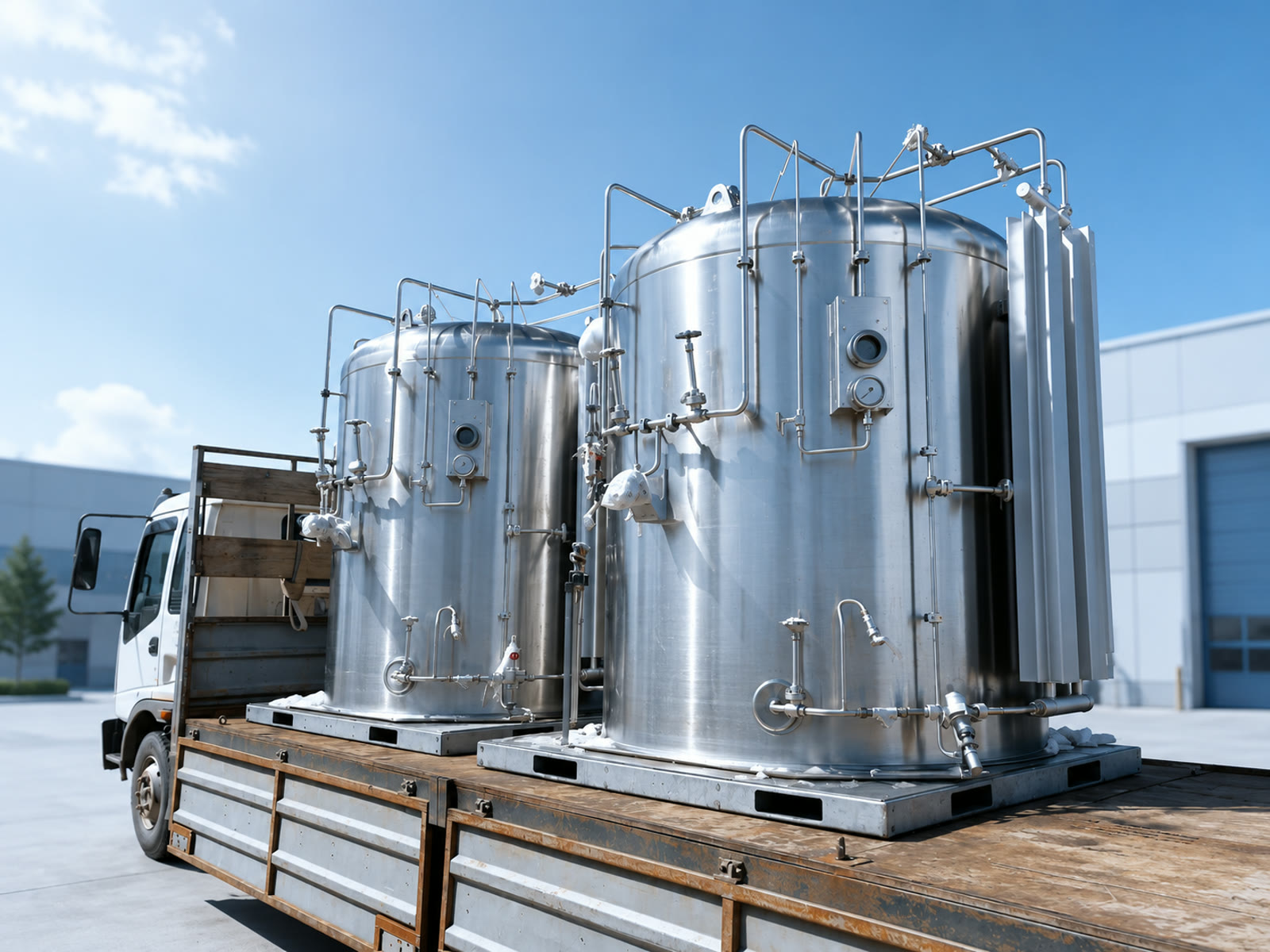
India puts a single federal agency between an imported cryogenic tank and its first fill. Where most importing countries split pressure-equipment oversight across customs, a standards body and a state inspectorate, India concentrates it: static cryogenic pressure vessels are governed by the Static and Mobile Pressure Vessels (Unfired) Rules, 2016 — the SMPV(U) Rules — administered by the Petroleum and Explosives Safety Organisation (PESO), historically the office of the Chief Controller of Explosives (CCOE), under the Department for Promotion of Industry and Internal Trade. A tank that reaches an Indian port without its PESO groundwork done cannot lawfully store gas. It waits, at the buyer’s expense, while paperwork catches up with steel.
On the other side of that gate sits one of the fastest-growing gas markets in the world. Steel and metallurgy keep adding oxygen and argon demand; the healthcare oxygen buildout that followed 2021 left thousands of hospital sites with storage pads, pipelines and procurement experience; electronics, food processing and LNG distribution add load every year. The buyers are gas distributors expanding their networks and plant owners taking storage on site. India is also a price-conscious market, and Chinese-manufactured vessels backed by a correct PESO file have become a standard combination there rather than an exotic one. The combination only works when the file is genuinely correct — which is what this page is about.
Cryofortune Engineer & Supply Co., Ltd. is an international sourcing and engineering supplier: equipment comes from a network of vetted Chinese manufacturers, we are not a factory, and every certificate in the file belongs to a specific manufacturer, model and order. Statutory approvals inside India — drawing approval, manufacturer recognition, the storage licence — are obtained by the buyer, the importer or their Indian representative; our part is the manufacturer-side documentation those filings are built on. This guide is part of our country-by-country series on where the regulatory gate sits in each market.
Cryogenic equipment supplied to India
The India-bound scope is the standard distributor and plant kit, specified from day one with the PESO submission in mind:
- Cryogenic storage tanks — vertical and horizontal vacuum-insulated vessels for liquid oxygen, nitrogen, argon, carbon dioxide and LNG, typically 3–200 m³, for hospital pads, filling stations and industrial sites.
- Cryogenic vaporizers — ambient-air units sized for Indian conditions, where high ambient temperatures help capacity but monsoon humidity argues for switching pairs and generous frost margins.
- Cryogenic liquid cylinders — 175–500 litre vessels for distribution rounds and lower-volume users.
- Industrial pressure vessels — buffer tanks and process vessels supporting gas plants and filling infrastructure.
One boundary matters immediately: cylinders are not SMPV(U) equipment. Gas cylinders — and, depending on classification, transportable liquid cylinders — fall under the Gas Cylinders Rules, 2016, as amended, with their own PESO approval track covering the cylinder type and its valve. A project that includes both a static tank and a cylinder fleet is running two regulatory files, not one.
PESO approval for cryogenic tanks: the SMPV(U) layer
For a static cryogenic vessel, PESO involvement typically arrives at three distinct points, and an India project plan should carry them as three separate lines:
- Design and drawing approval. The vessel’s general-arrangement and fabrication drawings, design calculations and design code are reviewed on the Indian side before the vessel is accepted for use — and ideally before it is built.
- Manufacturer recognition. PESO recognises vessel manufacturers, including foreign ones. The fabricator’s competence file — code certification, shop approvals, quality system, reference list — forms part of the submission, which is one reason the choice of factory and the approval strategy cannot be separated.
- The storage licence. The installation itself is licensed to store the compressed or liquefied gas: siting, safety distances and layout drawings feed into it, and it attaches to the occupier of the site, not to the vendor of the tank.
The volume thresholds in the Rules are low enough that essentially every commercial cryogenic storage tank falls inside scope. The Rules are also amended periodically and PESO practice evolves, so the forms, thresholds and fees current at order time are confirmed against the live text — and, in practice, with an Indian consultant who files with PESO regularly, not against a web page, including this one.
Transportable vessels get one paragraph here because they deserve their own project. Road tankers and vehicle-mounted microbulk units also sit within SMPV(U) scope, on a separate approval track that adds transport-specific requirements and vehicle licensing on top of the vessel file. If an order includes mobile equipment, treat it as its own approval line with its own timeline, not as an accessory to the static tank.
Design codes: the ASME route
Most imported cryogenic vessels enter the Indian process built to ASME Section VIII, and U-stamped construction is the route Indian consultants request most often — the code’s documentation set maps cleanly onto what the submission needs. Vessels designed to EN codes also appear in Indian service. In either case the code is the language of the review, not its outcome: a U-stamp makes a vessel reviewable; it does not make it approved. Acceptance of a specific code, edition and design case is confirmed for the specific order, not assumed from the previous one.
Two technical details recur. Indian reviewers commonly work from design ambient temperatures well above European habit — often taken around 55 °C — which touches relief sizing, filling considerations and vaporizer selection. And documentation completeness beats documentation polish: a thin file in perfect English loses to a complete file every time.
The import sequence: PESO before fabrication
The most expensive mistake in India-bound cryogenic procurement is a sequencing mistake: fabricate first, approach PESO second. The submission is built partly from the vessel drawings and partly from the manufacturer’s credentials, so the approval work and the production contract are entangled by design. When paperwork follows fabrication, every gap between what was built and what the reviewer expects becomes a negotiation — and occasionally a modification order against a finished vacuum-jacketed vessel, which is among the least convenient objects on earth to modify.
The working pattern is the reverse. The buyer or their consultant opens the PESO file while the commercial contract is finalised; we deliver the drawing package and the manufacturer credential file for the submission; production is released once the approval position is confirmed. The weeks spent at the front of the schedule are recovered at the port and at first fill.
The division of labour is fixed. The applicant before PESO is the buyer, the importer or their Indian representative — never Cryofortune and never the factory filing from China. We arrange the documentation the application stands on and answer the technical queries it generates. The freight, Incoterms and customs mechanics of the move itself are a separate subject, covered in our guide to importing cryogenic equipment from China.
Choosing the factory for an Indian order
Not every vetted manufacturer is the right manufacturer for India. The shortlist for an Indian order weights a live track record of supply into PESO-regulated projects, prior submissions or existing recognition for comparable models, and current ASME certification with the shop capacity to hold a schedule. The general method — audits, weld-shop review, document discipline — is described in how Cryofortune selects a manufacturer; the India filter sits on top of it. Our standing rule applies here with particular force: certificates belong to a specific manufacturer, model and order. A brand cannot hold a PESO recognition. A factory can.
Inside the documentation file
A PESO-ready manufacturer file is assembled during production, not reconstructed after it. For a typical static tank it includes:
- general-arrangement and detail drawings with design calculations to the agreed code;
- material certificates (EN 10204 type 3.1) for pressure-bearing parts;
- welding procedure specifications, procedure qualification records and welder qualifications;
- NDT records, pressure and leak test reports;
- code certificates and data reports where U-stamp construction applies;
- the manufacturer’s credential set for recognition — quality certificates, shop approvals, reference list.
What each document is, who issues it and how it is authenticated for use abroad is covered in export certification for cryogenic equipment. For India the test is simple: could the Indian consultant lift the file straight into the submission without writing back to China? That is the standard we assemble to.
Starting an India enquiry
To scope an order, send five things through the contact page: the medium (LOX, LIN, LAr, CO2 or LNG), the required capacity, the working pressure, the installation state and city, and whether a PESO consultant is already engaged. We return a configuration proposal, a candidate manufacturer profile from the network, and the document scope matched to the SMPV(U) submission — settled before production, which in India is the only sequence that works.
Availability and applicability of any standard, certificate, marking or registration procedure are confirmed for the specific manufacturer, model and order before production.