Bangladesh has spent the past decade becoming one of Asia’s fastest-growing industrial economies, and its industrial gas infrastructure is racing to keep up. Garment and textile factories, steel re-rolling mills, shipyards and ship-recycling plots, food processors and hospitals all pull on the same supply chain of liquid oxygen, nitrogen, argon and carbon dioxide — and that supply chain runs on cryogenic storage tanks, vaporizers and liquid cylinders, most of which arrive by sea from China.
Cryofortune Engineer & Supply Co., Ltd. is an international sourcing and engineering supplier. We are not a factory: every order is placed with a manufacturer selected from our network of vetted Chinese plants, matched to the duty, the design code and the documentation the destination requires. For Bangladesh that last point matters more than it first appears, because the country’s pressure-equipment framework is more boiler-centric than an Indian or European buyer might expect — which shifts the weight of compliance onto the quality of the manufacturer’s paperwork.
Statutory steps inside Bangladesh — registrations, licences, factory-level approvals — are carried out by the buyer, the importer or their local representative. Our role is to arrange the manufacturer documentation those steps stand on, and to configure equipment that does not raise questions it cannot answer.
Cryogenic equipment supplied to Bangladesh
Bangladesh enquiries typically involve four families of equipment, each sourced from a manufacturer vetted for that specific product line:
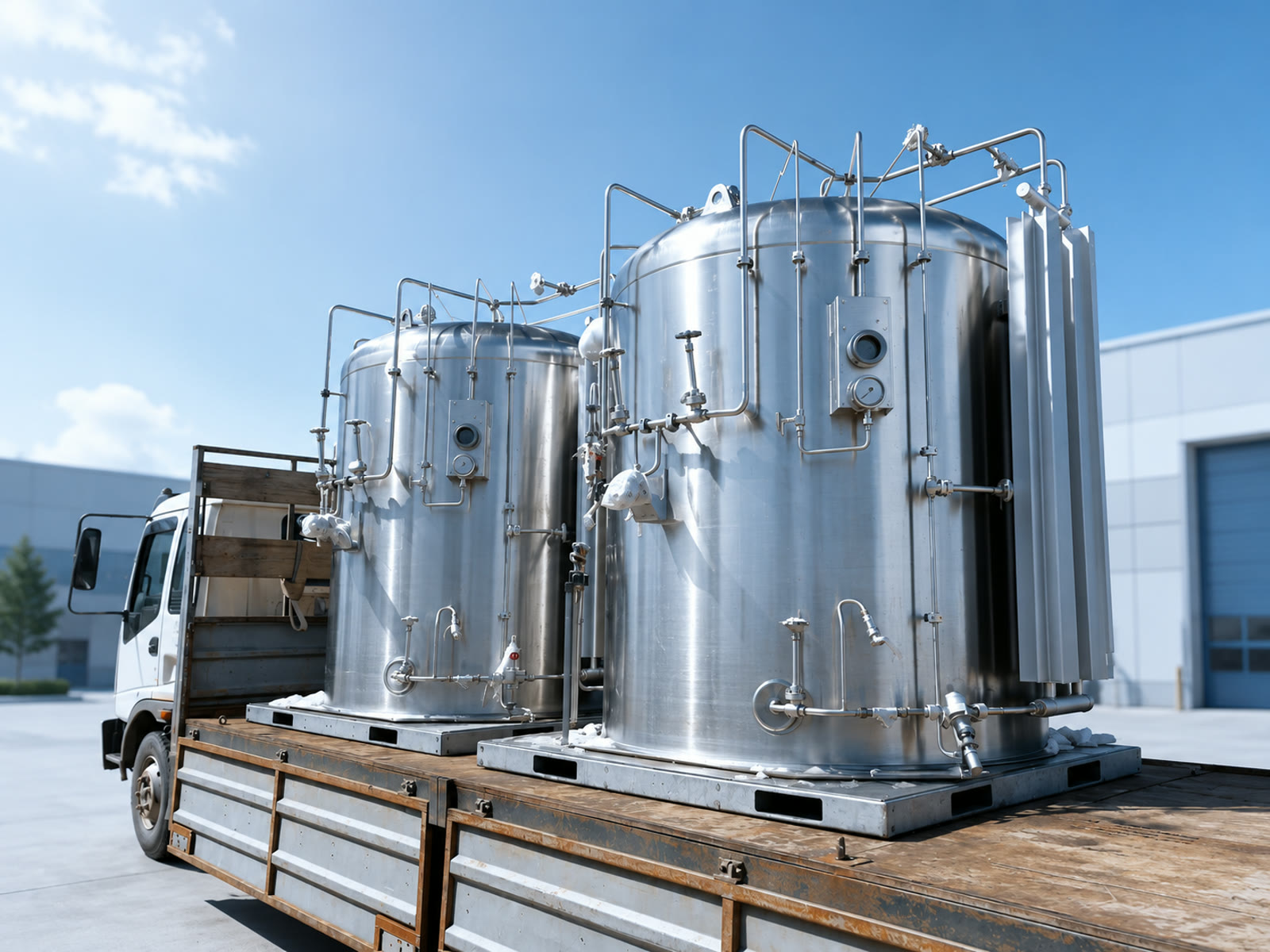
- Cryogenic storage tanks — vertical and horizontal vacuum-insulated vessels for liquid oxygen, nitrogen, argon, carbon dioxide and LNG, from hospital and workshop installations to bulk storage at filling stations and industrial plants.
- Cryogenic vaporizers — ambient-air and heated units that turn stored liquid back into gas before it enters a pipeline, a filling manifold or a process line, sized against the local climate, the flow and the duty cycle rather than picked from a shelf.
- Cryogenic liquid cylinders — self-pressurising portable vessels for distributed liquid supply to workshops, laboratories and smaller hospitals where a fixed tank is not yet justified.
- Industrial pressure vessels — buffer tanks, gas storage vessels and the other code-built equipment that surrounds the cryogenic core of a gas plant or filling station.
Capacities, working pressures and connection standards are fixed per project and confirmed with the manufacturer before contract; in a sourcing model, the figures belong to a specific factory and a specific order, not to a brand.
The regulatory layer: boiler law, the Labour Act and DIFE
Bangladesh regulates pressure equipment through a framework that is, by regional standards, boiler-centric. Steam boilers fall under the country’s boiler legislation, administered by a chief inspectorate; registration, certification and periodic inspection concentrate there. Cryogenic tanks, vaporizers and most gas-side pressure vessels are not steam boilers, so the dedicated boiler regime largely does not capture them.
What captures them instead is the workplace framework. The Labour Act and its rules govern plant and machinery inside factories and establishments, and the Department of Inspection for Factories and Establishments (DIFE) oversees the operator’s side of that obligation. The compliance conversation therefore tends to happen on the operator’s premises, after installation — an inspector, an insurer or a corporate auditor asking what this vessel is, who built it, and to which code.
The practical rule for imports follows directly: a recognised design code plus a complete manufacturer data book is what the operator’s side builds its compliance on. There is no single-window pre-approval of the kind an Indian buyer would recognise from PESO — projects start faster, and the full weight lands on the file that travels with the vessel. Depending on the gas and its use, separate regimes may also apply: medical products, flammable media and cylinder filling each carry their own local requirements. Current rules and their application are confirmed per order with the buyer’s local consultant; we treat that confirmation as a working step in the project, not as a disclaimer at the end of it.
Design codes and the data book
For vessels built in China for export, ASME Section VIII is the design code Bangladeshi projects most often specify. It is internationally recognised, familiar to the consultants and insurers who work in the market, and available from a meaningful share of Chinese manufacturers — though never from all of them, and never as a property of a brand. Where an order requires a code stamp, that stamp belongs to a specific manufacturer, a specific vessel and a specific order, and its availability is confirmed before the contract is signed.
In a jurisdiction where no central reviewer pre-clears the design, the data book is decisive. Complete means design drawings, strength calculations, material certificates, welding and test records — all present. Consistent means the drawing, the nameplate, the material certificates and the test reports describe the same vessel without contradiction. A data book that contradicts itself invites exactly the questions an operator in Bangladesh has no regulator to help answer, so we check the file against the vessel before shipment, while the manufacturer can still correct it cheaply.
Where the equipment works: industry demand in Bangladesh
The demand map explains most Bangladesh enquiries:
- Ready-made garments and textiles — industrial growth around one of the world’s largest apparel-export sectors keeps construction, machinery fabrication and maintenance busy, work that pulls steadily on welding and cutting gases.
- Shipbuilding and ship recycling — the steel cluster around Chattogram, including some of the world’s largest ship-recycling operations, is a heavy consumer of oxygen for cutting, alongside the re-rolling mills that turn recovered plate into rebar.
- Food processing and cold chain — nitrogen and carbon dioxide for freezing, chilling and packaging, growing with processed-food output and exports.
- Medical oxygen — the hospital oxygen buildout that accelerated after 2021 continues to add liquid oxygen tanks and vaporizers at public and private hospitals.
- Economic zones — the national economic-zone programme keeps adding manufacturing sites, and each new plant eventually needs gas supply: piped, bulk or cylinder.
Logistics run through Chattogram (Chittagong), the port that handles most of the country’s seaborne trade. Customs clearance is carried out by the buyer’s C&F agent — the licensed clearing and forwarding agent — working from the export documents we prepare on the China side.
Bangladesh is a price-sensitive market, and Chinese equipment with proper papers is the standard here, not the exception. The real competition is rarely a Chinese vessel against a European one; it is a well-documented Chinese vessel against a poorly documented one. That competition is won at the factory-selection and data-book stage, not at the port.
Choosing the factory for a Bangladesh order
We do not own a factory, and that is the point of the model: no obligation to sell whatever one plant happens to make. Tanks, vaporizers, liquid cylinders and process vessels come from different specialised manufacturers, and the selection is weighted per order. For Bangladesh the weighting is specific: export track record into South Asia, ASME capability where the project requires it, English-language data books produced as a routine rather than as a favour, and honest price discipline — because this market punishes padding, while thinning the documentation to save money costs more later than it saves.
The method — audits, document trials, track record — is described in how Cryofor selects a manufacturer. The principle that governs it does not bend: certificates and code stamps belong to the manufacturer, the model and the order. We never re-badge equipment, and we never present a factory’s credentials as our own.
The document set for a Bangladesh delivery
A Bangladesh file has two layers. The engineering layer is the manufacturer data book:
- design drawings and strength calculations to the agreed code;
- material certificates traceable to the pressure-bearing parts;
- welding procedure specifications and welder qualifications;
- non-destructive testing reports and pressure and leak test records;
- code certificates or stamp documentation where the order includes them;
- nameplate details that match all of the above.
The trade layer is the export set — commercial invoice, packing list, bill of lading, certificate of origin and the related papers the C&F agent files with customs. How both layers are assembled and verified is covered in our guides to export certification for cryogenic equipment and importing cryogenic equipment from China.
Before shipment we apply one test: could the buyer’s engineer or local consultant hand this file to an inspector, an insurer or a bank without writing back to China for a missing page? If the answer is not clearly yes, the file is not finished — and neither is the order.
Starting a Bangladesh enquiry
Four data points are enough to begin: the medium (oxygen, nitrogen, argon, carbon dioxide or LNG); the capacity to be stored or supplied; the working pressure of the process; and the district or site — Dhaka, Gazipur, Narayanganj, Chattogram, an economic zone, or another site. Send them through the contact page and we come back with a configuration proposal, the profile of the manufacturer we would build it with, and the documentation scope for the order.
Requirements for other markets are collected in our country-by-country guide to cryogenic equipment.
Availability and applicability of any standard, certificate, marking or registration procedure are confirmed for the specific manufacturer, model and order before production.