
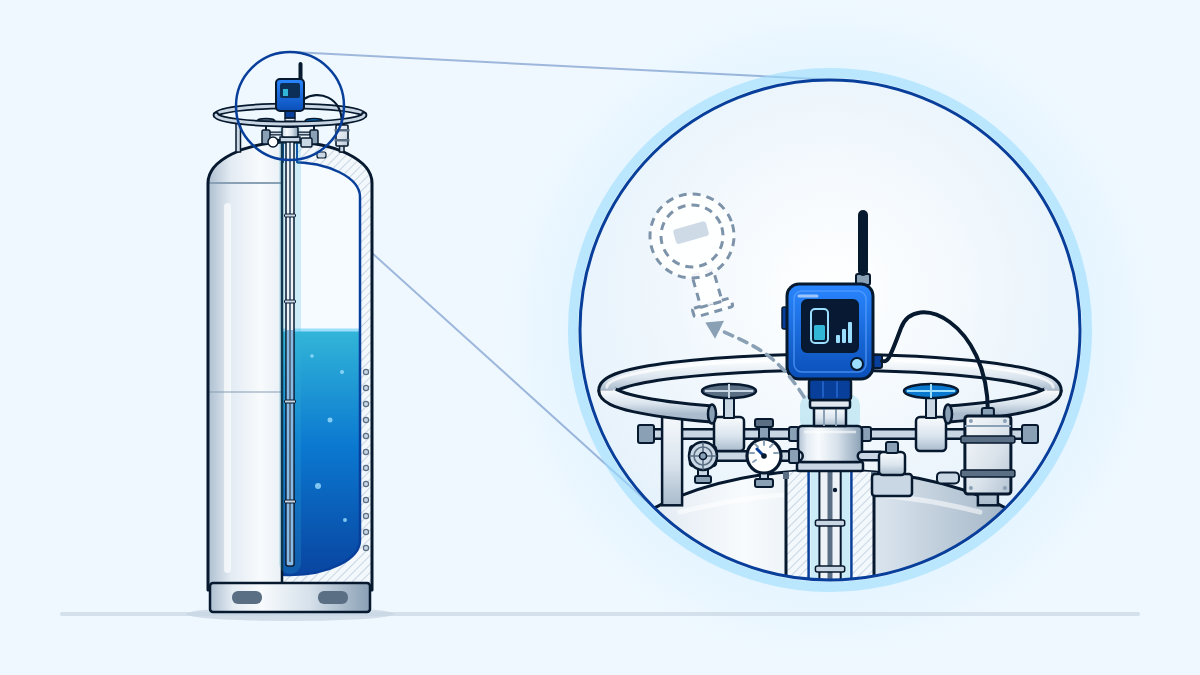
Many cryogenic liquid cylinder fleets have the same gap. The vessels are sound, many carry a working capacitive level probe, and an electronic level gauge shows the reserve to whoever stands next to the cylinder. Nobody can read it from the office, so the reserve is known only after someone walks the yard or a customer calls.
Closing that gap does not mean replacing the cylinder. The CryoFor TM2 module takes the place of the stock electronic level gauge, reads the probe already in the vessel and reports the level on a set schedule to the CryoFor Telemetry remote level and pressure monitoring platform. Pressure is reported as well once a separate pressure sensor is fitted. This guide covers what changes, what stays and what is checked before any proposal.
What stays on the cylinder and what changes
A liquid cylinder (DPL-type dewar) with an electronic level gauge has two parts that matter here: the capacitive probe inside the vessel, and the gauge head outside that turns the probe’s signal into a reading. A retrofit keeps the first and changes the second.
- Stays: the vessel, its capacitive level probe, its valves, relief devices and pressure gauge.
- Changes: the stock electronic (digital) level gauge head is replaced by the TM2 electronic unit, with a separate battery box and a 2.4 GHz antenna. Oxygen sites use a different arrangement, described under power and connection below.
- Can be added: a pressure sensor, for pressure readings as well as level. It is fitted separately and is not part of the TM2 kit.
One point is easy to miss. The stock gauge head shows the level on the cylinder itself, while a level readout on a TM2 unit needs the display option. The option is recorded in the unit’s passport.
How TM2 reads the probe already in the vessel
A capacitive level probe changes its capacitance as the liquid level rises and falls. TM2 takes that signal directly: its level input accepts a probe whose capacitance stays within 120–500 pF across the fill range. That range is the first thing checked on any cylinder model.
The signal is converted into a level using two reference points, 0% and 100%. At each fill, the fill event is registered and the calibration is recalculated. Density is set per gas. Level accuracy depends on the connected probe, the calibration and the density of the medium, so no single accuracy figure is quoted.
Pressure is a separate input. With a pressure sensor fitted and connected over I²C, TM2 reports pressure alongside level; without one, it reports level only.
Compatibility check before any proposal
Compatibility is checked per cylinder model before anything is quoted:
- The level probe. Its capacitance across the fill range (120–500 pF) and its insulation. On oxygen sites, the probe cable is checked as well.
- The gauge fitted today. An electronic gauge working from a capacitive probe, or only a float or dial gauge (see below).
- Pressure. Whether you need pressure readings and, if so, which pressure sensor is used and how it is fitted.
- Mounting and cables. Where and how the electronic unit, battery box and antenna are mounted. Mounting hardware and sensor cables are not part of the TM2 kit.
- Connection. 2.4 GHz Wi-Fi through a router where the cylinders stand, and whether an optional hub is needed where internet is unreliable. Hub availability is confirmed per project.
- Gas and site. The TM2 version for your gas and site is confirmed per project.
A practical start is a list of cylinder models with a clear photo of each gauge head and its label. Gauge types found on liquid cylinders are compared in liquid cylinder level gauge types.
Float or dial gauges: TM2 needs a capacitive probe
Some liquid cylinders have no electronic level gauge at all, only a float gauge or a dial. TM2 does not read float or dial gauges. It needs a capacitive probe within 120–500 pF across the fill range.
Fitting a capacitive probe to such a cylinder changes the vessel’s instrumentation and is agreed per project with the vessel manufacturer. In a mixed fleet, the cylinders that already carry a compatible probe are the natural place to start. Cylinders that leave the factory able to report their level are covered in smart cryogenic cylinder telemetry for manufacturers.
What you see after the swap
Once TM2 is reporting, typically every 15–30 minutes, each cylinder appears in the CryoFor Telemetry web console (on a desktop or phone browser) and in the Telegram bot and Mini App:
- Level, on a history chart with a marker at every fill and a run-out forecast;
- Pressure, where a pressure sensor is fitted;
- Battery voltage, reported every cycle.
Alerts cover low level, low battery, lost connection and, with a pressure sensor, high pressure, in the console and in Telegram. The fleet dashboard marks each vessel Critical, Warning or Normal and flags offline modules separately, so a silent module is not mistaken for a full cylinder.
For a distributor, levels at every customer site replace phone rounds, and run-out forecasts help schedule refills before they become rush deliveries. See liquid cylinder delivery planning and the views for gas distributors.
Power and connection
TM2 runs on its own Li-ion battery (3.7 V, 5.3 Ah) in a separate aluminum battery box, so no mains connection is needed at the cylinder. The battery is rated for at least 6 months per charge at a 30-minute reporting interval, a calculated rating under normal ambient conditions (25 ± 10 °C); shorter intervals mean shorter life. For charging, the battery box is disconnected and is not opened. The low-battery alert gives time to plan the charge.
The unit is intended for outdoor installation from −40 to +50 °C, with the battery box kept within −30 to +50 °C.
TM2 reports over 2.4 GHz Wi-Fi (IEEE 802.11 b/g/n) through the site’s router, using an external antenna. Short connection drops lose no readings: up to 12 unconfirmed packets stay queued and are re-sent when the link returns. A local hub that collects and buffers data from several modules is optional and not part of the TM2 kit; its availability is confirmed per project. Radio approvals are confirmed per destination market and project.
Oxygen sites use a dedicated version where only the probe and its cable stay at the vessel and the electronics and battery box are installed outside zones of possible oxygen enrichment. TM2 is not intended for classified explosive-hazard (Ex) zones.
What the retrofit does not change
- Valves, relief devices and gauges. The cylinder’s valves, relief devices and mechanical gauges and level indicators stay as they are. Where a pressure sensor is added, how it is fitted to the cylinder is agreed per project.
- Metering. TM2 is not a measuring instrument, is not subject to metrological verification and is not intended for commercial gas metering. Invoicing stays with your metering equipment.
- Filling. Cylinders are filled as before, and every fill shows on the chart.
What is in the TM2 kit
| Item | In the TM2 kit | Note |
|---|---|---|
| Electronic unit | Yes | Display is an option, recorded in the unit’s passport |
| Battery box | Yes | Li-ion 3.7 V, 5.3 Ah, separate aluminum box |
| 2.4 GHz antenna with cable | Yes | External antenna |
| Passport and operating manual | Yes | Documentation language confirmed per project |
| Capacitive level probe | No | On a retrofit, the cylinder’s own probe is used |
| Pressure sensor | No | Needed only for pressure readings |
| Mounting hardware and sensor cables | No | Specified per cylinder model |
| Local hub | No | Optional, availability confirmed per project |
New cylinders for the same fleet
The same check applies when you add cylinders. TM2 can be specified with new cylinders sourced per order, such as a vertical cryogenic cylinder or a horizontal 500 L cylinder, provided the chosen model carries a compatible capacitive probe. This is confirmed per order.
Common questions
Battery life, hubs, data access and supported gases are covered in the CryoFor Telemetry FAQ.
Will we still see the level at the cylinder after the swap?
A level readout on the cylinder itself needs the display option, which is recorded in the unit’s passport. Without it, the level is read in the web console and in Telegram. If your team reads the level at the cylinder today, say so when the order is specified.
How is TM2 calibrated after the gauge head is replaced?
The level is calculated from two reference points, 0% and 100%. At each fill, the fill event is registered and the calibration is recalculated. Setting the reference points follows the TM2 operating manual. Level accuracy depends on the connected probe, the calibration and the density of the medium.
Who installs TM2 on cylinders we already own?
Installation and setup follow the TM2 operating manual. Who fits the modules on your cylinders is agreed per project once compatibility has been checked. Mounting hardware and sensor cables are not part of the TM2 kit, so they are specified in the same check.
What should we send to have our cylinders checked?
For each cylinder model: the gas, the level gauge fitted today with a photo of the gauge head, whether you need pressure readings, and whether the sites have 2.4 GHz Wi-Fi. That is enough to start the compatibility check: which cylinders suit TM2, what else must be fitted and which need a compatible probe first.
Send your cylinder list
Tell us the gas, the cylinder models and the level gauges they carry today, and whether the sites have 2.4 GHz Wi-Fi. We will check compatibility first and say plainly which cylinders can report their level and what else they need. Send your cylinder details.