
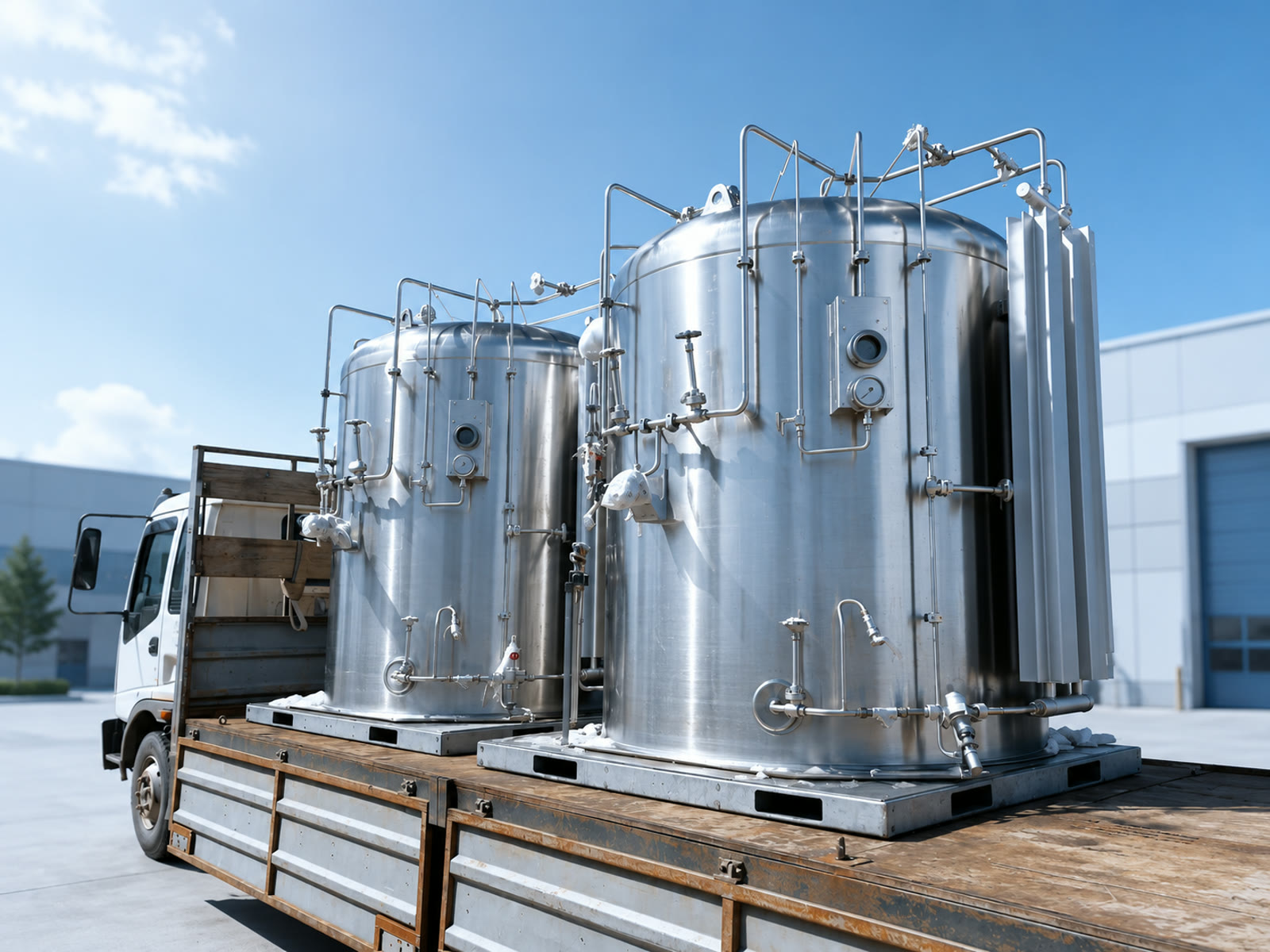
Thailand carries the broadest industrial base in mainland Southeast Asia: a food-export sector of global rank, the region’s automotive assembly hub, a petrochemical corridor on the eastern seaboard, and an electronics industry wired into world supply chains. All of it consumes industrial and cryogenic gases, and all of it needs storage tanks, vaporizers and cylinders that clear Thai requirements without improvisation. This page is the Thailand breakout from our regional guide to cryogenic equipment for Southeast Asia — the regional page explains the pattern across the whole bloc; this one stays on Thai ground.
Cryofortune Engineer & Supply Co., Ltd. is an international sourcing and engineering supplier. We work from a network of vetted Chinese manufacturers, matching each Thai order to the factory whose code scope, export record and documentation discipline fit the project. We are not a factory: the engineering coordination, manufacturer selection and document assembly are ours, while every certificate in the file belongs to a specific manufacturer, a specific model and a specific order — never to the Cryofortune brand. That distinction is not a formality; it is how pressure-equipment documentation works, in Thailand as everywhere else.
Equipment we source for Thai projects
The equipment scope for Thai buyers is configured to the order rather than pulled from a shelf. The core of it:
- Cryogenic storage tanks — vacuum-insulated vessels for liquid oxygen, nitrogen, argon and CO2, vertical or horizontal, sized to the site and its draw;
- Cryogenic vaporizers — ambient and heated units that turn stored liquid into process gas at the flow the plant actually pulls;
- Cryogenic liquid cylinders — portable vacuum-insulated cylinders for hospitals, laboratories, food plants and workshops that consume liquid in smaller lots;
- Industrial pressure vessels — buffer tanks and process vessels supplied alongside the cryogenic scope under the same documentation discipline.
Thai ambient conditions favor ambient vaporization — heat is rarely in short supply — but year-round humidity accelerates frost build-up on finned surfaces, so vaporizer sizing, switching arrangements and redundancy are decided against the site’s real duty cycle rather than a nominal rating. That sizing conversation happens at enquiry stage, before any manufacturer is committed.
The Thai regulatory layer
Thai oversight of industrial pressure equipment runs through more than one channel, and it helps to know which one is asking before the file is assembled. Factories operate under the Factory Act, administered by the Department of Industrial Works (DIW), which frames factory licensing and the machinery installed inside licensed premises. The workplace safety of boilers and pressure vessels falls under ministerial safety regulations, which require periodic inspection and certification by qualified engineers — an obligation that sits on the operator’s side and continues for the working life of the equipment.
In parallel, the Thai Industrial Standards Institute (TISI) maintains the national standards catalogue. Thai Industrial Standards are voluntary unless declared compulsory, and some product categories are compulsory: items in that scope must conform before they circulate on the Thai market. Whether a given tank, vaporizer or cylinder configuration falls inside compulsory TISI scope is confirmed at order time for the specific item — it is not a question a general page can settle in advance.
The division of labor is the same one that applies across the region. Statutory steps in Thailand — factory filings, qualified-engineer inspections, any compulsory-standard procedure — are performed by the buyer, the importer or a local representative. Cryofortune arranges the manufacturer documentation those steps consume; performing the statutory act itself is not our role, in Thailand or anywhere else.
Design codes and the document file
For imported cryogenic vessels, ASME Boiler and Pressure Vessel Code Section VIII is the design code Thai engineers most commonly see, and manufacturers in our network build to it routinely — our guide to ASME Section VIII covers what the code certifies and what it does not. Other code paths exist, and the acceptability of any particular route for a particular installation is confirmed against the project before production begins, not assumed from habit.
The file behind the vessel matters as much as the code on the nameplate, because it is what the operator-side engineer inspections draw on for years afterward: design documentation, material traceability, weld and non-destructive examination records, pressure test reports and the manufacturer’s data report. We assemble this file per order from the manufacturer that built the equipment — which is why the certificates name that manufacturer, and why a brand-level certificate detached from a model and an order would be worthless to the engineer reviewing it.
Where Thai demand sits
Thailand’s gas-consuming industries are unusually spread for a single market:
- Food processing — Thailand is a world-scale exporter of seafood and poultry, and freezing lines running liquid nitrogen or CO2 are core infrastructure; our page on liquid nitrogen food freezing covers the cryogenic side of that duty;
- Beverage and carbonation — a large domestic and export drinks industry keeps steady demand for liquid CO2 equipment, from storage tanks to carbonation supply;
- Automotive — Southeast Asia’s vehicle-assembly hub, where body shops and component plants consume welding and cutting gases at industrial scale;
- Electronics — nitrogen for inerting and assembly processes in a sector that ships globally;
- Petrochemicals — the Rayong corridor concentrates refining and chemical capacity, with the gas infrastructure that follows it;
- Healthcare — hospital oxygen systems, from bulk storage with vaporization to cylinder supply;
- Tourism-linked food and beverage — hotels, catering and cold-chain operators serving a visitor economy of global scale.
Operator files in Thailand are commonly kept in Thai. Where the buyer needs Thai-language documentation alongside the English manufacturer file, we arrange it per order.
The Eastern Economic Corridor
Much of the new demand concentrates in the Eastern Economic Corridor (EEC), the flagship development zone covering Chachoengsao, Chonburi and Rayong provinces on the eastern seaboard. The corridor runs under dedicated legislation and channels investment promotion toward targeted advanced industries — next-generation automotive, smart electronics, food processing and biotechnology among them — on infrastructure anchored by the Laem Chabang deep-sea port and the Map Ta Phut industrial port. For equipment buyers the practical reading is simple: EEC projects are commissioned on tight timetables, and the equipment file has to arrive complete the first time.
How the manufacturer is selected
Because we are a network rather than a factory, manufacturer selection is the decision everything else depends on. For a Thai order we shortlist against the code scope the project needs — ASME most often — the manufacturer’s export history into ASEAN markets, and, weighted above price position, documentation discipline: traceable materials, complete weld records, data reports that survive scrutiny from the engineer who signs the periodic inspection. The audit and selection method is described in how Cryofortune selects a manufacturer; the short version is that a factory unable to produce a clean file does not get the order, whatever its price.
Documents you receive
A Thailand order ships with the manufacturer’s documentation package assembled for the specific equipment: code documentation, material certificates, weld and NDE records, test reports, the data report, operating documentation, and Thai-language versions where arranged. The package feeds the buyer’s side of the process — the factory-level steps under the Factory Act, the qualified-engineer inspections under the safety regulations, and any compulsory-standard procedure that TISI scope turns out to require for the item. We stay available while those steps run: questions from a reviewing engineer are normal, and answering them from the manufacturer’s records is part of the service.
Start a Thailand enquiry
To scope a Thai project, send four things through the contact page: the medium (oxygen, nitrogen, argon, CO2 or another gas), the required capacity, the working pressure, and the province or site where the equipment will operate. We return a configuration proposal, a candidate manufacturer profile and the document scope for the order. If you are comparing markets or supplying across borders, the full set of market pages is indexed at cryogenic equipment by country.
Availability and applicability of any standard, certificate, marking or registration procedure are confirmed for the specific manufacturer, model and order before production.