A cryogenic tank imported into Brazil is judged twice. The first judgement happens at the port, where customs treats it as capital equipment like any other. The second happens at the establishment, where Brazilian regulation takes over the moment the vessel is installed, pressurised and put to work. That second judgement — under NR-13, Brazil’s regulation for pressure vessels in operation — is the one that determines whether the import was engineered correctly, and it turns almost entirely on records that can only be created at the factory, before the vessel ships.
Cryofortune Engineer & Supply Co., Ltd. is an international sourcing and engineering supplier, not a factory. As a cryogenic equipment supplier for Brazilian projects, we source tanks, vaporizers and vessels from a network of vetted Chinese manufacturers, match each order to a factory with the right code experience, and structure the fabrication records so the Brazilian operator’s side can meet its statutory obligations. Statutory compliance in Brazil is run by the buyer, the importer or their local representative; our role is to make sure the manufacturer’s documentation gives them everything that work requires.
This page covers the equipment we supply to Brazil, how NR-13 treats an imported vessel, which design codes Brazilian buyers specify, and what a properly documented order looks like. It is part of our country-by-country series on importing cryogenic equipment from China.
Cryogenic equipment we supply to Brazil
Brazilian enquiries concentrate on the storage and regasification side of the gas chain:
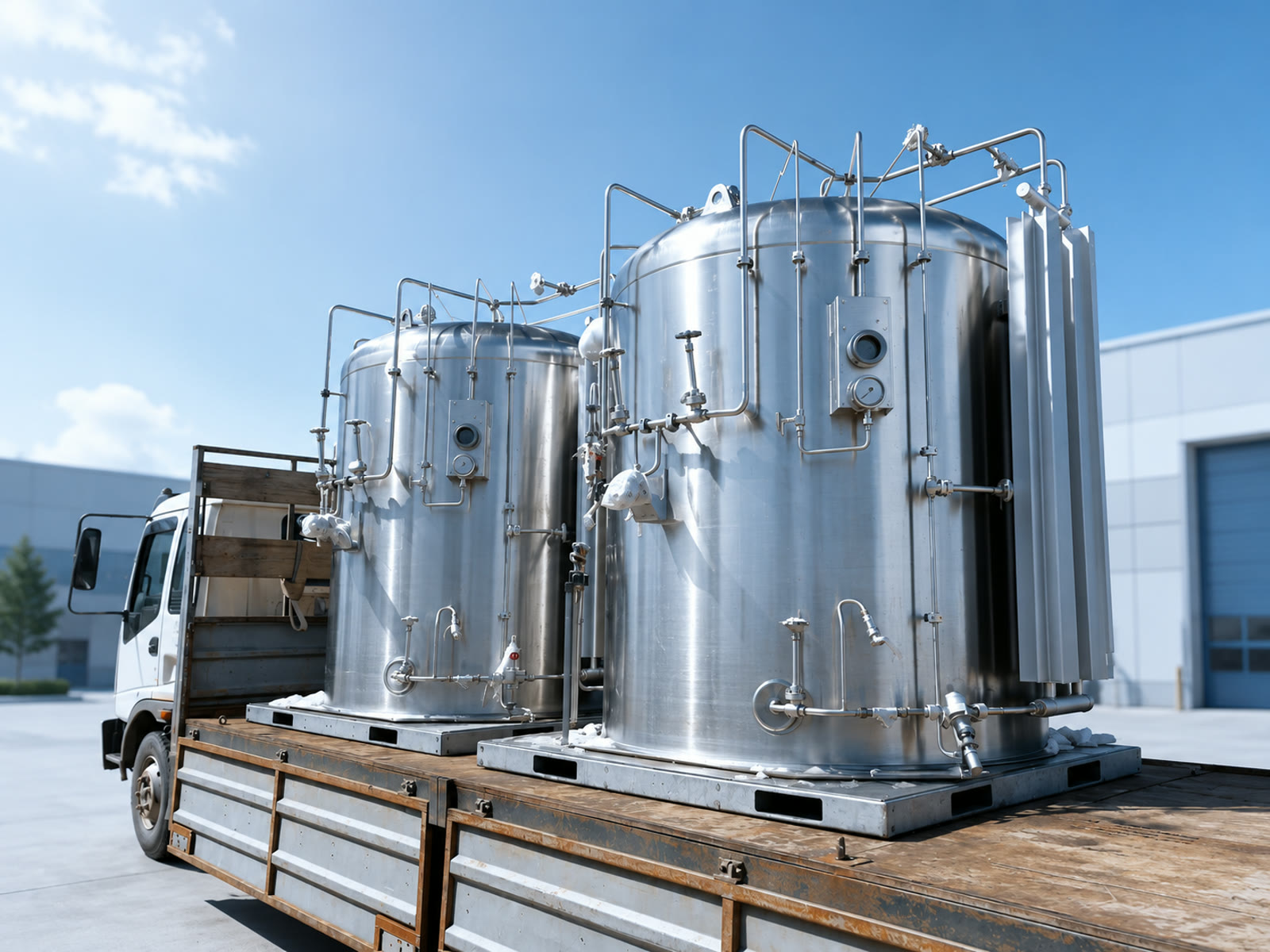
- Cryogenic storage tanks for liquid oxygen, nitrogen, argon, CO2 and LNG — vertical and horizontal, vacuum-insulated, from a few thousand litres to full site tanks;
- Cryogenic vaporizers and regasification skids — Brazilian climate conditions generally favour ambient-air vaporization for most of the year;
- Cryogenic liquid cylinders for distributed oxygen, nitrogen and CO2 supply;
- Liquid CO2 storage and recovery equipment — a large segment in Brazil, driven by beverage carbonation and food freezing;
- Custom pressure vessels — buffer tanks, separators and process vessels built to the buyer’s code and specification.
The demand behind these orders is broad-based: industrial gas producers and independent distributors; steel and metals plants running oxygen-intensive processes; food and beverage groups with CO2 and freezing loads; hospital and healthcare oxygen systems; and agribusiness cold-chain projects, from protein exporters to fruit processors.
NR-13: the layer that governs the vessel in operation
In Brazil, pressure vessels in service are governed by NR-13 (Norma Regulamentadora No. 13), one of the regulatory standards issued under Brazil’s labour-ministry framework. NR-13 is not a product-certification scheme; it is an occupational-safety regulation aimed at the establishment that operates the vessel. For vessels within its scope, it broadly requires:
- classification of the vessel into a hazard category, derived from the pressure–volume product and the class of fluid it contains;
- a safety documentation file for the vessel — the “prontuário” — holding the design and fabrication records: design code and data, drawings, material specifications, maximum allowable working pressure, test records and safety-device data;
- an indelible nameplate carrying data such as the manufacturer, serial number, year of build, maximum allowable working pressure, test pressure, design code and capacity, with the vessel’s category marked visibly;
- calibrated safety devices — relief protection set at or below the maximum allowable working pressure, and pressure indication;
- a Profissional Legalmente Habilitado (PLH) — a legally qualified professional, in practice a registered engineer — who takes technical responsibility for the vessel’s inspections and records;
- periodic internal and external inspections, at intervals that depend on the vessel’s category and on the establishment’s inspection regime.
The structural point for importers is this: NR-13 is an operation regulation. It does not certify foreign factories, and there is no Brazilian pre-approval of the manufacturer before shipment. Instead, the imported vessel must arrive with design and fabrication records complete and coherent enough for the operator’s PLH to constitute the prontuário and take responsibility for putting the vessel into service. A vessel that arrives with a thin or inconsistent data book is not stopped at the border — it simply becomes very difficult to commission at the establishment.
That is why we treat the documentation package, not the hardware, as the make-or-break element of an NR-13 pressure vessel import. The steel is rarely the problem; the file is.
Design codes and the documentation behind them
NR-13 expects a vessel designed and built to a recognised pressure-vessel code. For Chinese-built vessels heading to Brazil, ASME Section VIII is the most common basis — with a U stamp where the buyer or their engineering firm specifies it — and EN 13445 also appears in Brazilian specifications. Which code is appropriate, and whether any additional requirements apply on top of it, is confirmed case by case with the operator’s engineering side before production; we do not assume acceptance in advance.
Language matters more than buyers expect. The operator’s file lives in Brazil and is reviewed by Brazilian professionals, so Portuguese-language documentation is the practical expectation for at least the operation manual and the key vessel data. Manufacturer records are typically issued in English; translation of the items the operator’s file needs is arranged per order, and we structure the manufacturer’s documentation so that translation is a clean, mechanical step rather than a reconstruction.
The importer’s position: who does what
Responsibilities in a Brazilian order split cleanly. The buyer, the importer or their local representative runs the statutory side in Brazil: engaging the PLH or an inspection firm, constituting the prontuário from the manufacturer’s records, the inspection before start-up, safety-valve calibration under the local regime, and the ongoing inspection calendar. Cryofortune runs the sourcing side: manufacturer selection, specification control, fabrication and third-party inspection, and assembling the manufacturer documentation the Brazilian side will build its file from.
Customs itself is standard capital-equipment importation: entry through Brazilian ports, import duties and taxes per the current Brazilian tariff, cleared by the buyer’s customs broker. We prepare the commercial and technical export documents the broker needs and align packing and marking with the shipping route; duty planning and tax treatment stay with the buyer’s broker, who works from the current rules rather than a supplier’s assumptions.
Selecting the factory for a Brazilian order
Not every competent factory is the right factory for Brazil. When we place a Brazilian order with a manufacturer from our vetted network, the shortlist is filtered for:
- current ASME certification where a stamped vessel is specified, with real production history under the code — not a certificate on the wall;
- export track record to the Americas or other documentation-heavy markets, which predicts how the data book will actually look;
- documentation discipline: complete data books as standard output, traceable material certificates, and nameplates built to the order’s requirements;
- acceptance of third-party inspection during fabrication, including hold points the buyer’s side can attend or delegate.
The process behind this filtering is described in how Cryofortune selects a manufacturer. One principle from it bears repeating here: certificates belong to a specific manufacturer, model and order — never to a brand, and never to a trading company. When a Brazilian buyer is shown an ASME certificate, we make sure it is the certificate of the factory actually building their vessel, valid for the scope their vessel needs.
What ships with a Brazilian order
A Brazil-bound vessel leaves the factory with the records the operator’s PLH will need on the other side. Depending on the vessel and the specification, the package typically includes:
- design drawings and the vessel data sheet, stating the design code, design conditions and maximum allowable working pressure;
- strength calculations for the pressure envelope;
- material certificates traceable to the pressure parts;
- weld procedure and welder qualification records, and NDE reports;
- the pressure test report;
- safety-valve sizing, settings and certificates;
- nameplate data consistent with all of the above;
- the operation and maintenance manual;
- commercial and packing documentation for customs clearance.
How this package is scoped and verified per destination is covered in cryogenic equipment export certification. For Brazil, the test we apply is simple: could a PLH who has never spoken to the factory open this file and constitute the prontuário without writing a single follow-up email? If the answer is no, the package is not finished.
Start a Brazilian enquiry
The fastest route to a concrete proposal is to send the parameters that drive both the engineering and the documentation plan: the medium (oxygen, nitrogen, argon, CO2 or LNG), the capacity, the working pressure, the state of the site (new installation, replacement or expansion), and whether a PLH or engineering firm is already engaged on the Brazilian side. With those, we return manufacturer options from the network, a design-code recommendation, a documentation plan aligned to NR-13’s operator file, and a delivery estimate — through our contact page.
Availability and applicability of any standard, certificate, marking or registration procedure are confirmed for the specific manufacturer, model and order before production.