
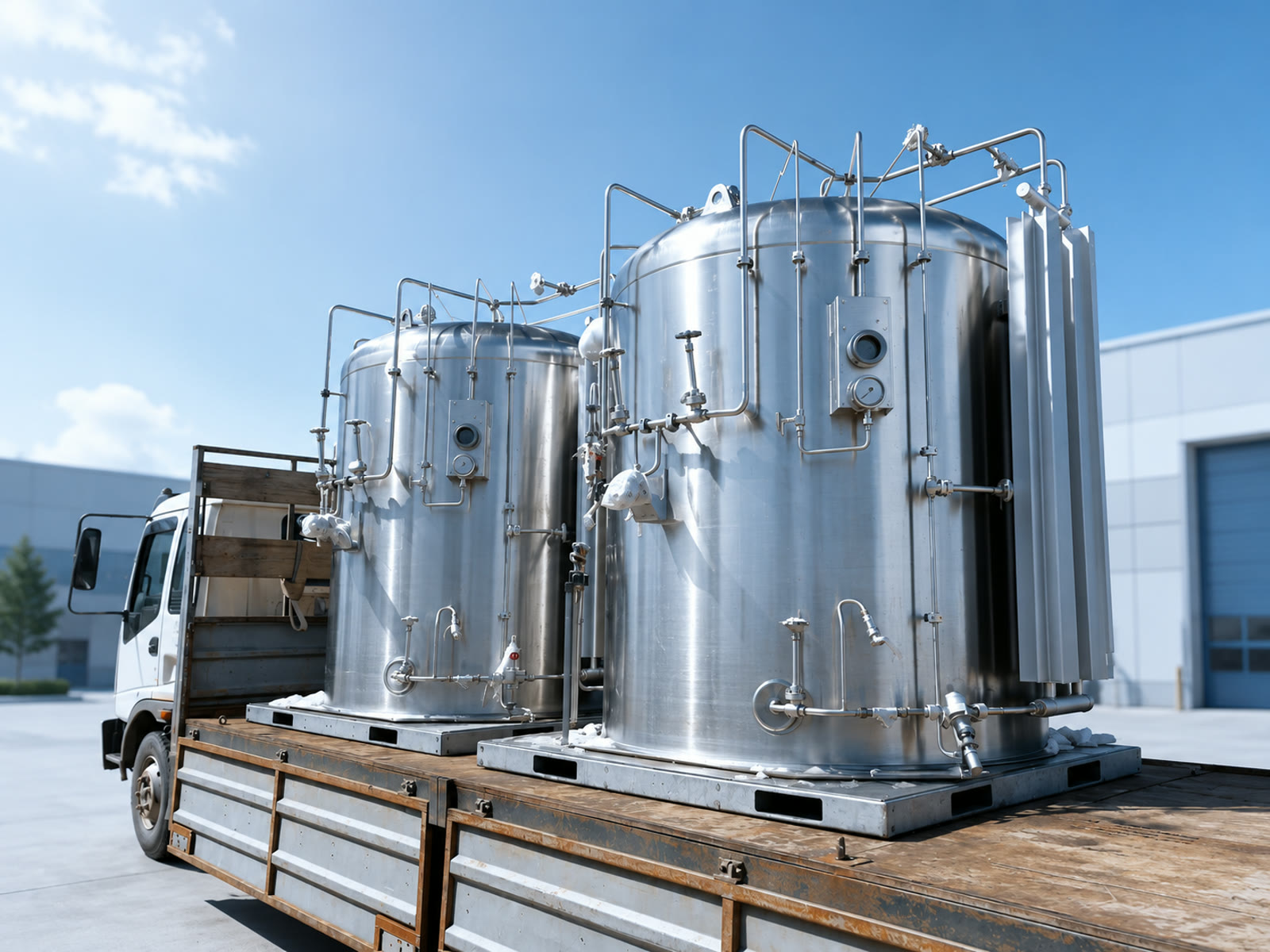
Cryogenic pumps move liquefied gases — liquid nitrogen, oxygen, argon and carbon dioxide — from storage vessels into cylinders, tanks and process lines. This page covers the two duties a pump serves, the catalog units we supply, selection by flow, pressure and media, and the pump’s place in a filling station.
Cryogenic transfer pump vs filling pump: one unit, two duties
A pump in a gas plant does one of two jobs. Transfer duty moves liquid between vessels at modest pressure — offloading a tanker, decanting into smaller vessels, or feeding a local cylinder. Filling duty raises the liquid to high pressure, so a downstream vaporizer can deliver gas at cylinder filling pressure. Reciprocating piston pumps are the usual choice for filling duty at small and mid-size plants.
Within the cylinder filling pump family, one base unit covers both duties: it is configured for transfer or filling service rather than offered as separate models.
The catalog unit: cylinder filling pump and skids
The Cryogenic Cylinder Filling Pump is a reciprocating pump and filling-skid family for liquid transfer and high-pressure cylinder filling. Catalog figures: flow 800–1,000 L/h, inlet pressure 0.3–0.8 MPa, discharge pressure 16–25 MPa, drive motors 7.5–11 kW. Media covered are LN2, LOX, LAr and liquid CO2; media compatibility is confirmed per order. Units are offered as a pump or as a packaged skid, depending on the station layout.
A second catalog line, the Cryogenic Liquid Pump, is a reciprocating plunger pump for LN2, LOX, LAr and liquid CO2 with a wider envelope: flow 50–5,000 L/h, maximum outlet pressure 16.5–35 MPa and drive power 4–75 kW. It covers flows below and above the filling-pump band.
Where the pump sits in a cylinder filling line
A high-pressure filling line follows one sequence: storage, pump, vaporizer, manifold. A vertical storage tank or vertical cryogenic cylinder holds the liquid and keeps suction pressure inside the pump’s inlet range. The pump raises the liquid to discharge pressure, and a cryogenic vaporizer converts it into gas; the vaporizer is selected to the line’s design pressure (catalog units up to 200 bar working pressure). A gas heater stabilizes outlet temperature where the duty calls for it. The gas then fills high-pressure cylinders at the manifold.
The pump is one component of a station, not the station itself; manifolds, metering and the overall layout are specified alongside it. CO2 stations have a dedicated walkthrough in the CO2 filling station setup guide.
Selection by flow, pressure and media
Four inputs define the duty, and each maps to a catalog figure or a configuration choice.
- Flow. Convert cylinders per shift into liters of liquid per hour and compare against the 800–1,000 L/h band. A station that outgrows the band moves to parallel pumps or to the Cryogenic Liquid Pump line, which runs up to 5,000 L/h.
- Discharge pressure. The target is set by cylinder service pressure plus a filling margin. Our seamless cylinders run 150–300 bar working pressure; the pump’s 16–25 MPa discharge band is matched against the fleet during configuration.
- Inlet pressure. The pump expects 0.3–0.8 MPa at suction. The supply vessel’s pressure-building circuit maintains this, so tank and pump are selected together.
- Media. Oxygen duty calls for oxygen-compatible, degreased wetted parts. Liquid CO2 runs at higher temperature than LN2, LOX or LAr and is configured separately; the CO2 filling station setup guide covers the CO2-specific line. State the media in your inquiry.
A step-by-step sizing method is set out in how to choose a cryogenic cylinder filling pump. Gas-by-gas equipment differences are summarized in cryogenic equipment by gas.
Cooldown, sealing and wear
The points below are general practice for reciprocating cryogenic pumps; the manual of the selected model governs, and wetted parts and seals are configured per gas at order stage.
- The cold end is cooled down with product liquid before start. Starting against a warm cold end produces vapor and unstable delivery.
- Adequate suction pressure prevents cavitation. Keep the supply vessel’s pressure-building circuit serviceable and the suction line short and insulated.
- Cold-end seals and piston rings are wear parts. Replacement intervals depend on media, duty cycle and cooldown discipline, and are stated per model.
- Oxygen service adds cleaning requirements for every part that touches the product. Spares for oxygen duty are handled as oxygen-clean items.
Standards and destination documentation
A pump skid carries a motor and pressure-bearing parts, so destination electrical and pressure-equipment rules may apply. Site voltage and frequency are confirmed per order. We do not make blanket certification claims; the manufacturing factory and the documentation package are selected per destination. The standards hub maps the common regimes, and the export certification guide explains how documents are assembled. Country-specific notes start with the Australia page, with further destinations added as they are published.
Specifying a pump
Configurations and documentation are confirmed for the specific manufacturer, model and order before production. Send a rough duty description — media, cylinders per shift, target filling pressure, supply vessel and site power — and we will return a pump or skid configuration with documentation scope.