
ASME Section VIII of the Boiler and Pressure Vessel Code is a design and construction code. It is not a legal regime, a conformity procedure or a marking scheme, although each of those may reference it. On the scale set out on the standards hub, it belongs to the first category: rules governing how a pressure vessel is engineered and built.
What ASME Section VIII covers
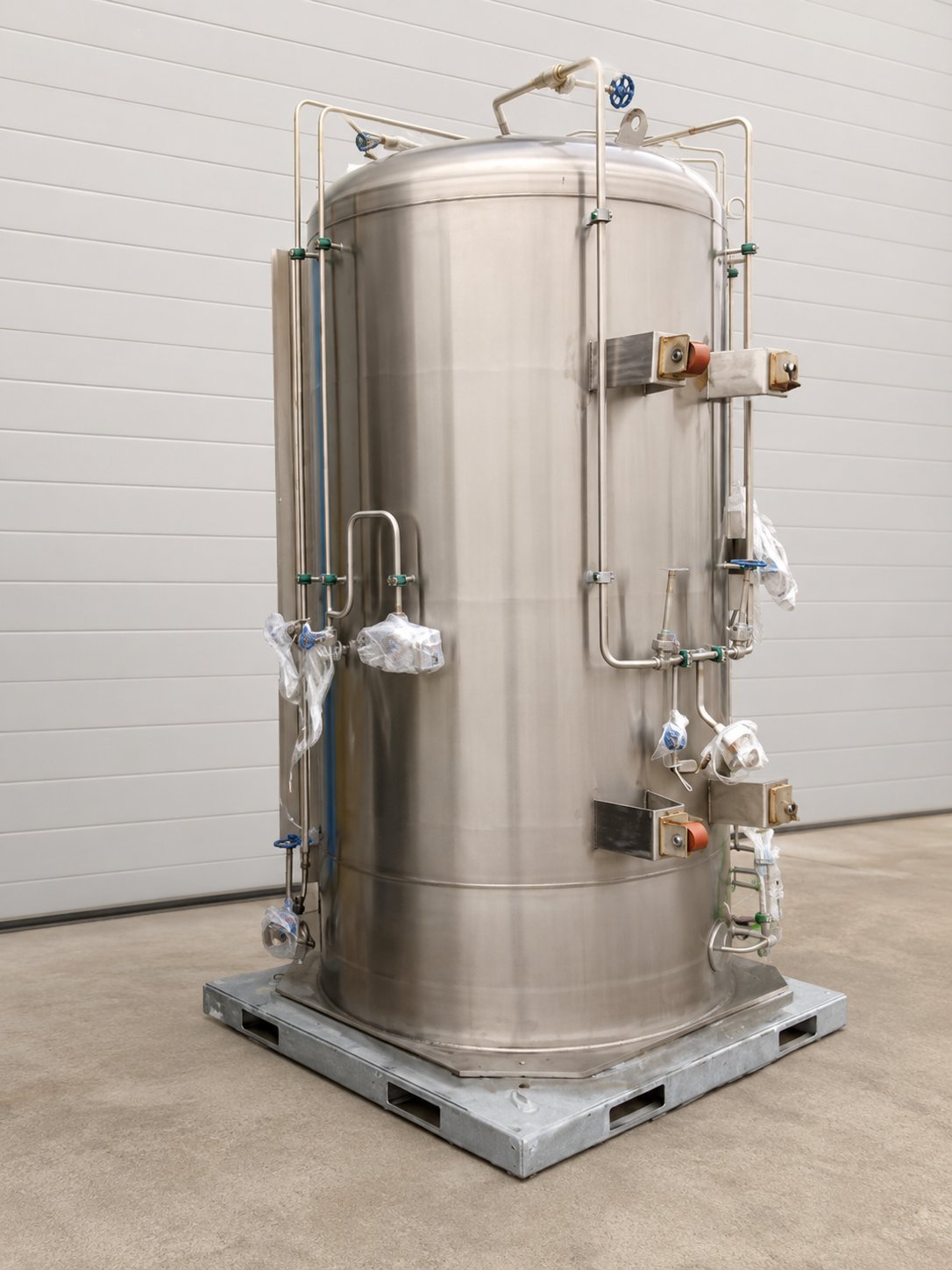
Section VIII sets rules for the design, materials, fabrication, examination, inspection, testing and certification of pressure vessels. Cryogenic equipment falls within its scope wherever the inner vessel or an attached pressure part qualifies as a pressure vessel. That can include vertical storage tanks, liquid cylinders and the vessels inside ISO tank containers, depending on configuration. In the United States and most Canadian jurisdictions, law commonly requires ASME construction for installed pressure vessels. Elsewhere, the code appears by buyer specification, or through national standards that accept it as an equivalent design basis.
ASME Section VIII Division 1 vs Division 2 (and Division 3)
The code is published in three divisions. Division 1 is design by rules: prescriptive formulas with conservative design margins. Most cryogenic storage vessels and liquid cylinders built to ASME are Division 1 vessels. Division 2 offers alternative rules with design-by-analysis options, permitting thinner walls in exchange for more engineering and examination. It appears in cryogenic work mainly on large or weight-sensitive projects. Division 3 addresses very high pressure vessels and is rarely relevant to cryogenic storage duties. Which division applies is a design decision, confirmed against the duty, not a grade of quality.
The U stamp: Certificate of Authorization and the U designator
A vessel may carry the ASME Certification Mark with the U designator — commonly called the U stamp — only if built by a Certificate Holder. The Certificate of Authorization is issued to a manufacturer for a named production site, after ASME reviews its quality system, and it is maintained through periodic joint reviews. Holding it also requires a standing agreement with an accredited Authorized Inspection Agency. The authorization belongs to the specific plant, not to a brand, a trading company or a country. A factory group may hold stamps at one site and not another; scope and validity are checked per order, not assumed.
The Authorized Inspector
ASME construction is third-party inspected as it happens, not audited afterwards. An Authorized Inspector, employed by the Authorized Inspection Agency and commissioned through the National Board, reviews the design documentation, attends agreed hold points during fabrication, and witnesses the pressure test. The vessel cannot be stamped, and the data report cannot be certified, without the inspector’s sign-off. For a buyer, this is the practical difference between an ASME vessel and a vessel merely “designed to ASME”: the former carries evidence of independent inspection during manufacture.
The Manufacturer’s Data Report and National Board registration
Every stamped vessel is documented on a Manufacturer’s Data Report — Form U-1 or, for single-chamber vessels, the shorter U-1A. It records the design conditions, materials, welding, examination and test data, and is signed by both the manufacturer and the Authorized Inspector. It functions as the vessel’s birth certificate and should be retained for the life of the equipment.
The manufacturer may also register the data report with the National Board of Boiler and Pressure Vessel Inspectors, which assigns an NB number shown on the nameplate. Many US states and Canadian provinces require National Board registration before a vessel may be installed; in Canada, provincial design registration under a Canadian Registration Number (CRN, per CSA B51) applies in addition — a separate statutory step that rests with the buyer or importer’s side of the project. A registered report remains retrievable from the National Board if the original is lost. Where the destination is North America, NB registration is normally specified at order stage; adding it later is difficult.
Materials and welding for cryogenic temperatures (Sections II, IX and V)
ASME construction pulls in the companion sections of the code. Materials conform to ASME Section II, with toughness requirements that matter directly at cryogenic temperatures — inner vessels are typically austenitic stainless steel for this reason. Welders and welding procedures are qualified to Section IX. Nondestructive examination follows Section V, with the extent of radiography tied to the joint efficiency used in design. These expectations shape cost and schedule, and they are visible in the documentation a factory can produce.
Where ASME vessels are accepted outside North America
An ASME vessel is not confined to North America. In Australia, AS/NZS 1200 recognizes ASME Section VIII among acceptable pressure equipment codes, alongside AS 1210; state plant-registration steps remain separate and rest with the importer, as outlined on the Australia page. In New Zealand, acceptance runs through design verification by a recognized inspection body under the PECPR Regulations, described on the New Zealand page. Inside the EU, by contrast, conformity is governed by PED 2014/68/EU and design more commonly follows EN 13445; an ASME-designed vessel does not carry EU market access by itself.
How Cryofor applies the code in factory selection
Cryofor supplies from a network of Chinese manufacturers. In China’s pressure-vessel industry, ASME Certificates of Authorization are held by individual plants for specific production sites — never by a brand or a network. Where the order requires ASME construction, a manufacturer holding a current U authorization at the producing site can be selected, with scope, Authorized Inspection Agency arrangement and National Board registration capability checked against the specific vessel. Cryofor arranges the supporting manufacturer documentation — data reports, material certificates, NDE records — while statutory steps in the destination country remain with the buyer or importer. The general approach is described in the export certification guide.
Availability and applicability of any standard, certificate, marking or registration procedure is confirmed for the specific manufacturer, model and order before production.
If ASME construction may apply to your project, send a rough duty description — media, capacity, working pressure and destination country — and the applicable division, stamping and registration requirements can be confirmed against specific factories.