South Africa runs the most mature industrial gas market in sub-Saharan Africa. Mines and smelters take oxygen, nitrogen and argon at scale; hospital groups operate bulk liquid oxygen installations; food processors, breweries and beverage plants draw liquid CO2 and nitrogen; and LNG is moving from discussion to procurement as gas-to-power and off-grid energy projects advance. All of it stands on the same physical layer: cryogenic storage tanks, vaporizers, liquid cylinders and the pressure vessels around them.
Cryofortune Engineer & Supply Co., Ltd. is an international sourcing and engineering supplier. We source cryogenic and gas equipment from a network of vetted Chinese manufacturers — we do not own a factory, and we say so plainly, because it is the honest description of how most of this equipment actually reaches Africa, and because it shapes how documentation works. Certificates belong to a specific manufacturer, a specific model and a specific order, never to a brand. Our job is matching your specification to the right workshop, holding that workshop to the design code your project requires, and assembling the manufacturer documentation your South African approval process will ask for.
That approval process is the part that punishes improvisation. South Africa regulates pressure equipment through its own national system, with its own categorisation logic and its own inspection bodies. A tank that ships with a full data book moves through that system as routine engineering; a tank that ships with a thin folder becomes a stranded asset on a quayside in Durban. This page maps the system and, more importantly, the sequence.
Equipment supplied to South Africa
Typical scope for South African buyers, each sourced against the code and documentation requirements of the specific order:
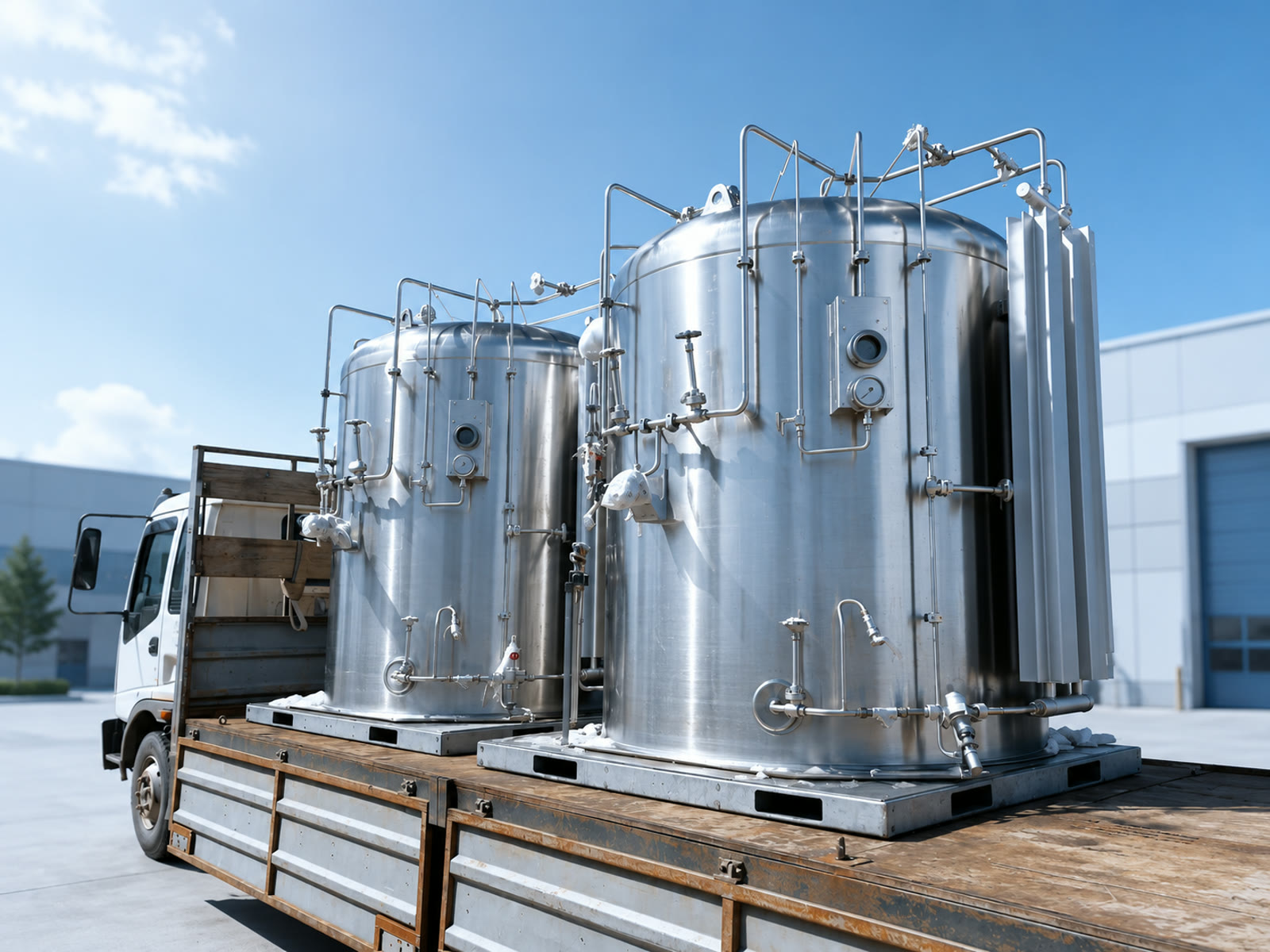
- Cryogenic storage tanks — vertical and horizontal vessels for liquid oxygen, nitrogen, argon, CO2 and LNG, commonly 3–200 m³, vacuum-perlite or vacuum-multilayer insulation, working pressure selected per application.
- Cryogenic vaporizers — ambient air vaporizers as the default choice, with water-bath and electric units where the flow profile or duty cycle requires them.
- Cryogenic liquid cylinders — 175 to 500 litre dewars for gas distributors, laboratories, clinics and food plants where a bulk installation is not yet justified.
- Pressure vessels — buffer vessels, CO2 storage and custom fabrications built to the code the contract specifies.
Load-shedding and the case for ambient vaporization
One South African operating reality deserves engineering attention rather than sympathy: the grid. Load-shedding turns any gas supply scheme that depends on continuous electricity into a calculated risk. On-site liquid storage with ambient vaporization is the counter — an ambient vaporizer is a passive heat exchanger that takes its energy from the surrounding air and needs no electricity at all, so a tank-plus-ambient-vaporizer installation delivers gas through an outage exactly as it does on any other day. Sites running power-dependent on-site generation increasingly hold liquid storage as backup for the same reason. It is not a marketing angle; it is a genuine argument for this architecture in this market.
The regulatory layer: OHS Act, PER and SANS 347
Pressure equipment in South Africa falls under the Occupational Health and Safety Act through the Pressure Equipment Regulations (PER). The regulations do not carry the technical machinery themselves; that sits in SANS 347, which provides the categorisation and conformity-assessment framework. Equipment is placed into hazard categories according to pressure, volume and the fluid it contains — an approach similar in spirit to the European PED, though the two systems are not interchangeable and South African category assignment is its own exercise.
The category matters because it drives the conformity route: what is reviewed, by whom, and how deeply. A small nitrogen buffer vessel and a 50 m³ oxygen tank do not travel the same path. We treat categorisation as an order-level question — category-dependent, confirmed per order with the parties actually performing the assessment — rather than something a supplier should assert generically on a web page.
Two structural points hold across categories. First, vessels are designed and built to a recognised health and safety standard — in practice most commonly ASME Section VIII, EN 13445 or PD 5500. Second, once the equipment is in service, inspection duties sit with the user or operator under the South African system. The import is the beginning of a compliance life, not the end of one, and the data book delivered at handover is what every future inspection refers back to.
Design codes and the Approved Inspection Authority
The design code is fixed by contract before fabrication. For South African orders the workable choices are ASME Section VIII, EN 13445 or PD 5500 — codes the South African framework recognises and South African engineers read fluently. Factories in our network build to ASME and EN routinely for export. What we screen out for South Africa is a domestic-code-only build with translated paperwork, because it gives the reviewing engineer nothing to anchor an assessment to.
Conformity involvement of an AIA — an Approved Inspection Authority — is part of the South African system. Depending on the category and the route agreed for the order, the AIA’s role can include review of design documentation and involvement in verification of the equipment; the exact scope is category-dependent and confirmed per order. The AIA relationship belongs to the buyer’s side, and that is precisely why sequencing matters: engage your AIA before production starts, agree what they expect to see, and we write those expectations into the manufacturing contract. An AIA consulted after the vessel lands can only tell you what should have been done differently.
Your position as importer
Statutory registration and approval in South Africa are carried out by the buyer, the importer or their local representative — not by Cryofortune and not by the manufacturer in China. This is not a limitation we apologise for; it is how the system is built, and pretending otherwise is how equipment gets stuck. What the foreign side owes you is manufacturer documentation deep enough for your AIA and your responsible engineer to work with, delivered in the sequence your approval route needs. Arranging that documentation is our half of the job; the process is described step by step in importing cryogenic equipment from China.
An imported cryogenic tank should arrive with the manufacturer data book — design calculations to the contract code, material certificates to EN 10204 3.1, weld procedure and qualification records, NDT reports, the pressure test record, nameplate details — plus the code certificate where one is ordered. With that package in hand, the South African steps run on the buyer’s side with their AIA. Without it, they do not run at all.
One further point, stated factually: South Africa often acts as the procurement hub for sub-Saharan projects, with equipment landed at Durban or Cape Town and on-shipped to mining and energy sites in neighbouring markets. If that is the plan, say so at enquiry stage. The final destination sets the documentation target, and a package assembled for a South African review is not automatically the right package for the next jurisdiction.
How the manufacturer is selected
We are a supplier with a network, not a factory with a sales office, so the manufacturer is chosen per order rather than defended by default. For South Africa the shortlist filters are concrete: proven builds to the contract code, with the certification to show for it; oxygen-cleaning practice with records where the service is oxygen; welding and NDT capability matching the hazard category; export packing that survives ocean freight; and willingness to host third-party inspection during fabrication. Because certificates attach to a specific manufacturer, model and order, we verify them for the actual workshop and the actual vessel — never by pointing at a brand name. The full method is documented in how Cryofortune selects a manufacturer.
Documents that travel with the order
A South African order typically ships with:
- Design calculations and general-arrangement drawings to the contract code;
- Material certificates to EN 10204 3.1 for pressure-bearing parts;
- Weld procedure specifications, procedure qualification records and welder qualifications;
- NDT reports and the pressure test record;
- Cleaning-for-oxygen-service certificate where the medium requires it;
- The code certificate for the vessel, as ordered;
- Commercial set: invoice, packing list, bill of lading, certificate of origin.
Where the buyer’s AIA specifies the content or format of the data book, we pass that requirement to the manufacturer as a contract term before fabrication begins. The cheapest moment to secure any document is before the vessel exists; the most expensive is after it clears customs.
Request a quotation
To start, send five facts: the medium (oxygen, nitrogen, argon, CO2 or LNG), the capacity, the working pressure, the site — including whether the equipment stays in South Africa or moves onward — and whether an AIA is already engaged. We return a proposed configuration, a factory shortlist from the network and a document plan sequenced against your approval route. Reach us through the contact page; other markets are covered in cryogenic equipment by country.
Availability and applicability of any standard, certificate, marking or registration procedure are confirmed for the specific manufacturer, model and order before production.