
Can pressure history help identify which cryogenic cylinders deserve a closer look, without connecting a vacuum gauge to every vessel? It can support preliminary screening—provided the operating conditions are understood. A pressure trend alone does not measure vacuum quality.
One day of operation, two useful signals
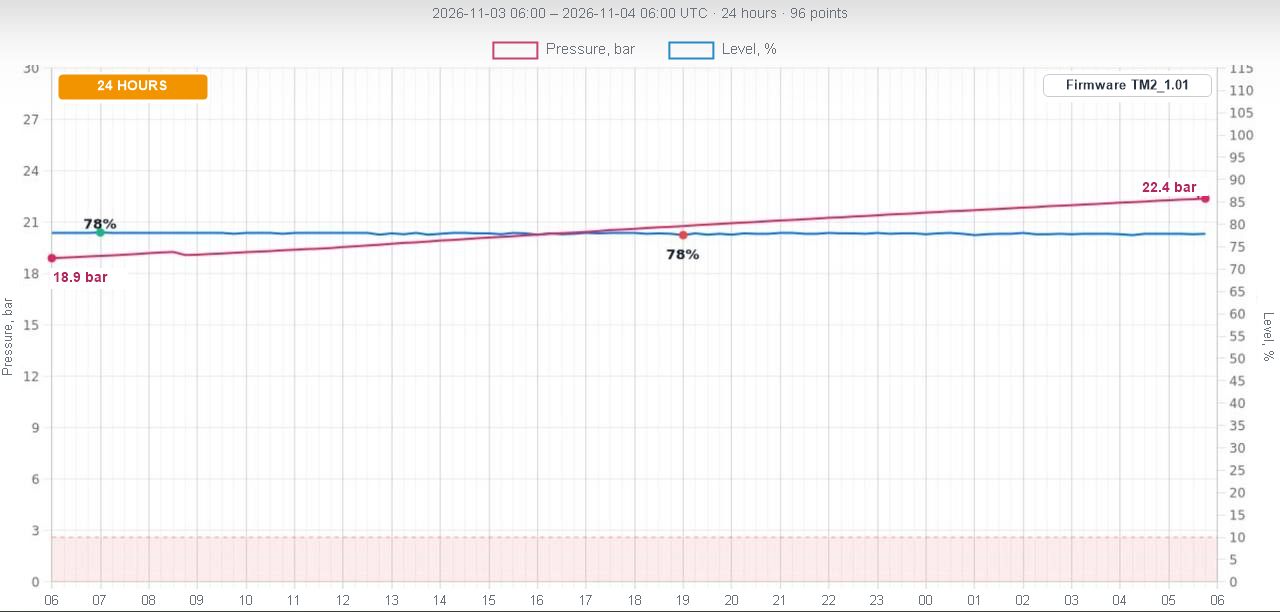
- Pressure: 18.9 → 22.4 bar over 24 hours.
- Displayed liquid level: approximately 78% throughout the interval.
- Average pressure rise: about 0.146 bar per hour for this example.
The increase is 3.5 bar. Dividing it by 24 hours gives an average for this record, not a diagnostic threshold. The chart alone cannot establish whether this cylinder’s behaviour is normal. A nearly unchanged level reading also does not prove that no liquid evaporated or that no operating events occurred.
Pressure can rise with healthy insulation
Vacuum insulation reduces heat ingress; it does not eliminate it. Heat entering the vessel changes the state of the liquid and vapour and can increase internal pressure. Pressure also depends on the product, filling level and thermal condition. Recent filling, product withdrawal, venting and pressure-building equipment can change the trend.
Compare like with like
For useful screening, compare each cylinder with its own established history and with similar vessels under comparable conditions:
- The same stored fluid and comparable model, geometry and equipment configuration.
- Similar filling level and starting pressure.
- Comparable ambient conditions and time allowed to settle after filling.
- Periods where filling, withdrawal, venting, relief-valve operation and the pressure-building circuit do not explain the change.
- Reliable pressure and level readings, with sensor condition and calibration considered.
Use suitable periods from normal operation. This analysis does not require disabling safety devices or changing the manufacturer’s operating procedure.
From an unusual trend to a planned service queue
- Find a repeatable deviation. Look for a change against a cylinder’s baseline or comparable peers, rather than judging one isolated interval.
- Check the context. Review operating events, filling history and sensor data before assigning a service priority.
- Arrange a targeted inspection. A qualified service team determines the cause using the manufacturer’s diagnostic procedure. Vacuum deterioration is one possible cause, not the only one.
- Plan confirmed work. Where a repair is needed, schedule the return, inspection and any confirmed vacuum restoration. Establish a new baseline after service.
Applied across a fleet, this approach can help spread routine diagnostic work over time, keep healthy cylinders in service and make workshop loading more predictable. Conditions requiring immediate action must still follow the manufacturer’s safety instructions.
How TM2 can support this workflow
TM2 records liquid-level history; pressure history requires an additional pressure sensor. A service team can use these histories together with operating records for further analysis. Maintenance priorities require engineering review, and vacuum condition must be confirmed by a dedicated inspection.
Considering telemetry for your fleet? Tell us the cylinder models, approximate quantity, current level gauges and whether pressure sensors are fitted. We can discuss the monitoring scope and the data needed for a useful pilot.
Technical background: Chart Industries liquid-cylinder product manual; Research on heat-leak evaluation by self-pressurization.