Turkey reads the CE mark natively. Industrial goods circulate between Turkey (Türkiye) and the European Union inside a customs union, and Turkish technical legislation has been aligned with the EU directives behind that trade — pressure equipment is regulated under a Turkish transposition of the Pressure Equipment Directive, so a CE-marked cryogenic tank arrives speaking the right regulatory language. What changes at the border is procedure, not philosophy: Turkey operates risk-based import conformity checks on regulated industrial products, and the operator’s documentation is expected to work in Turkish. An order for Turkey is built around both of those local layers from the start.
Cryofortune Engineer & Supply Co., Ltd. is an international sourcing and engineering supplier, not a factory. Each order is matched to a vetted Chinese manufacturer in our network whose certification, design codes and documentation fit the destination — for Turkey, normally the CE route, with ASME available where a project specifies it. This page covers the equipment we supply to Turkish buyers, how the conformity, import and operation layers fit together, and what we need to price a configuration. The overall process is described step by step in our guide to importing cryogenic equipment from China.
Equipment supplied to Turkish buyers
Turkish demand for imported cryogenic equipment concentrates where cryogenic media meet production: steel plants consuming oxygen and argon, shipyards and fabrication shops running welding and cutting gases, food and beverage processors freezing and carbonating with nitrogen and CO2, and independent gas distributors building out storage at customer sites. The supply scope for Turkey covers:
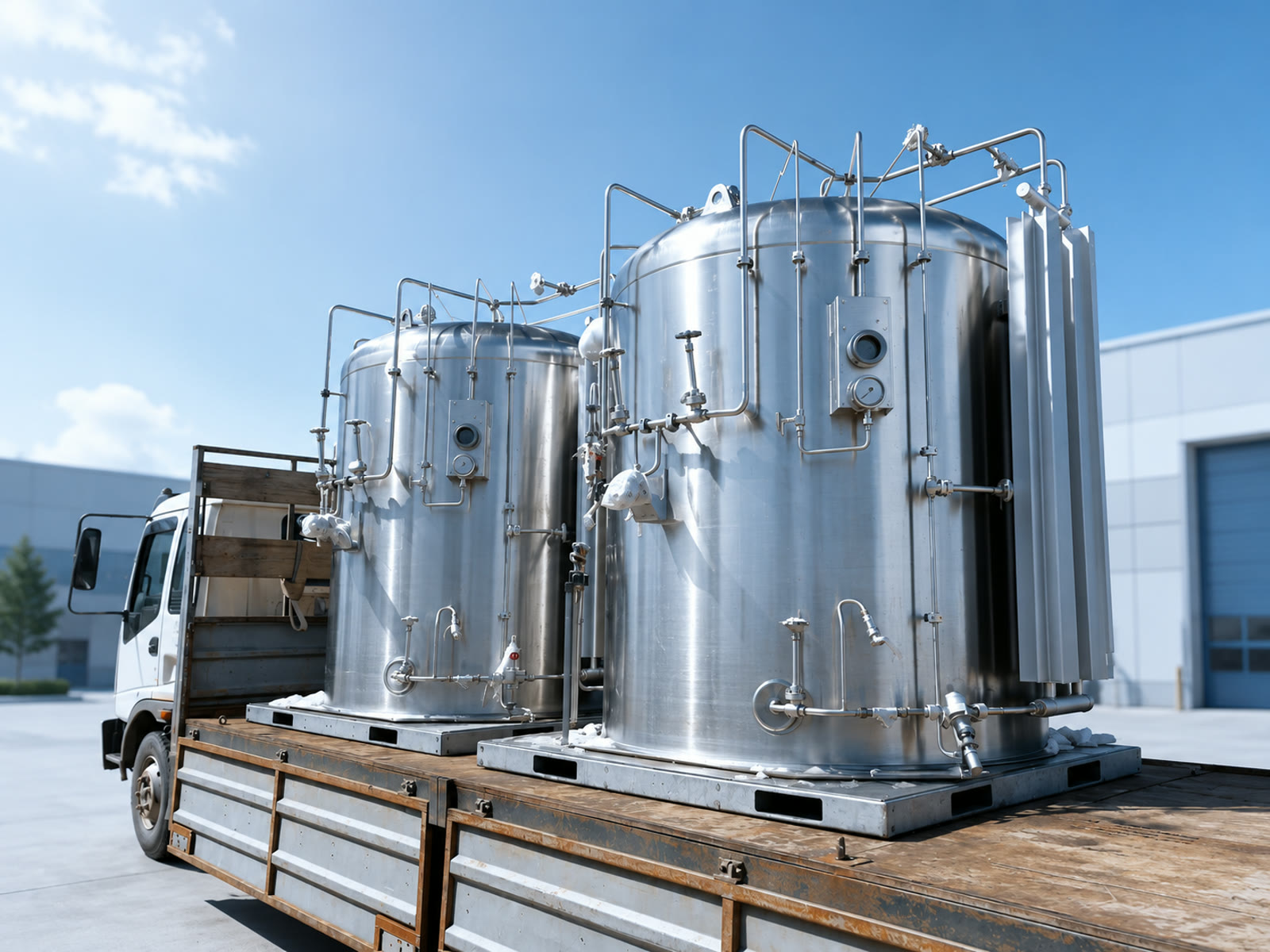
- Cryogenic storage tanks — vertical and horizontal vacuum-insulated vessels for liquid oxygen, nitrogen, argon and CO2 service, from compact site tanks to bulk storage;
- Cryogenic vaporizers — ambient-air units and skids that turn stored liquid into process gas at the flow and pressure the site requires;
- Cryogenic liquid cylinders — palletized dewars for sites that need liquid supply without a fixed tank;
- Pressure vessels — buffer and process vessels for compressed-gas duty;
- Liquid CO2 equipment — storage, pumping and supporting hardware for carbonation, inerting and dry ice production.
Configurations are engineered per order rather than pulled from a shelf: medium, capacity, working pressure and vaporization duty drive the design, and the destination drives the code and the paperwork.
The conformity layer: a Turkish transposition of PED
The customs union between Turkey and the EU covers industrial goods, and alongside it Turkey has harmonised its technical rules with the EU legislation that governs them. For pressure equipment, the operative framework is a Turkish transposition of PED 2014/68/EU: the same classification of equipment into conformity categories, the same assessment modules, notified-body involvement rising with the category, and the CE marking with a declaration of conformity at the end. A cryogenic tank assessed for the EU market has been measured against essential safety requirements that Turkey applies, in substance, as its own.
In practice this means the engineering route for a Turkish order looks European. Design and fabrication follow harmonized standards — EN 13445 for unfired pressure vessels among them — under a module certified by the manufacturer’s notified body. How the categories, modules and markings work is set out on our PED 2014/68/EU page.
ASME construction also appears in Turkey, typically on energy and industrial projects whose specifications were written around American codes. An ASME Section VIII vessel does not automatically satisfy the CE route, and a CE-marked vessel is not an ASME one; where a project sits between the two, the applicable route is confirmed for the specific manufacturer and order before production.
The import layer: risk-based conformity checks at the border
The layer that most distinguishes Turkey from an EU member state is what happens at customs. Turkey operates risk-based import surveillance over regulated industrial products: consignments are registered in an electronic conformity system — TAREKS, operated with the involvement of the Turkish Standards Institution (TSE) — and, depending on risk profile, may be released on declaration or selected for document review or physical inspection. For CE-regulated goods, a check typically looks at the marking itself, the declaration of conformity, supporting test evidence and labelling before the consignment is released into free circulation.
Whether a specific consignment is subject to these checks, and what a reviewer asks to see, depends on the tariff classification and the surveillance regime in force at the time of import. Those statutory steps belong to the Turkish importer and their customs broker; Cryofortune does not act in the Turkish import procedure. What we do is confirm the expected treatment with the buyer’s broker at order time and arrange the manufacturer’s documentation package so that a document review finds what it is looking for on the first pass.
The second local expectation is language. Products placed on the Turkish market are generally expected to carry Turkish-language user instructions and safety labelling, and the operator’s file works better in Turkish. Translation and any statutory filings sit with the buyer or their local representative; on our side, the manufacturer’s manuals, drawings and certificates are assembled in clean English so that translation is a formatting exercise rather than an investigation.
The operation layer: periodic controls in service
Once installed, a cryogenic tank becomes work equipment under Turkish occupational health and safety legislation, and pressure installations are among the equipment subject to periodic controls carried out by authorised persons and inspection bodies. The scope and frequency of those controls are set by the Turkish regulations in force and are confirmed locally by the operator — we do not quote intervals from abroad. What the inspection environment consistently needs is the vessel’s documentation: design data, test certificates, the declaration of conformity and the instructions. That is why the documentation package is treated as part of the equipment rather than an afterthought.
Where Turkish demand comes from
Turkey is one of the world’s major steel producers, and steelmaking is a structural consumer of oxygen and argon — which keeps liquid storage and vaporization capacity in demand around mills and metal-processing clusters. Shipbuilding and a broad metal-fabrication base draw welding and cutting gases; food and beverage processing uses nitrogen for freezing and CO2 for carbonation; and the growing use of LNG in Turkish energy supply keeps cryogenic competence spreading through the industrial landscape.
Structurally, much of the Turkish market is served by gas distributors that install tanks at customer sites and sell gas under supply contracts — and Turkish distributors actively import Chinese equipment. Cryofortune supplies that side of the market as well as end users who prefer to own: the same tanks and the same documentation discipline, under a different ownership model.
Selecting a factory for a Turkish order
Not every manufacturer in the network is a fit for Turkey. A Turkish order on the CE route is matched to a factory that holds valid PED certification under the module and category the vessel requires, keeps its notified-body relationship in good standing, and produces EN-based design documentation that survives a border document review. Where a project specifies ASME, the match is a factory with the corresponding ASME programme. Certificates belong to a specific manufacturer, a specific model and a specific order — never to a brand — and we verify their scope and validity before contract, following the process described in how Cryofortune selects a manufacturer.
Documents that can accompany a Turkish order
The typical documentation scope for a CE-marked cryogenic tank bound for Turkey:
- Declaration of conformity issued by the manufacturer, referencing the applicable pressure-equipment rules and the module applied;
- CE marking and nameplate data consistent with the declaration;
- Notified-body certificates corresponding to the conformity module;
- Technical documentation — design drawings, calculations and the equipment data sheet;
- Material certificates for pressure-bearing parts;
- Welding, NDT and pressure test records;
- Operating and maintenance instructions, prepared so they can be translated into Turkish.
The same package serves twice in Turkey: it answers an import document review, and it seeds the operator’s file for periodic controls. The exact scope is confirmed per manufacturer, model and order.
Confirming a Turkish configuration
A quotation for a cryogenic tank bound for Turkey starts from five facts: the medium (oxygen, nitrogen, argon or CO2), the capacity, the working pressure, the site province, and whether the project expects CE or ASME construction. With those five, we shortlist manufacturers in the network, check certification scope against the order, and return a configuration with its documentation plan. Send them through the contact page; if you are comparing several destination markets, the rest of the series is collected under cryogenic equipment by country.
Availability and applicability of any standard, certificate, marking or registration procedure are confirmed for the specific manufacturer, model and order before production.