
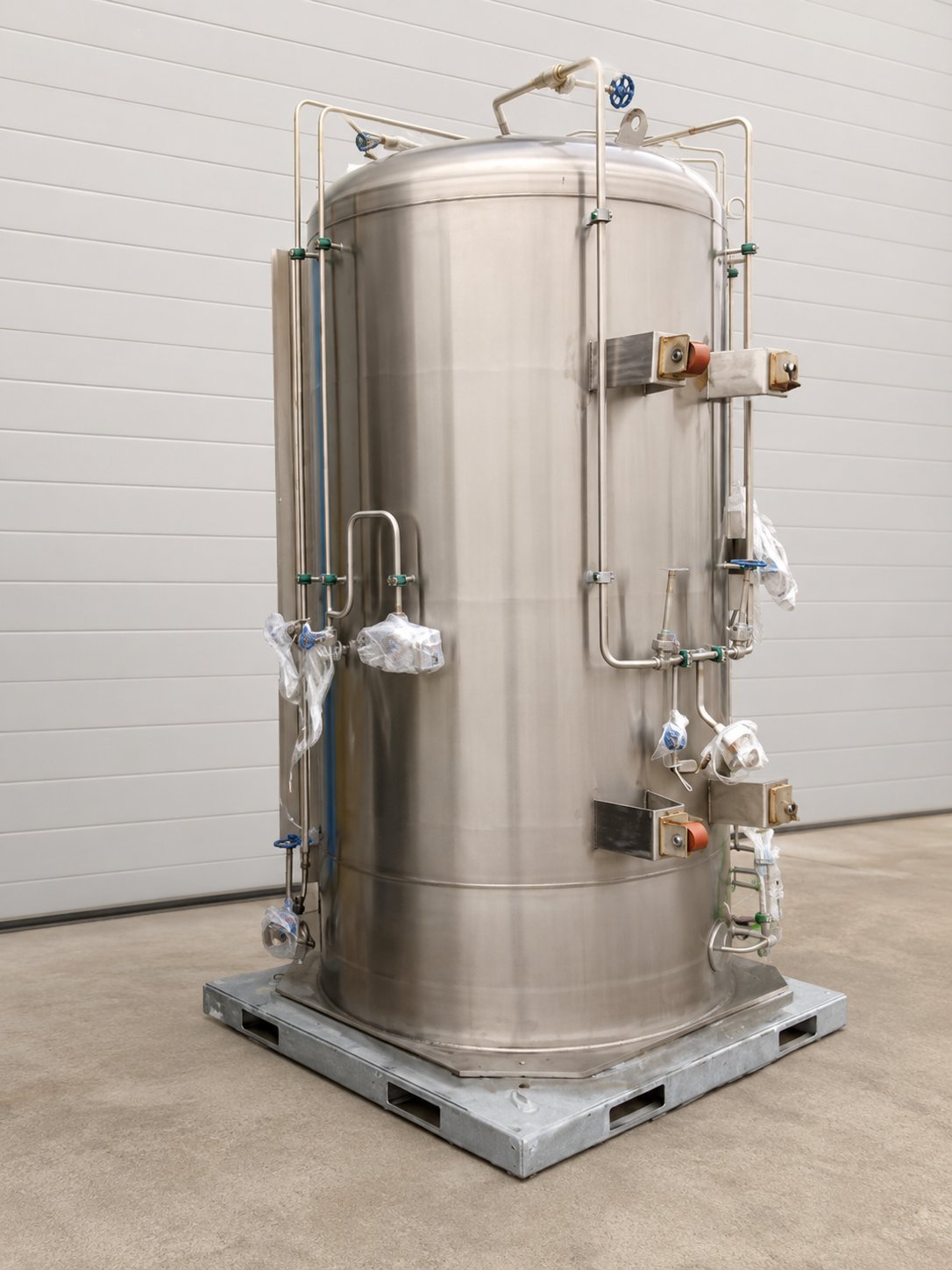
CE marking is a marking — the visible outcome of a conformity assessment carried out under one or more pieces of EU legislation. It is not a certificate, not a quality label, and not evidence that an authority tested the product. Within our standards and procedures reference, design standards, legal regimes, assessment procedures and markings are kept as separate concepts. CE belongs to the last group, and this page treats it as such.
What CE on a cryogenic tank attests
By affixing CE, the manufacturer declares that the equipment conforms with every EU harmonisation regime applying to it. For a static vacuum-insulated vessel such as a vertical cryogenic storage tank, the governing regime is normally the Pressure Equipment Directive (PED). PED places the vessel into a category based on pressure, volume and fluid group, and that category determines the conformity assessment modules. Design to a harmonised standard such as EN 13445 can support a presumption of conformity, though other design routes remain permitted. Equipment falling under sound engineering practice, below Category I, must not carry CE under PED — absence of the mark there is correct, not a defect.
An ASME Section VIII stamped vessel sits under a different regime entirely. The U stamp does not substitute for CE, and CE does not substitute for the stamp.
The EU declaration of conformity
The EU declaration of conformity (DoC) is the document that stands behind the mark. It identifies the product, the legislation applied, the standards or specifications used, the assessment module, and the notified body where one was involved. The manufacturer draws it up and retains it with the technical documentation for ten years after placing the equipment on the market. A buyer can reasonably request a copy before shipment, together with the module certificates the DoC references. The mark on the nameplate is a claim; the DoC is where the claim becomes checkable.
The notified body number
Where a notified body took part in production-phase conformity assessment, its four-digit identification number appears next to the CE mark. Under PED this involvement is required from Category II upward, so most cryogenic storage vessels of commercial size carry a number. The number identifies a specific body, which can be looked up in the EU’s NANDO register of notified bodies. A CE mark with no number on equipment that plainly needs third-party assessment is a document-review flag, and is checked before order.
Who affixes the CE mark
The manufacturer affixes CE, before the equipment is placed on the EU market. The notified body does not affix it, no authority affixes it, and Cryofortune does not affix it. Where an order requires CE, a manufacturer operating the relevant PED modules can be selected from the network, and that factory marks the equipment as manufacturer of record. Statutory steps in the destination country remain the buyer’s or importer’s; Cryofortune arranges the supporting manufacturer documentation.
Common CE marking misconceptions
- “CE certified.” The phrase is loose. There is no CE certificate as such — there may be module certificates, such as an EU-type examination certificate, but the mark itself is the outcome of a declared assessment, not a certificate.
- CE means authority-tested. It does not. For lower categories, assessment can rest largely on the manufacturer’s internal production control, with no third party involved.
- The “China Export” mark. No such mark exists. The European Commission has stated it is not aware of any China Export marking; oddly proportioned logos are simply non-compliant CE marks. The sober response is document review, not logo geometry — ask for the DoC and verify the notified body number.
Pi marking for transportable cryogenic cylinders
Transportable receptacles — repeatedly filled liquid cylinders, cylinder bundles, closed cryogenic receptacles — fall under the Transportable Pressure Equipment Directive (TPED), not PED. TPED uses the π (Pi) marking, with conformity assessed against the ADR and RID transport rules rather than PED modules. A transportable liquid cylinder may therefore carry Pi where a static tank carries CE; open dewars (open cryogenic receptacles) are excluded from TPED scope. Tank containers in international multimodal service follow their own approval route, outlined in the ISO tank container guide. Which marking a given receptacle needs depends on how it will be used and moved, and is confirmed per order.
UKCA in Great Britain
After leaving the EU, Great Britain introduced the UKCA marking as its own conformity marking, administered under GB regulations that mirror much of PED. For pressure equipment, UK legislation now provides for continued recognition of CE marking on the GB market without a stated end date, so CE-marked equipment can currently be placed there. Recognition terms can change, and the applicable route is confirmed at order stage.
What to ask for when buying CE-marked equipment
Four items make a CE claim checkable, and all four are ordinary requests to a manufacturer:
- the EU declaration of conformity, naming the equipment and the legislation applied;
- the PED category the vessel was assessed under;
- the conformity assessment module or modules used;
- the notified body’s name and four-digit number, matching the nameplate.
Cryofortune collects these from the selected factory as part of packaged supply, alongside the wider document set described in the export certification guide. Send a rough duty description — media, volume, working pressure, destination country — and we return which markings may apply and which documentation the factory provides. Availability and applicability of any standard, certificate, marking or registration procedure are confirmed for the specific manufacturer, model and order before production.