
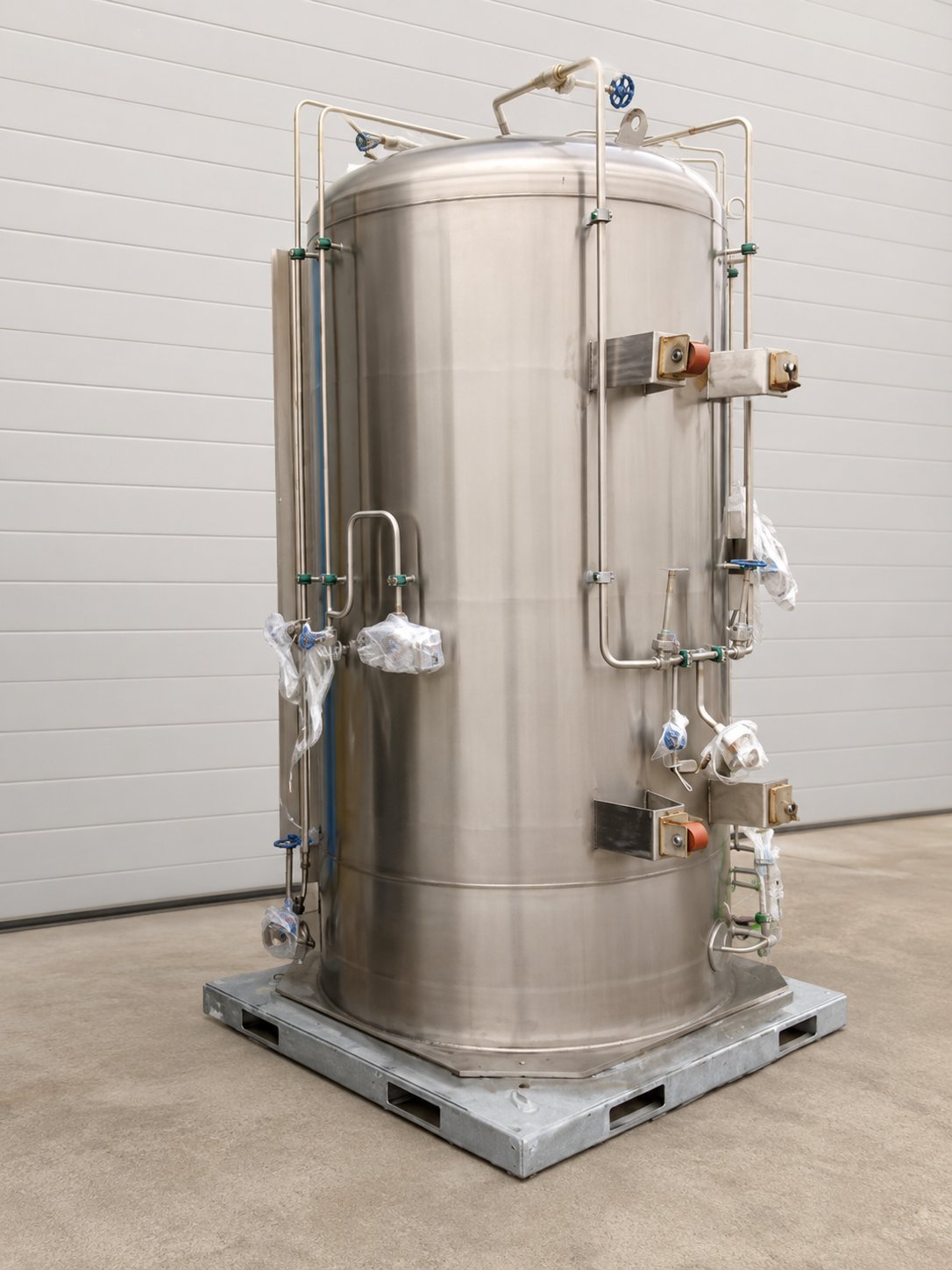
A Canadian Registration Number (CRN) is a registration — a number issued by a Canadian provincial or territorial authority confirming that a specific pressure equipment design has been reviewed and accepted for use in that jurisdiction. It is not a design code, not a conformity marking and not a certificate held by a company in general. A CRN attaches to a design: a particular vessel model or a particular fitting, as documented in the registered drawings and calculations. For cryogenic equipment destined for Canada, the CRN question is usually decided before the commercial question, because equipment within the scope of the provincial acts generally may not be installed without a valid registration for the destination province.
CSA B51 and provincial pressure vessel acts
Canada regulates boilers and pressure vessels at the provincial and territorial level. Each jurisdiction has its own boiler and pressure vessel legislation and its own safety authority — TSSA in Ontario, ABSA in Alberta, Technical Safety BC in British Columbia, and equivalents elsewhere. The common technical framework is the CSA B51 standard, Boiler, Pressure Vessel, and Pressure Piping Code, which the jurisdictions adopt by regulation and supplement with their own rules. The result is a single national numbering system administered separately by each province.
What gets a CRN
Two broad groups of designs are registered:
- Vessels and boilers — including cryogenic storage tanks and other stationary pressure vessels. Each registered vessel design receives its own CRN.
- Fittings — valves, flanges, expansion joints and similar components, registered under the letter categories of CSA B51 (commonly described as categories A through H). Fitting CRNs are distinguished by a leading zero in the number.
Tanks in dangerous-goods transport service — highway tanks and TC/UN portable tanks, including tank containers — follow a separate federal route: design registration with Transport Canada (TCRN) under CSA B620 and B622, not the provincial CRN system. A stationary cryogenic installation, by contrast, typically involves several provincial registrations: the vessel design itself and the pressure-retaining fittings on it, each traceable to its own number.
How CRN numbers work province by province
A CRN is issued first by one jurisdiction; the digit immediately after the decimal point in the number identifies that province of first registration. When the same design is subsequently accepted by additional provinces, further digits or letters are appended after the decimal. A design accepted across the country can carry an extension covering all jurisdictions. The practical consequence for a buyer is simple: a CRN that covers Alberta does not by itself cover Ontario. Registration status is checked against the destination province, not against Canada as a whole.
Relationship to ASME Section VIII
CRN registration is a review and acceptance procedure, not a construction code. The underlying design work for vessels shipped to Canada is normally carried out to ASME Section VIII, and such vessels are commonly also registered with the National Board. In this sense the Canadian regime sits close to the US regime: the same ASME-constructed vessel can serve both markets, with CRN registration added as the Canada-specific step. Provincial reviewers assess the design documentation against CSA B51 and the referenced construction code and may raise jurisdiction-specific requirements during review.
Who applies for a CRN and what the factory supplies
The application is normally prepared and filed by the manufacturer or by a representative acting for the manufacturer, and is reviewed by the provincial authority. The statutory responsibility for the design being registered in the destination province, however, remains on the buyer or importer’s side of the project: the provincial acts bar installation of unregistered designs regardless of who filed the paperwork. The supporting package generally includes design calculations, fabrication drawings and material specifications; once units are built, the relevant Manufacturer’s Data Reports accompany the equipment for the jurisdiction’s records. Review timelines vary by jurisdiction and by workload, so registration is treated as a lead-time item rather than a formality. For serial products, a manufacturer with Canadian market experience may already hold CRNs for its standard models; for project-specific designs, the manufacturer can apply for a new registration as part of the order where its calculation and drawing package supports review, and the review time is planned into the delivery schedule.
What an importer checks before shipping
Before cryogenic pressure equipment is shipped to Canada, the importer or end user can reasonably verify three things: that a CRN exists for the exact design being purchased, that its coverage includes the destination province, and that the pressure-retaining fittings are registered where the destination jurisdiction requires it. Confirming this before production and shipment is considerably cheaper than discovering a gap at installation, when the local authority reviews the equipment on site. The statutory steps in the destination jurisdiction — design registration, installation permits, inspections, in-service registration — remain the responsibility of the buyer or importer; the manufacturer’s role is to supply the design documentation and, where its package supports it, the registered design behind the order.
How Cryofortune approaches CRN
Cryofortune Engineer & Supply Co., Ltd. is a sourcing supplier working with a network of Chinese manufacturers, and the factory for a Canadian order is selected accordingly: preference is given to plants with ASME construction capability and prior CRN experience, whose standard models may already carry registrations, or which can support a new registration with the required calculation and drawing package. The registration itself is per-design and per-jurisdiction, so it belongs to a specific factory and model rather than to any supplier in general. Availability and applicability of any standard, certificate, marking or registration procedure are confirmed for the specific manufacturer, model and order before production. If Canada is your destination, send us the province, the product — for example a vertical storage tank — and the intended service, and we will describe which factories can support the order and what the CRN position for that design looks like; for equipment in transport service, such as a 20 ft tank container, we will point to the Transport Canada registration route instead.