
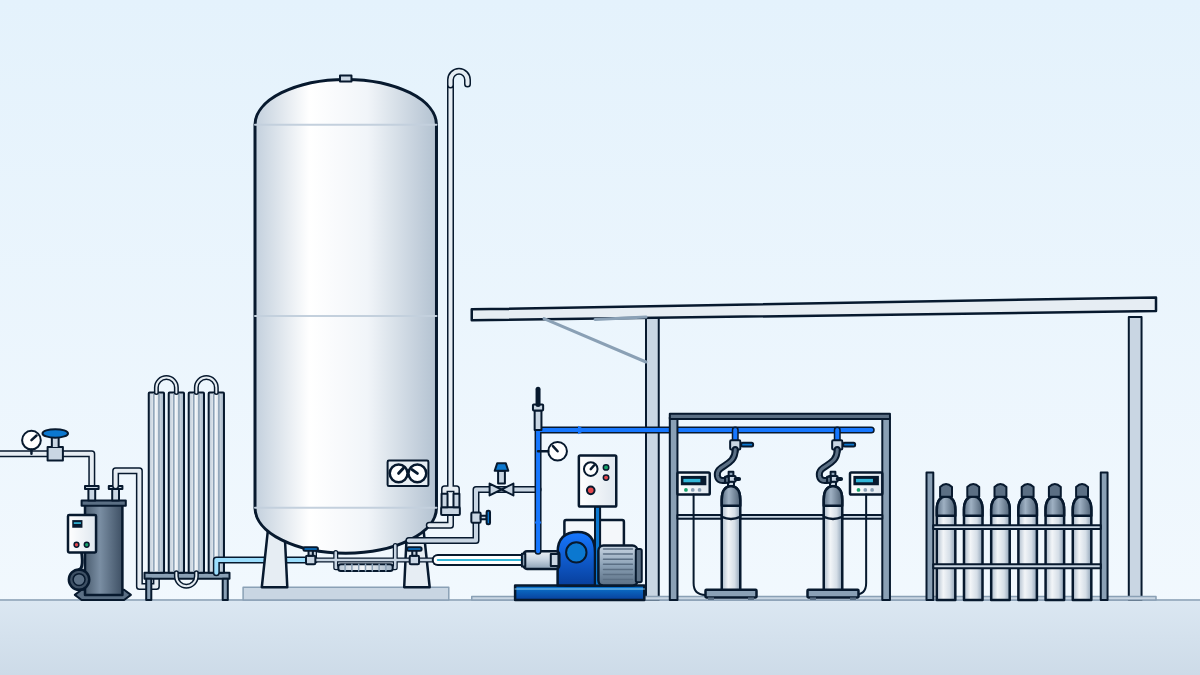
Setting up a CO2 cylinder filling station is a systems problem, not a shopping list. Carbon dioxide moves through the station as a refrigerated liquid, is pumped as liquid and ends up as liquid CO2 (with vapour above it) inside the cylinder, and each stage introduces its own pressure, temperature, and safety constraints. If you specify components in isolation, you will end up with mismatched pressure ratings, undersized heating, or a vaporization stage that frosts over under real demand. This guide walks through the equipment list and the workflow for a CO2 cylinder filling station so that an engineer or buyer can compare options sensibly before issuing an inquiry.
What a CO2 cylinder filling station actually does
A CO2 cylinder filling station takes carbon dioxide from bulk storage and transfers a measured charge into individual cylinders at the correct pressure and temperature. Carbon dioxide is normally stored as a refrigerated liquid in an insulated tank, typically held in the region of 2.0 MPa. From there the liquid is pumped and dispensed by weight as liquid.
The reason temperature control matters so much is the physics of CO2 itself. Liquid CO2 is cold, and pulling it through a pump and into a cylinder drops the temperature further through expansion. Without heat input at the right stage, you get frost, sluggish flow, and cylinders that read low once they warm to ambient. A well-designed station therefore treats heating not as an accessory but as a core process step wherever gas is drawn or tank pressure is built.
The same station footprint is often expected to serve more than one gas over its life. Equipment configured for CO2 frequently shares a design lineage with units handling O2, N2, and Ar, so it is worth confirming early whether your supplier can configure the line by gas rather than forcing a single-purpose build.
The core equipment list for a CO2 cylinder filling station
A practical CO2 cylinder filling station is built from a handful of interdependent subsystems. The exact selection depends on throughput, but the backbone is consistent:
- Bulk CO2 storage tank — an insulated vessel holding refrigerated liquid CO2, commonly around the 2.0 MPa working range, feeding the rest of the line.
- Cryogenic liquid pump — raises pressure from storage level to above the pressure already sitting inside the cylinder, so that liquid transfers. CO2 cylinders are filled in the liquid phase, which is why a pump does this work rather than a compressor; confirm the rated envelope of the pump, manifold and hoses against the actual fill pressure of your cylinder type.
- Vaporiser — converts liquid CO2 to gas for the duties that actually need gas: building and holding pressure in the storage tank, and any gas-phase draw the site takes off the line. It does not sit in the cylinder fill path. Ambient-air vaporizers are simple but lose capacity in cold weather and under sustained draw, which is exactly when a filling station is busiest.
- Gas heater (CO2 heater) — provides temperature support after vaporization or during CO2 service, holding the gas above the point where it would re-condense or freeze out. This is the step most often under-specified.
- Filling manifold and connections — the dispensing point where cylinders are coupled, with valves, hoses, and fittings matched to the gas and pressure.
- Pressure regulation, instrumentation, and safety devices — gauges, relief valves, and controls that keep each stage inside its rated envelope.
- Weighing or metering — CO2 cylinders are typically filled by weight, so scales or load cells define accuracy and overfill protection.
Treat this as a connected chain. The pump outlet pressure, the heater power, and the manifold rating all have to agree, or the weakest link sets the real-world capacity of the whole station.
Weighing is also how LPG cylinders are filled, but LPG is a separate duty with its own filling-post equipment and hazardous-area requirements; electronic LPG filling scales with automatic cut-off are covered on the LPG cylinder filling page.
Sizing the gas heater for CO2 service
The gas heater deserves its own discussion because it is where buyers most often guess. The CO2 gas heater Cryofortune supplies is offered as an electric or water-bath unit and exists precisely to give temperature support after vaporization or during CO2 service. Getting its rating right is what keeps a station running smoothly at peak demand.
Heater capacity should be matched to your flow rate and electrical supply rather than copied from another site. Published configurations for this class of equipment span flow capacities such as 100, 150, and 300 m³/h, with corresponding electric heating power options of 24 kW, 36 kW, 48 kW, and 96 kW on a 380V supply. Heating can be electric or steam-assisted, which matters if you already have a steam header available and want to reduce electrical load. Models in this family carry designations such as DYQ-150 and SYQ-300, and the same platform appears in oxygen variants like SYQ-300/25, underlining that gas selection is a configuration choice.
Two practical points when sizing. First, specify for worst-case ambient and continuous draw, not for a single cylinder on a mild day; an undersized heater shows up as frost and falling fill weights during a shift. Second, confirm the working pressure rating of the heater against the stage where it sits. These units are built around defined pressure classes: the 2.0 MPa range covers the CO2 liquid side, while the 25 MPa range belongs to the high-pressure O2, N2 and Ar variants of the same platform, and the heater has to match the pressure of the stage it actually serves. Physical envelope matters too: a representative unit measures roughly 900×730×1350 mm and weighs in the 180 to 520 kg range depending on configuration, so plan floor space and lifting access before delivery.
The filling workflow, stage by stage
Mapping the workflow against the equipment list makes the dependencies obvious:
1. Storage — refrigerated liquid CO2 sits in the bulk tank at storage pressure. 2. Pressurisation — the cryogenic pump raises the subcooled liquid above the pressure already in the cylinder. 3. Dispensing — liquid CO2 passes through the fill manifold into the connected cylinder, which stands on a scale. 4. Verification — the cylinder is filled to a target weight, then checked and disconnected. Alongside the fill path, the vaporizer and the gas heater serve tank pressure-building and any gas draw-off; they do not sit between the pump and the cylinder.
The heating stage supports the fill from the gas side: it keeps tank pressure up during heavy liquid draw and serves any gas draw-off. Skip or undersize it and the rest of the chain still runs, just badly: slow fills, frosted lines, and inconsistent cylinder contents.
Common mistakes and how to compare options
A few errors recur across CO2 cylinder filling station projects, and most are avoidable at the specification stage:
- Pressure-class mismatch. Mixing a high-pressure pump with components rated only for low pressure is both a safety and a performance failure. Confirm every stage against the same pressure map, from the storage side up to the fill pressure your cylinders actually require.
- Heater chosen on price, not duty. A heater sized for intermittent use will frost under continuous draw. Match kW to your m³/h and to ambient conditions, and check whether electric or steam-assisted heating fits your utilities.
- Ignoring electrical supply. A 96 kW heater on 380V is a serious load. Verify your supply and distribution before committing to a flow rate.
- Single-gas tunnel vision. If you may handle O2, N2, or Ar later, ask whether the platform configures by gas now, rather than rebuying.
- Overlooking documentation and after-sales. Cross-border projects live or die on paperwork. Cryofortune supplies this equipment worldwide with export documentation and manuals; the certificate pack is confirmed per manufacturer, model and destination market before production, which is worth settling up front rather than discovering at customs.
When comparing suppliers, line up flow rate, heating power, heating method, pressure rating, gas configurability, footprint, and the documentation package side by side. A quote that omits any of these is incomplete.
Selection checklist
- Required throughput in m³/h and matched heater power in kW
- Pressure class confirmed across pump, heater, and manifold, matched to the gas actually being filled
- Heating method chosen (electric or steam-assisted) against available utilities
- Electrical supply verified for the heater load on 380V
- Gas configuration confirmed (CO2 now, and O2 / N2 / Ar if needed later)
- Footprint and weight planned for installation and access
- Export documentation and manuals included; certificate pack confirmed for your destination
Closing thoughts
A CO2 cylinder filling station works only when storage, pumping, vaporization, heating, and dispensing are specified as one system. The gas heater is the quiet pivot in that chain, the gas-side stage that keeps tank pressure-building and any gas draw-off running at rated capacity while the cylinders themselves are filled with liquid. Get its flow, power, heating method, and pressure class right, and the rest of the station performs as designed.
If you are scoping a station and want to ground your numbers in real equipment, review the Gas Heater / CO2 Heater specifications and configurations to see how flow rate, heating power, and pressure class map to a unit you can size against your own duty cycle.
Availability and applicability of any standard, certificate, marking or registration procedure are confirmed for the specific manufacturer, model and order before production.