Engineers and procurement teams often treat cryogenic gas supply as a single category, then discover at commissioning that a tank or vaporizer specified for one gas is unsuitable for another. The reality is that liquid nitrogen, liquid oxygen, liquid argon and carbon dioxide each impose distinct demands on materials, cleanliness, insulation and pressure design. Selecting cryogenic equipment for LOX and LN2 service — and for LAr and CO2 alongside them — starts with the gas, not the hardware. This guide walks through what actually changes between gases, how to compare options before you inquire, the mistakes that cause the most rework, and a checklist you can apply to any storage, vaporization or transfer package.
Why the gas, not the vessel, drives the specification
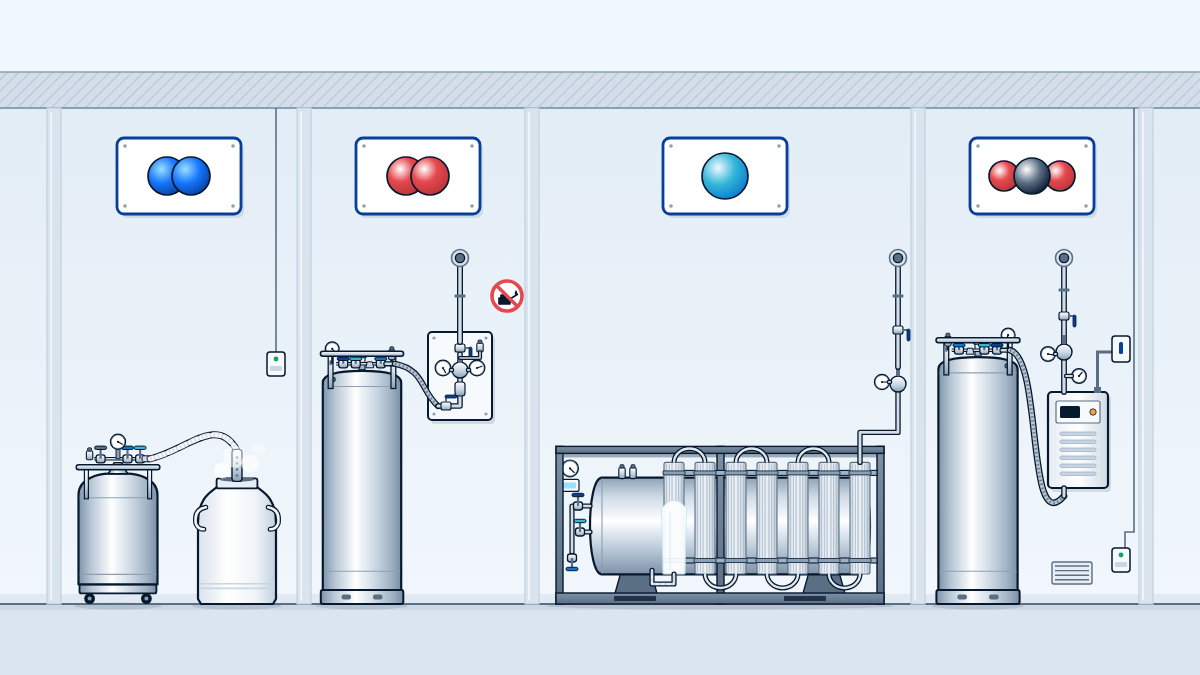
A vacuum-insulated cryogenic tank may look identical whether it holds LN2, LOX or LAr, but the internal requirements diverge sharply. Liquid nitrogen at roughly −196 °C is chemically inert and forgiving, which is why it dominates lab, medical and small-volume field use. Liquid oxygen is the demanding case: it is a strong oxidizer, and any hydrocarbon contamination — oil, grease, certain gasket materials — on a wetted surface can become an ignition hazard. That is why LOX equipment must be specified and built oxygen-clean, with compatible materials throughout the wetted path, even when the vessel geometry matches an LN2 unit.
Liquid argon sits between the two: inert like nitrogen, but stored about ten degrees warmer (−185.8 °C against −195.8 °C) and markedly denser, with a higher liquid density that affects tank weight, pressure build-up behavior and economics. Carbon dioxide is the outlier. It is stored at far higher pressure and warmer temperature than the air gases, behaves as a liquefied gas rather than a deep cryogen, and forms dry ice (which then sublimes) if it is depressurized below its triple point of about 5.2 bar. Equipment configured for LCO2 — including the 20 ft cryogenic tank container, which Cryofortune lists as handling LCO2, LOX, LN2 and LAr by configuration — is set up differently from the same platform configured for an air gas. The phrase “by configuration” that appears across these product lines is the key signal: the base equipment is shared, but the gas determines the build.
Storage: matching the vessel to the gas and the duty
Storage selection is a function of three things: which gas, how much, and how stable the on-site supply needs to be. Cryofortune’s range maps cleanly onto these duty points and is a useful reference frame for any comparison:
- Lab and small-volume field use: the YDZ-50 liquid nitrogen container and open-neck Dewar vessels are LN2-only, built for safe handling and decanting where portability matters more than throughput.
- Local storage with pressure build-up: vertical cryogenic cylinders are vacuum-insulated and support LN2, LOX, LAr and CO2 — the broadest gas coverage in the cylinder class.
- Horizontal duty: the horizontal cryogenic cylinder 500 L is rated for LN2, LOX and LAr, suited to installations where headroom is limited.
- Bulk on-site supply: vertical cryogenic storage tanks deliver stable bulk supply for LN2, LOX, LAr or CO2 by configuration.
- Transportable bulk: the 20 ft cryogenic tank container offers ISO-style handling for LCO2, LOX, LN2 and LAr.
When comparing storage options, look past nominal capacity. Vacuum insulation quality governs static evaporation loss, which is an ongoing operating cost, not a one-time spec. For LOX, confirm oxygen-clean construction explicitly. For CO2, confirm the vessel is configured for the higher working pressure that liquid carbon dioxide demands rather than assuming an air-gas tank will serve.
Vaporization and heating: where flow rate and gas meet
A storage vessel is only as useful as its ability to deliver gas at the right rate, pressure and temperature. This is where many specifications fall short, because vaporizer sizing depends on both the gas and the worst-case ambient conditions at the site. Cryofortune offers ambient-air and water-bath vaporizers, configurable for LN2, LOX, LAr or CO2. Ambient-air units are economical and maintenance-light but lose capacity in cold or humid climates and during sustained high draw, when icing reduces heat transfer. Water-bath and heated designs hold output through those conditions.
CO2 deserves particular attention. Because it is drawn from a higher-pressure, warmer liquid and tends toward dry-ice formation if expanded without enough heat, it commonly needs dedicated heating. Cryofortune’s gas heater and CO2 heater line provides electric and water-assisted temperature support after vaporization specifically to stabilize delivery temperature. Specifying a vaporizer without confirming the downstream heating duty is one of the more frequent causes of flow interruptions in the field.
Transfer, filling and gas mixing
If your operation fills cylinders or feeds a distribution station, the cryogenic cylinder filling pump and pump skids cover liquid transfer, cylinder filling, pressure build-up and station-side distribution for LN2, LOX, LAr and CO2. The right unit is selected by flow rate and by inlet and discharge pressure — so define those duty parameters before comparing pumps, because a skid sized for one filling regime will underperform in another.
For welding and process applications, the question shifts from a single gas to a prepared mixture. Cryofortune’s gas mixer with buffer tank, gas mixing cabinet with PLC control, and gas mixture buffer tank handle two-component blends such as Ar/CO2, Ar/O2, Ar/He and N2/CO2. The mixer prepares the blend, the buffer tank stabilizes line pressure and flow downstream, and the PLC cabinet adds controlled dosing and operator monitoring. If consistent blend ratio under variable demand matters to your process, the buffer tank is not an optional extra — it is what smooths delivery when draw fluctuates.
Common mistakes to avoid
- Treating LOX like LN2. Reusing an LN2-cleaned vessel or non-oxygen-compatible fittings on liquid oxygen service is the single most consequential error. Specify oxygen-clean from the start.
- Sizing the vaporizer for average, not peak, draw in best-case weather. Ambient-air units in particular must be sized for the coldest, highest-demand scenario the site will see.
- Forgetting downstream heating on CO2. Vaporization alone often will not deliver CO2 at a usable temperature; plan the heater into the package.
- Ignoring static evaporation in the comparison. Two tanks of equal capacity can differ materially in boil-off and therefore in running cost.
- Specifying a pump by capacity alone. Inlet and discharge pressure and required flow rate determine fit; nominal size does not.
- Leaving documentation to the end. For cross-border projects, conformity and shipping paperwork should be scoped at the inquiry stage, not after award.
A practical selection checklist
Before you send an inquiry, confirm you can answer the following:
1. Gas and phase — LN2, LOX, LAr or CO2/LCO2, and the cleanliness class required (oxygen-clean for LOX). 2. Volume and duty — portable, local with pressure build-up, or bulk on-site; horizontal or vertical footprint. 3. Delivery requirements — peak flow rate, required pressure, and minimum acceptable delivery temperature. 4. Vaporizer type — ambient-air for mild climates and intermittent draw, water-bath or heated for sustained or cold-weather duty; dedicated heating for CO2. 5. Transfer and filling — flow rate plus inlet and discharge pressure for any pump skid. 6. Mixing needs — blend type (Ar/CO2, Ar/O2, Ar/He, N2/CO2) and whether PLC dosing and buffering are needed. 7. Site and transport — fixed installation versus transportable ISO-style tank container. 8. Documentation route — which standards and export papers your project requires.
That last point is where international buyers benefit from a supply partner set up for export. Cryofortune supplies this equipment worldwide and notes that documentation can be prepared around China standard and international routes such as ISO, ASME, PED, DOT and TPED where applicable, with English communication available for export inquiries. Confirming the documentation path early keeps customs and conformity from becoming a late-stage surprise.
Closing
Choosing cryogenic equipment well is mostly a matter of starting from the gas and working outward to materials, insulation, vaporization, heating and transfer — then confirming the paperwork your destination requires. Define the gas, the duty and the delivery conditions before you compare hardware, and most of the difficult decisions resolve themselves. If you want to see how specific storage tanks, vaporizers, pumps, dry ice equipment and mixing systems are configured per gas, browse the full range at Cryofortune’s products page as a reference for your own specification.