If you are scoping a bulk liquid installation, the first question is almost always the same: what is a fair cryogenic storage tank price for what we actually need? It is a reasonable question and a frustrating one, because a single headline figure rarely means much. Two tanks of identical volume can differ substantially in cost once you account for design pressure, insulation, the gas being stored, the documentation required to import and operate the vessel, and the cost of getting several tonnes of steel to your site. This guide breaks down the variables that genuinely move the number, so you can compare quotations on equivalent terms before you send an enquiry.
The reference point throughout is a typical vertical vacuum-insulated bulk tank: capacities from 8,000 L up to 25,000 L gross, working pressures of 0.8, 1.45, 1.6 and 2.2 MPa, and media including liquid oxygen (LO2), nitrogen (LN2), argon (LAr) and CO2 depending on configuration. Those parameters are not marketing options; they are the cost drivers themselves.
Capacity is the obvious driver, but usable volume and footprint matter more
Gross volume sets the baseline. More litres means more inner and outer shell material, more weld length, more insulation and a larger vacuum space to evacuate, so cost rises with size. But raw litres are a blunt instrument for comparison. Usable volume is typically around 95 percent of gross, because you cannot draw a tank completely empty and still maintain stable supply pressure, so always compare quotations on usable capacity rather than the nameplate figure.
Footprint and height matter as well. A 25,000 L vertical tank stands over 11 metres tall and weighs close to 10 tonnes empty; a 20,000 L unit is around 10 metres. Those dimensions feed straight into foundation design, crane requirements and, frequently, local planning or height constraints. The cheapest tank on a spec sheet can become the most expensive installation if your site cannot accommodate its height or bearing loads. Size the vessel to consumption and refill frequency, not to the largest unit your budget appears to allow.
Design pressure changes the cryogenic storage tank price more than buyers expect
Working pressure is the variable most often underestimated. The same nominal volume can be built for 0.8 MPa or for 2.2 MPa, and the higher rating is materially more expensive. A higher design pressure means thicker shells, more conservative weld and head design, and more demanding testing, all of which add material and labour.
Match the rating to the duty. A low-pressure tank around 0.8 MPa suits high-throughput sites with their own pumps and vaporisers, where the tank is essentially bulk reserve. Higher ratings such as 1.6 or 2.2 MPa earn their cost where you need to push gas through a pipeline network or maintain delivery pressure without additional pumping. Note also that media availability is tied to pressure class in real product ranges: some higher-pressure configurations are offered for LO2 only, while multi-service LO2/LN2/LAr tanks cluster at the lower and mid ratings. Specifying more pressure than the application requires is one of the most common and avoidable ways to inflate a cryogenic storage tank price.
Insulation and the gas you store
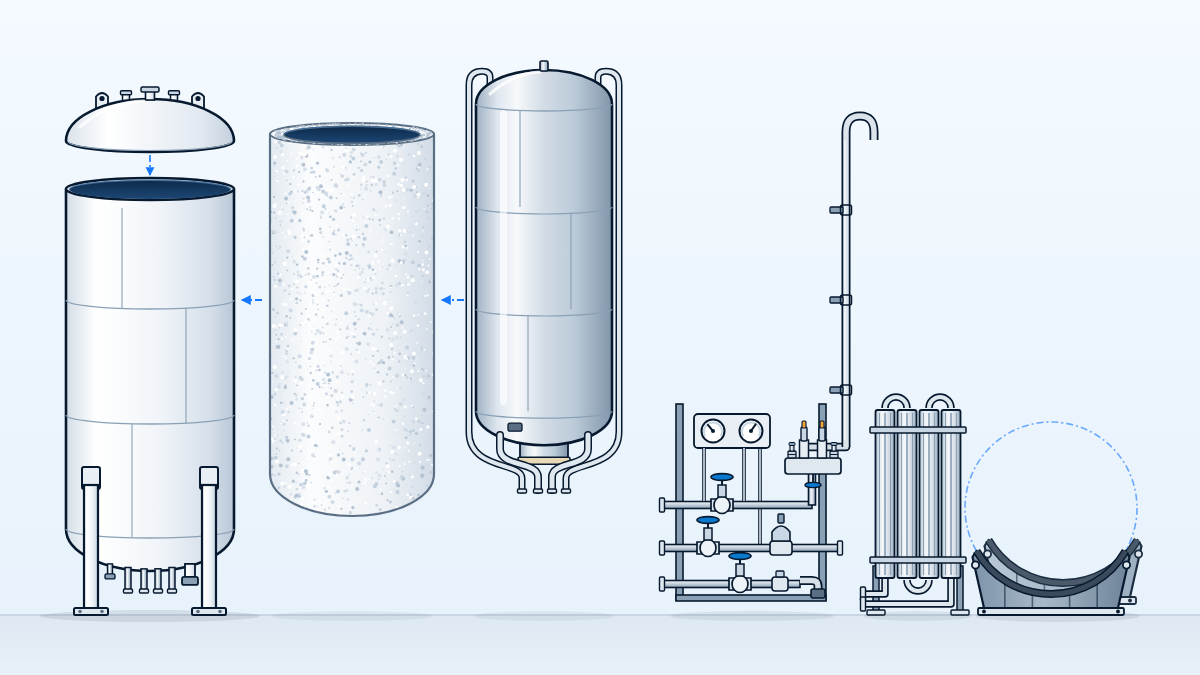
Bulk cryogenic tanks are double-walled with an insulated vacuum space. The common, cost-effective approach for static bulk storage is a vacuum-perlite jacket, which keeps the liquid cold with low evaporation. Insulation quality is not a line item you see on a quotation, but it is where long-term operating cost is decided: every litre lost to boil-off is product you paid for, evaporating into the atmosphere. A modestly cheaper tank with a poorer vacuum or weaker insulation can erase its saving within a couple of years through higher losses.
The stored medium also shapes specification. Liquid oxygen is an oxidiser and demands rigorous cleanliness and oxygen-compatible construction throughout, which legitimately adds cost compared with an inert-service nitrogen or argon tank. CO2 service has its own pressure and temperature profile. When you compare prices, confirm each quotation is for the same medium and the same service conditions, because an LO2-rated, oxygen-clean vessel and a basic LN2 tank are not interchangeable even at identical volume and pressure.
Certification, documentation and compliance
This is where a low quotation most often hides its true cost. A cryogenic vessel is pressure equipment, and the certification regime that applies in your country governs whether you can legally install and operate it. Different markets recognise different pressure-vessel codes, and a tank built and certified to one regime may need additional assessment, documentation or a recognised third-party route before it can be commissioned elsewhere.
Treat the documentation package as part of the deliverable, not an afterthought. Material certificates, weld and pressure-test records, the data report, the declaration of conformity and a complete export file all have real cost behind them, and a price that omits them is not comparable to one that includes them. Cryofortune, based in Foshan, Guangdong, supplies these tanks for export-oriented industrial projects and can arrange accessories, export packing and the documentation needed for customs clearance and commissioning. Always ask explicitly which standard a tank is certified to and which documents are supplied.
Logistics: the line item that surprises first-time buyers
A bulk tank is heavy, tall and classified as out-of-gauge cargo. Freight, specialised handling, export packing, insurance and inland transport to site can represent a significant share of the delivered cost, especially for the larger 20,000 L and 25,000 L units. Two factors dominate: distance and dimensions. Because these vessels exceed standard container envelopes, shipping is rarely a simple per-unit rate.
Get a delivered, all-in figure rather than an ex-works price you then have to build on. Confirm Incoterms explicitly, clarify who handles customs clearance and inland haulage, and budget for offloading at site, which a standard yard crane may not cover for a unit approaching 10 tonnes. As a global exporter, Cryofortune ships this equipment worldwide with the export documentation that keeps that logistics chain moving.
A practical selection checklist
Before you request a quotation, settle these points so every supplier prices the same thing:
- Medium and service conditions — LO2, LN2, LAr or CO2, with cleanliness requirements stated for oxygen service.
- Usable capacity — sized to consumption and refill interval, compared on usable not gross volume.
- Working pressure — matched to your distribution method, not over-specified.
- Insulation and boil-off — vacuum-perlite quality and expected evaporation, weighed as an operating cost.
- Site constraints — height, footprint, foundation loads, crane access.
- Certification and documents — the exact code and the full documentation package.
- Delivered cost and Incoterms — freight, packing, clearance and offloading included.
Specifying these clearly turns a vague price comparison into a like-for-like decision, and usually reveals that the lowest headline number is not the lowest total cost of ownership.
If you want to see how capacity, pressure and configuration map to a real product range, review the vertical cryogenic storage tank specifications and use the eight configuration options as a starting point for your own requirement before reaching out.